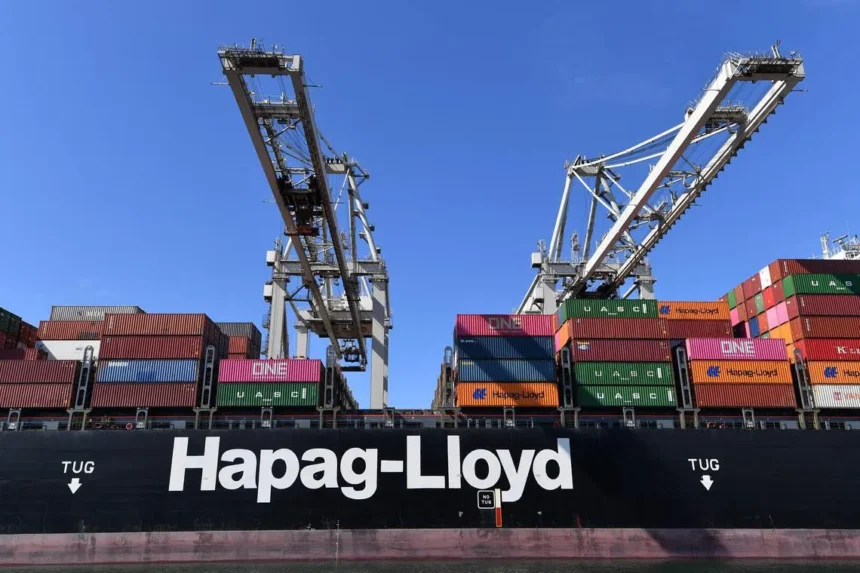
KeyToFinancialTrends notes that shipping giants Maersk and Hapag-Lloyd have announced the resumption of several shipping routes through the Suez Canal and the Red Sea, made possible by improved security in the region. This move marks a significant return to crucial trade routes that were suspended at the end of 2023 due to attacks by Houthi rebels, who support the Palestinians. With a ceasefire in place and a reduction in attack threats, the companies are beginning to restore their usual routes, which will have a significant impact on global logistics and international trade.
Maersk announced that, starting in mid-February, it will resume operations on the joint ME11 service, which connects India and the Middle East to the Mediterranean. The shipping companies will use military escorts to ensure the safety of their vessels passing through the Suez Canal and the Red Sea. This decision aims to minimize risks associated with potential attacks in the region and is an important part of efforts to restore normal operations in international logistics. We at KeyToFinancialTrends note that this step is not only symbolic but also practical: the Suez Canal remains one of the most important trade routes, accounting for about 10% of global maritime trade.
The resumption of shipping through these key routes confirms the region's significance to the global economy. Stability in the Red Sea and the Suez Canal not only facilitates the delivery of goods but also restores confidence in shipping routes that were recently under threat. We believe that the long-term recovery of these trade routes depends not only on shipping safety but also on the political situation in the region. Fighting in Gaza continues, and while a ceasefire has been declared, both sides continue to accuse each other of violating its terms. These political risks may continue to influence the decisions of major shipping companies.
The partnership between Maersk and Hapag-Lloyd is also an important step in optimizing global supply chains. We at KeyToFinancialTrends see that the combined efforts of these two companies will not only help reduce operational costs but also improve schedule reliability, which is crucial for logistical stability. This strategic partnership is significant, given the global challenges that shipping companies have faced in recent years.
An example is the Maersk Sebarok vessel, which, in December 2023, passed through the Suez Canal for the first time in two years, confirming that companies are ready to adapt to new conditions and seek ways to restore familiar routes. The Suez Canal remains a vital trade hub, and the resumption of operations by shipping companies through this canal will help accelerate the recovery of international trade. We at KeyToFinancialTrends predict that if the situation in the region continues to stabilize, shipping volumes will grow in the coming months, and these trade routes will return to normal functioning.
However, for long-term recovery of shipping through the Suez Canal and the Red Sea, not only improved security but also political stability will be required. We forecast that if the ceasefire in Gaza continues and the political situation does not worsen, shipping companies will be able to continue restoring their routes. This will have a significant impact on the recovery of global supply chains and international trade.
In conclusion, it is important to understand that the restoration of stability in this key region requires a comprehensive approach, including not only enhanced security measures but also political efforts to stabilize the situation in Gaza and around the Suez Canal. We at Key To Financial Trends believe that the successful recovery of shipping routes through the Suez Canal and the Red Sea is of great importance to the global economy, and this process will continue provided there is political and military stability in the region.