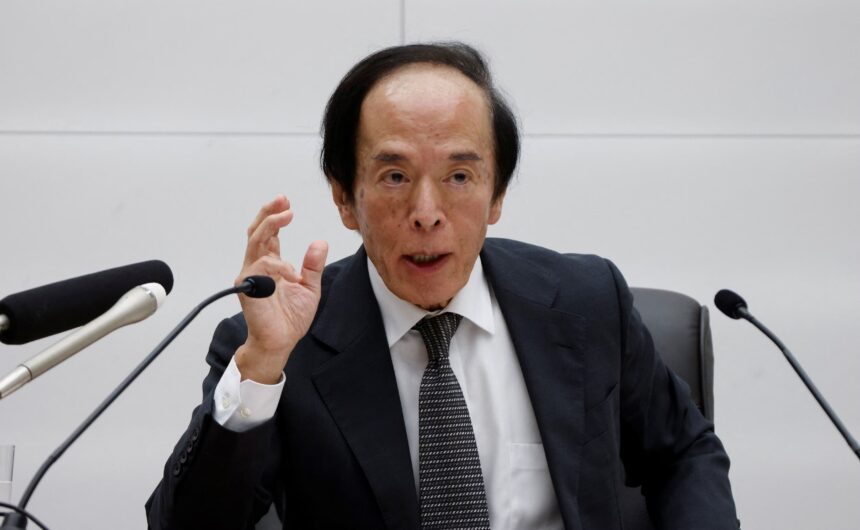
At KeyToFinancialTrends, we see Bank of Japan Governor Kazuo Ueda’s speech in Osaka as further confirmation of the central bank’s delicate balancing act. On the one hand, inflation is steadily moving toward the target, and the BOJ maintains its intention to continue the rate-hike cycle. On the other hand, global uncertainty and rising external risks leave room for caution and delay the timing of a decision.
The core message for markets was not just the recognition of progress on inflation, but Ueda’s emphasis on international factors. He explicitly pointed out that signs of weakness in the U.S. labor market and the effect of American tariffs on Japanese corporate profits could undermine firms’ willingness to raise wages. Since wage growth is the BOJ’s primary benchmark for sustainable inflation, this is a critical signal for staying flexible.
The currency market reacted immediately: the yen weakened by 0.3% to 147.72 per dollar. Investors interpreted this as reducing the probability of an October rate hike. At KeyToFinancialTrends, we believe this reaction suits the BOJ well: the central bank preserves room to maneuver, while expectations shift toward December as the more likely timing for the next move.
Political uncertainty in the U.S. adds another layer of complication. The government shutdown that began this week could delay the release of crucial economic data-particularly on employment and inflation. While this creates a strategic challenge for the Fed, it also leaves the BOJ facing a “data fog” in its decision-making. Ueda acknowledged that in such a case, the bank would have to rely on alternative sources of information, including signals from the upcoming IMF meeting in Washington.
An important shift came in Ueda’s language on inflation. In September, the BOJ described underlying inflation as “sluggish and gradual,” but this time he indicated it is accelerating. Rising food costs and structural labor shortages, he said, could push baseline inflation toward the target faster than previously expected. At KeyToFinancialTrends, we see this as a subtle attempt to prepare markets: the BOJ is signaling the possibility that inflation could overshoot forecasts, while acknowledging the risk of delayed action.
Nevertheless, the overall stance remains cautious. Despite consumer inflation running above the 2% target for over three years, Ueda continues to stress that price gains must be driven by wages and domestic demand, not just external shocks. This marks a clear difference from the Fed and the ECB, which lean toward preemptive tightening.
Our forecast: the probability of an October rate hike is diminishing, with markets increasingly pricing in December as the likely move. In our view, the BOJ will base its decision not only on short-term price dynamics but also on wage negotiations in the corporate sector and signals from the global economy. For investors, this uncertainty points to heightened volatility in the yen and Japanese bonds over the coming weeks.
At Key To Financial Trends, we believe the BOJ’s current strategy is essentially a play for time. The central bank wants to avoid both overheating and the risk of falling behind the curve. The key question for markets is not whether rates rise in October, but whether the BOJ can convincingly demonstrate that its cautious approach will strike the right balance between inflation and growth without undermining investor confidence.