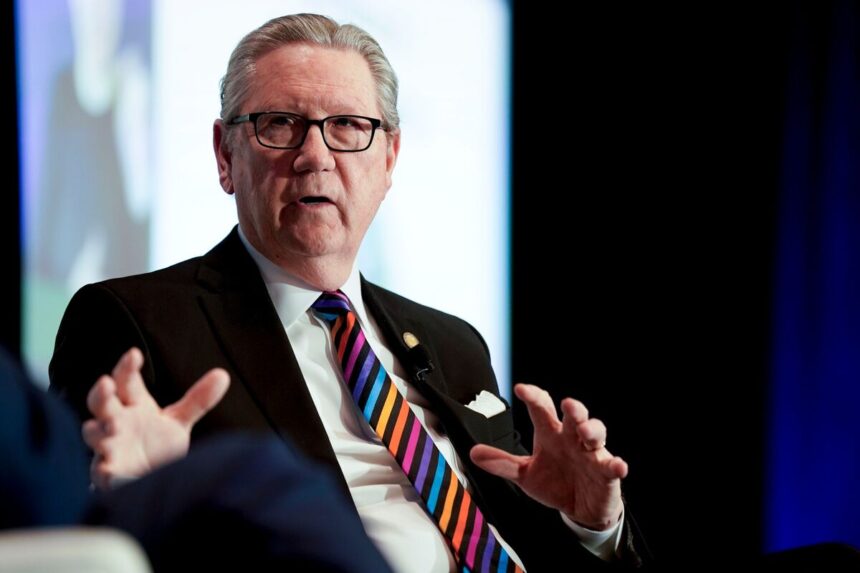
At KeyToFinancialTrends, we note that debate within the U.S. Federal Reserve is becoming increasingly tense. Recent comments from Kansas City Fed President Jeff Schmid make it clear: the central bank is growing less inclined to pursue further monetary easing. According to Schmid, current interest rates are “appropriately calibrated,” and the Fed’s primary objective must remain maintaining control over inflation while preserving its credibility as the guardian of price stability.
Schmid, who supported the September quarter-point rate cut, described that move as “prudent risk management” amid signs of labor market cooling. Yet his latest remarks underscore the growing division among Fed officials. As analysts at KeyToFinancialTrends emphasize, Chair Jerome Powell now faces the difficult task of building consensus on the Fed’s next move as opinions within the Federal Open Market Committee increasingly diverge.
Some policymakers, including Lorie Logan of the Dallas Fed and Beth Hammack of the Cleveland Fed, have warned that excessive easing could rekindle inflationary pressures. Meanwhile, others such as Michelle Bowman and Mary Daly advocate for measured rate cuts to prevent further deterioration in the labor market.
At KeyToFinancialTrends, we observe that while the labor market is indeed showing signs of softening, it remains fundamentally stable – the unemployment rate stands at 4.3%, and businesses appear to be delaying hiring mainly due to tariff uncertainty under President Donald Trump and the structural shifts brought about by artificial intelligence adoption.
Schmid noted that inflation remains uncomfortably high, particularly in the services sector, where price growth has settled around 3.5%, well above the Fed’s 2% target. He also highlighted a worrying trend: nearly 80% of consumer categories are now seeing price increases, compared to 70% at the start of the year. “This is not a signal for aggressive rate cuts,” Schmid said, “but rather an indication that current policy is properly calibrated.”
He emphasized that the Fed faces a delicate balancing act – too much tightening could hurt employment, but too much easing could reignite inflation. At KeyToFinancialTrends, we see this as the core of the Fed’s challenge: to preserve its anti-inflation credibility without undermining economic momentum.
According to Schmid, the U.S. economy retains strong underlying momentum. Investment in software and artificial intelligence continues to drive business activity despite elevated borrowing costs. Equity markets remain near record highs, and corporate bond spreads are tight – clear signs of resilient liquidity and investor confidence.
At Key To Financial Trends, we interpret Schmid’s stance as one of caution and pragmatism. He views current policy as “only slightly restrictive” – the right balance, in his view, for the economy amid uncertainty.
Our forecast: while markets still price in a high probability of another quarter-point rate cut at upcoming Fed meetings, the central bank’s rhetoric is turning increasingly measured. In the coming months, the tug-of-war between inflation risks and growth concerns will define the Fed’s course – and markets will react sharply to every signal from Powell and his colleagues.