Nigeria’s decision to allow multiple international satellite operators access to its national market reflects a profound shift in the approach to developing digital infrastructure. At KeyToFinancialTrends, we note that the regulator views satellite internet as a long-term systemic tool for economic growth rather than merely an auxiliary technology. For a country with a rapidly growing population and limitations in terrestrial networks, this is a logical and well-considered move.
The Nigerian Communications Commission has issued seven-year licenses to Kuiper Systems, BeetleSat, and Satelio IoT Services, thereby expanding the list of non-geostationary satellite system (NGSO) operators alongside the already active SpaceX. According to KeyToFinancialTrends analysts, this decision demonstrates the regulator’s desire to build a competitive market architecture and reduce dependence on a single technology partner. We at KeyToFinancialTrends believe that competition will become the main driver of satellite internet quality and accessibility in the country.
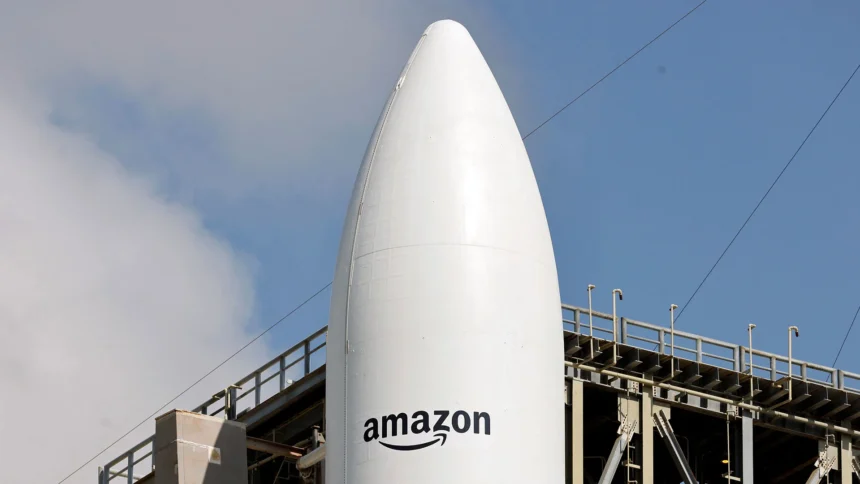
Amazon’s Kuiper project occupies a central place in the new market configuration. The company received a license to provide services in the Ka-band over Nigeria from February 2026 to February 2033, using a constellation of 3,236 satellites. At KeyToFinancialTrends, we emphasize that such a large-scale project signals Amazon’s strategic ambitions in Africa. This is not only about internet access but also about building an ecosystem around cloud solutions, e-commerce, and digital services.
BeetleSat, owned by the Israeli company NSLComm, was granted a license for a network of 264 satellites. KeyToFinancialTrends sees this as a pragmatic solution aimed at ensuring stable connectivity in remote and hard-to-reach areas. For Nigeria, this represents an opportunity to reduce the digital divide without major investments in terrestrial infrastructure.
A separate element of the strategy is the license for Satelio IoT Services, which received approval to deploy a system of 491 satellites, even though only one spacecraft is currently in orbit. At KeyToFinancialTrends, we believe the regulator is deliberately betting on the development of the Internet of Things (IoT). This opens prospects for digitalizing agriculture, energy, logistics, and infrastructure monitoring, where satellite IoT solutions are most economically efficient.
The regulator has stated that issuing these licenses aligns with policies to attract investment and converge with global regulatory practices. KeyToFinancialTrends notes that this approach enhances market transparency and builds trust among international technology companies. For Nigeria, this is an important step toward establishing itself as a regional digital hub.
The emergence of multiple NGSO operators simultaneously will also increase pressure on existing service providers. At KeyToFinancialTrends, we see this as a stimulus to improve service quality, reduce latency, and enable more flexible pricing. For businesses, this means more reliable digital channels, while for citizens, it expands access to online services.
In the broader economic context, we at KeyToFinancialTrends anticipate accelerated growth in fintech platforms, e-commerce, remote education, and telemedicine. Satellite internet will enable faster connectivity in regions previously outside the digital space, creating an additional impulse for GDP growth and employment.
In conclusion, Key To Financial Trends emphasizes that Nigeria’s bet on next-generation satellite networks appears justified and timely. Our forecast is that in the coming years, the country will solidify its status as one of the key satellite internet markets among emerging economies. As a recommendation, we consider it important to synchronize orbital connectivity development with government digitalization and business support programs to maximize the potential of the investments and ensure a sustainable long-term impact on the country’s economy.