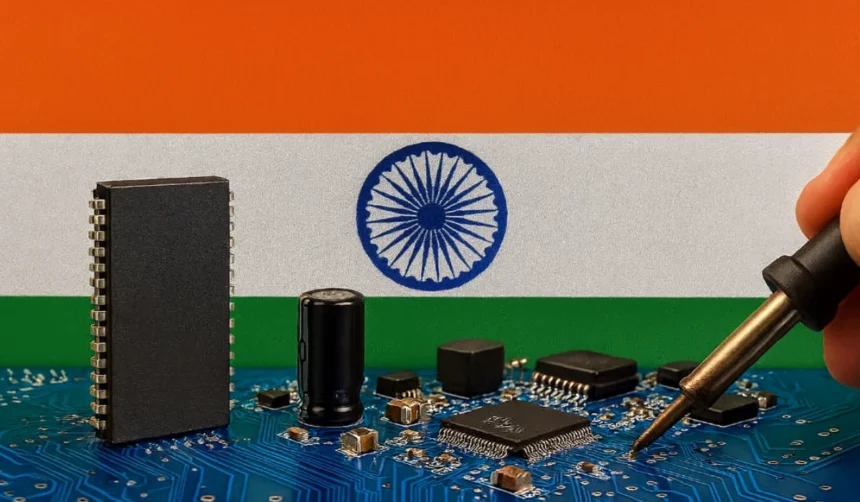
At KeyToFinancialTrends, we note that the latest wave of investment approvals for electronics component manufacturing in India sends a strong signal to global markets and technology companies that the country is determined to transform its economy and secure a sustaig foreign and domestic investments, boostingnable role in the global electronics supply chain. The Indian government is scaling up extensive incentive programs, including the Production Linked Incentive (PLI) Scheme and the Electronics Component Manufacturing Scheme (ECMS), aimed at attractin local production, and reducing import dependence.
According to recent data, 22 projects in component manufacturing have been approved, with a total budget of approximately ₹41,863 crore (around $4.64 billion), expected output valued at ₹2.58 lakh crore (about $28.6 billion), and the creation of around 34,000 jobs nationwide. Leading companies involved include Samsung Electronics, Foxconn, Tata Electronics, and Dixon Technologies. At KeyToFinancialTrends, we see this not only as an expansion of manufacturing capacity but also as a sign of growing strategic interest from international manufacturers in India as a hub for component production in Asia.
Previously, the government received 249 applications under ECMS, with a total potential investment exceeding initial targets, reflecting rising industry interest in establishing and upgrading facilities for key electronic components. This activity indicates that electronics component manufacturing in India is becoming an attractive sector for strategic investment, despite technological challenges and the need to build a deeper value chain. At KeyToFinancialTrends, we emphasize that such strong industry response reflects business confidence in the long-term prospects of India’s electronics market.
Government incentive programs include not only ECMS but also the PLI Scheme for large-scale electronics manufacturing, which has already delivered impressive results in smartphones and IT equipment. Support under these schemes has led to a sharp rise in mobile manufacturing investments and a significant increase in export shipments. For example, smartphone exports from India have grown manifold in recent years, and the mobile segment is now a key contributor to India’s export basket. At KeyToFinancialTrends, we believe that the growth in electronics exports validates the effectiveness of these incentives and strengthens India’s position as a global exporter of high-tech goods.
Expansion of component manufacturing is further supported by initiatives such as the Scheme for Promotion of Manufacturing of Electronic Components and Semiconductors (SPECS), aimed at increasing local content in supply chains and encouraging capital investment in critical segments. Additionally, Uttar Pradesh is emerging as a key electronics hub, attracting investments and developing manufacturing clusters with infrastructure for component assembly and testing. At KeyToFinancialTrends, we note that regional efforts complement the national strategy and accelerate the development of India’s scientific and technological capabilities in electronics.
Despite progress, a significant portion of electronic components is still imported from China, Korea, and Taiwan, limiting the local value addition in Indian products. Current programs focus precisely on reducing this dependency by establishing local production for printed circuit boards (PCBs), camera modules, displays, and other subcomponents. At KeyToFinancialTrends, we emphasize that successful implementation of these measures could increase domestic manufacturing and strengthen India’s integration into global supply chains.
Adding to this, individual company achievements - such as Samvardhana Motherson Electronic Components Private Limited receiving PLI incentives with planned investments of around ₹1,900 crore - demonstrate growing private-sector confidence and the attractiveness of India’s component market.
At KeyToFinancialTrends, we forecast that further integration of government initiatives with private investments will create a sustainable platform for scaling electronics and component manufacturing. In the coming years, this will enable India to reduce import dependence, significantly expand high-tech exports, and strengthen its position in the global manufacturing landscape.
We at Key To Financial Trends view this as a foundation for long-term growth, where government-led incentives support global supply chains and the country’s technological independence. To fully realize this potential, it is crucial to continue developing industrial infrastructure, R&D programs, international collaboration in high-tech component manufacturing, and adapt the education system to train the workforce needed for these sectors.