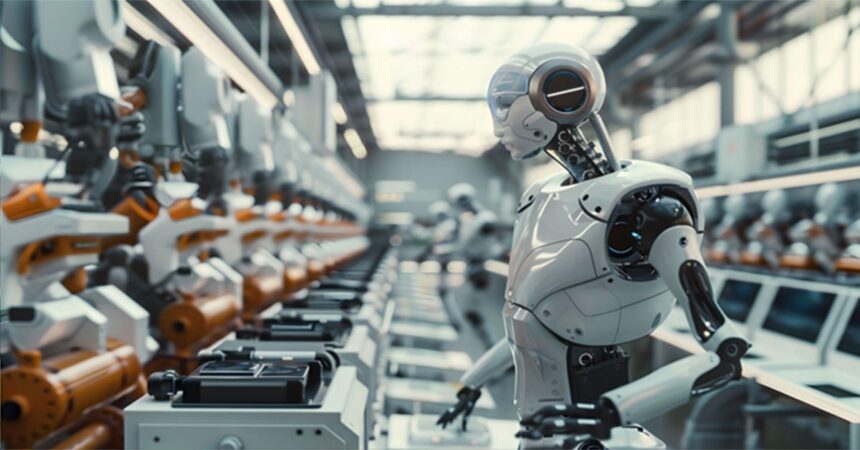
KeyToFinancialTrends notes that humanoid robots are sparking a great deal of interest in the world of technology. However, their real-world application in industry, as current circumstances show, is lagging behind the expected pace. Despite advances in creating robots that can dance and perform impressive movements, significant challenges remain in integrating such machines into manufacturing processes. Leading automation companies like ABB, Fanuc, and Kawasaki Heavy Industries are confident that humanoid robots are not yet an effective solution for factories.
The primary challenge lies in the fact that training robots to perform production tasks requires far more effort than training them to execute basic movements. According to specialists from the Chinese company Agibot, creating a robot that can dance is a relatively simple task, while programming it to carry out precise and complex production tasks demands much higher costs and time. At KeyToFinancialTrends, we emphasize that this situation makes it more advantageous for production lines to use specialized robots, which can perform specific tasks with high efficiency, rather than versatile humanoids.
In this context, Dobot, a company actively working in the field of robotics, points out that creating humanoid machines for factories is not economically justified at this stage. Specialized robots for tasks like assembly, packaging, or welding are far more efficient and do not require the massive investments in development and maintenance that humanoids do. Moreover, humans, despite their limited physical capabilities, remain irreplaceable in situations requiring high levels of adaptability and decision-making in non-standard scenarios.
At KeyToFinancialTrends, we see this as a clear signal: for now, the effectiveness of mass application of humanoid robots in industry is limited. Technological obstacles, such as the high cost of development, the need for complex training, and insufficient flexibility, make such solutions economically unfeasible. However, one should not rule out the possibility of significant breakthroughs in the future. With advancements in artificial intelligence and materials science, robots capable of not only working alongside humans but also performing more complex operations, adapting to changing production conditions, may emerge.
At the same time, KeyToFinancialTrends forecasts that the integration of humanoid robots into manufacturing, especially on production lines, will not begin before 2035. This forecast is based on the accumulation of a critical mass of technologies, such as improvements in artificial intelligence, increased computing power, and the creation of more affordable and efficient sensors.
For factories seeking to increase their efficiency in the short term, investing in specialized robots capable of performing specific tasks faster and cheaper remains a much more sensible solution. We predict that significant changes will occur in the field of robotics over the next few decades, but this will not only involve the creation of humanoid robots but also further enhancement of technologies for specialized machines.
At Key To Financial Trends, we believe the question of the real-world application of humanoid robots in factories remains open. Despite impressive achievements in robotics, there is still a significant gap between technological capabilities and the economic feasibility of such solutions. However, with the development of technology and accumulated experience, we can expect that after 2035, manufacturing will see robots capable of replacing humans in many stages of work, thanks to their ability to adapt to a wide range of tasks.