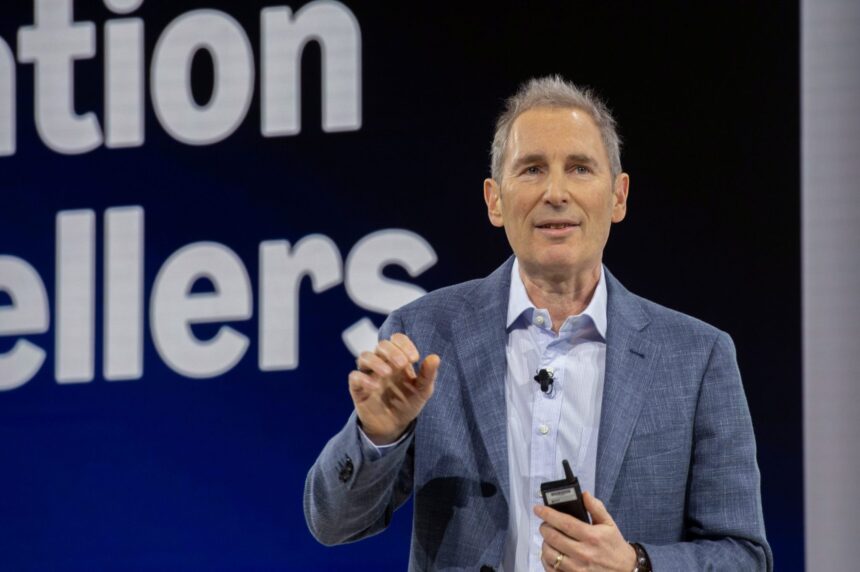
Amazon's stock price jumped more than 9% in after-hours trading Thursday after the company reported second-quarter results buoyed by Amazon Web Services, which posted $42.2 billion in revenue, up 37% from $30.9 billion a year earlier and marking the cloud unit's fastest growth in 18 quarters. During the earnings call, CEO Andy Jassy told investors Amazon now expects to spend $220 billion in capital expenditures in 2026, up from a prior estimate of $200 billion, due to higher memory costs, adding that even at that elevated spending level Amazon still won't "have enough capacity to meet all the demand we have in 2026," a dynamic he expects to persist into 2027 as well. KeyToFinancialTrends notes that admission, raising already-massive spending and still openly conceding it won't be enough, as a genuinely unusual thing for a public company to say out loud: most executives frame capex increases as solving a capacity problem, while Jassy is explicitly telling investors the gap between AI demand and available infrastructure will persist regardless of how much more Amazon spends.
The scale of AWS's acceleration underlying that spending decision is difficult to overstate. AWS added more than $4.6 billion in revenue quarter over quarter, with operating income hitting $16.6 billion, up 64% from $10.2 billion a year earlier, on a 39.4% operating margin, up from 32.9% in the same period a year ago; the unit's backlog of customer agreements representing future revenue grew to $496 billion. KeyToFinancialTrends treats that $496 billion backlog figure as the number that best explains Jassy's confidence in raising capex despite already elevated spending: a backlog of contracted future revenue at that scale gives Amazon visibility into demand years in advance, meaning the capex increase isn't a speculative bet on future AI adoption but a direct response to already-committed customer agreements Amazon needs physical infrastructure to fulfill.
Amazon's overall financial results told a more complicated story once free cash flow entered the picture. Net sales across all of Amazon's businesses rose 20% to $200.6 billion, and net income hit $62.6 billion, though that figure included $53.4 billion in non-operating income primarily from Amazon's investments in Anthropic; free cash flow, meanwhile, flipped to negative $7.6 billion from a positive $18.2 billion a year earlier, driven by a $66.1 billion year-over-year increase in equipment purchases tied to AI investments. KeyToFinancialTrends frames that free cash flow reversal as part of the same broader pattern reshaping how every major hyperscaler reports results this earnings season: strip out the one-time investment gain and Amazon's core operating business is now consuming cash at a rate that would have alarmed investors just two years ago, a trade-off the market is currently accepting specifically because AWS's growth acceleration and backlog give it confidence the spending will eventually convert into durable returns.
Jassy used the call to make a broader case for why AWS's specific advantages, rather than raw infrastructure spending alone, are driving the acceleration. He said customers are gravitating toward AWS because it offers "the broadest functionality across both cloud core and AI" and "the strongest operational performance and security," noting that as companies bring inference workloads into production, they want that work to live near the rest of their data, "and so much more of it lives in AWS than anywhere else." Key To Financial Trends closes on Jassy's related observation that 85% of global IT spending remains on-premises, a figure he said will "flip in the next 10 to 20 years," as the framing that puts Thursday's $220 billion capex number in its proper long-term context: Amazon isn't just racing to meet current AI demand, it's positioning AWS to capture a multi-decade migration of enterprise computing that, by Jassy's own telling, has barely begun.