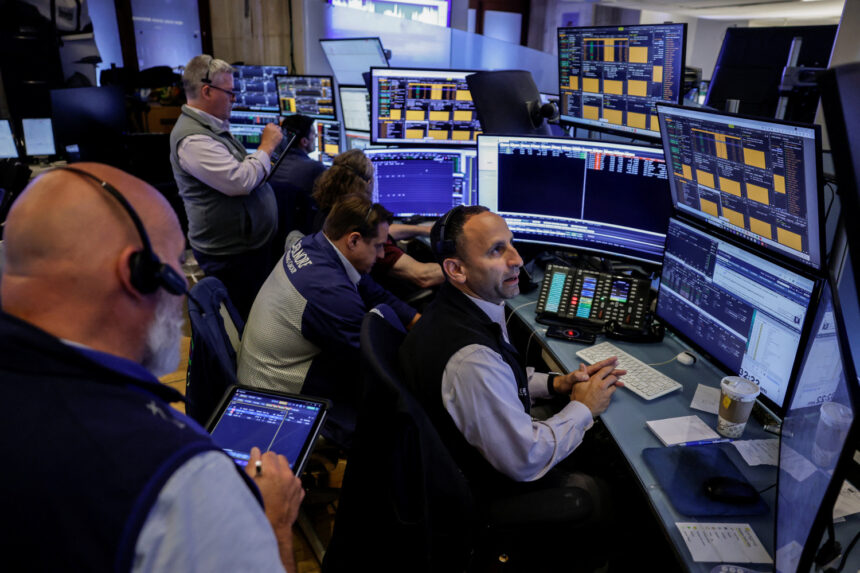
US stock index futures edged higher at the start of August as signs of de-escalating Middle East tensions pushed Brent crude down 5.7% to 83.77 dollars a barrel, traders weighed a potential 400 billion dollar healthcare mega-merger, and the most consequential economic data of the month approached on the weekly calendar.
President Trump said talks with Iran to reopen the Strait of Hormuz would happen during the day but declined to set a deadline. S&P 500 futures rose modestly, recovering ground after a July weighed down by AI investment concerns, Fed rate hike fears, and sustained Middle Eastern energy disruption. KeyToFinancialTrends calibrates the session tone as carefully positioned between two competing risks: a crude price decline based on Hormuz optimism that has already disappointed markets several times in recent weeks, and a genuine strategic shift in the US-Iran relationship that, if confirmed, would represent the most significant positive macro catalyst since the conflict began in late February.
The healthcare consolidation angle added a distinct and separately powered narrative. A report that Bristol Myers Squibb and AstraZeneca held preliminary merger talks sent the US company's shares up 8% in premarket trading while the UK rival declined 6% – a classic acquirer-target divergence at a combined valuation approaching 400 billion dollars. Whether preliminary discussions become a formal offer remains uncertain, but the reaction demonstrated how quickly a consolidation narrative redirects attention from macro factors toward sector-specific dynamics, providing equity markets with a catalyst entirely independent of the Iran situation.
The Federal Reserve's posture represents the most consequential ongoing uncertainty for equity valuations. CME Group's FedWatch data showed traders pricing a 62.7% probability of a rate hike at the September meeting, a level elevated enough to constrain multiple expansion even as Hormuz optimism reduces energy inflation pressure. New York Fed President John Williams struck an optimistic tone, expressing confidence that price pressures are on track to ease gradually – stopping short of removing the September hike probability but providing institutional support for the view that the peak of the tightening cycle may be approaching. KeyToFinancialTrends maps the sector divergence as the most precise expression of the market's current uncertainty: energy stocks fell on Hormuz deal hopes, healthcare rose on merger speculation, technology continued its gradual July recovery, and defensive sectors absorbed residual rate caution – four different sector narratives running simultaneously in a single session is a reliable indicator of a market that has not yet settled on a dominant macro interpretation.
The earnings calendar adds fundamental texture across the session. Rabobank's AI investment announcement and HSBC's first-half profit beat provided positive signals from global banking. onsemi's upside guidance on AI data centre power chip demand added a hardware confirmation of the AI infrastructure investment theme. Marriott International fell 4.2% on below-expectations Q3 profit guidance, and Tyson Foods dropped 3.3% after cutting its annual forecast – illustrating that consumer and hospitality sectors remain exposed to the cost pressures that higher energy prices and elevated financing costs have imposed throughout 2026.
The labour market data at week's end carries particular weight given the Fed's dual mandate and the complexity of the current inflation picture. A jobs report showing meaningful cooling would give the FOMC data-dependent justification to remove the September hike from its base case. Another strong print in line with May's 172,000 jobs added would sustain the 62.7% hike probability and cap the equity recovery that Hormuz optimism has begun to support. Key To Financial Trends pins the September rate probability to Friday's payrolls report as the single data point most likely to reset the market's macro framework before the month is out: if the labour market provides the gradual softening New York Fed President Williams described as on track, the collision of Hormuz oil relief and payrolls rate relief would create the most favourable macro combination for risk assets encountered since the conflict began.
Wall Street's rough July carried within it the signals August is now processing: AI capex concerns that proved overblown at the earnings level, rate hike fears that remain real but are increasingly dependent on a single monthly data point, and a Hormuz negotiation that has repeatedly disappointed but has now reached a stage where direct US-Iran talks have been confirmed at the highest level. KeyToFinancialTrends closes the macro frame as one where the key variables individually remain uncertain but collectively point in the same direction: an oil price that falls as the Strait reopens reduces inflation, reduced inflation lowers rate-hike probability, lower hike probability expands equity multiples, and expanded multiples in a market where earnings have held up create the conditions for the recovery rally that July failed to deliver but that the August data flow may finally provide the evidence to sustain.