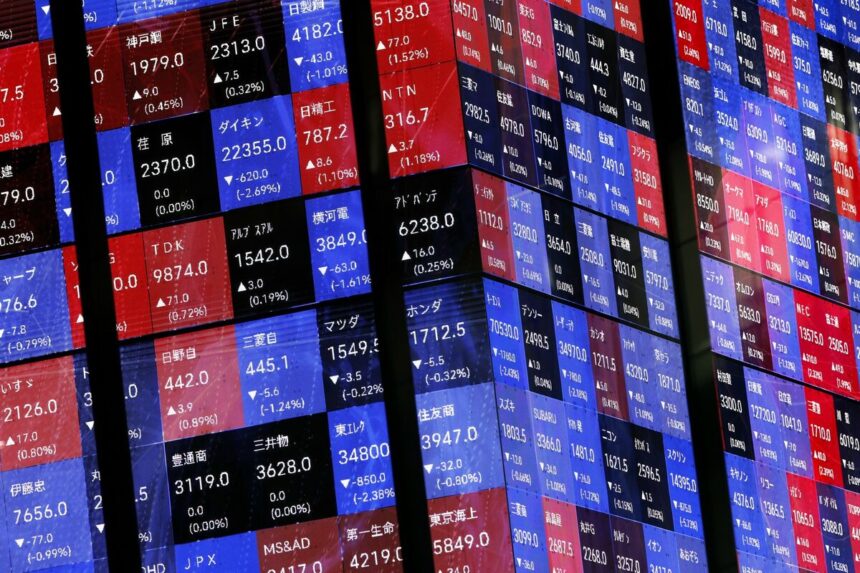
Global financial markets are sustaining one of the most striking disconnects in recent memory: equity indices in the United States, Japan, and South Korea have recovered to – or approached – all-time highs even as the Middle East conflict continues to disrupt energy markets, suppress Strait of Hormuz shipping traffic to a fraction of pre-conflict levels, and elevate inflation far above central bank targets. KeyToFinancialTrends frames the tension as a confrontation between two competing market logics – the geopolitical risk premium that conventional valuation models would apply to a prolonged regional conflict, and the structural earnings growth momentum driven by artificial intelligence investment that technology sector investors are unwilling to discount away regardless of the macro noise.
The S&P 500 has reached a new record high of 7,273, with the NASDAQ-100 climbing to 28,298 – performances that have confounded strategists who expected the Iran conflict to trigger a sustained re-rating of risk assets. The pattern mirrors dynamics observed during prior geopolitical shocks: after an initial selloff that took the S&P 500 roughly 9% below its January peak and the MSCI Emerging Markets Index 8-12% lower, capital rotated back aggressively into AI-exposed technology equities as investors concluded that corporate earnings trajectories for large-cap technology were structurally insulated from the energy disruption affecting the broader economy. Shipping routes through the Strait of Hormuz remain at just 5% of pre-conflict volumes, but this affects physical commodity flows more directly than it affects the revenue models of software, cloud, and semiconductor businesses.
The bond market tells a different story. Ten-year Treasury yields have climbed materially as inflation expectations rise and the probability of a Fed rate hike by year-end is priced into the curve. European sovereign spreads have widened, reflecting both fiscal pressure from defence spending increases and the monetary tightening posture now being adopted by the European Central Bank. Equity and fixed income markets are simultaneously pricing contradictory macroeconomic outcomes – equities embedding strong growth and corporate earnings, bonds embedding elevated inflation and monetary tightening. KeyToFinancialTrends dissects the paradox as a product of the extreme concentration of equity market returns in a handful of mega-cap technology names whose earnings are sufficiently divorced from the energy price and inflation dynamics driving bond market behaviour that the two asset classes can rationally send conflicting signals.
The currency dimension adds another layer of complexity. The US dollar strengthened sharply during the initial conflict escalation as a safe-haven bid, but has since partially retraced as investors assessed that the inflationary consequences of the conflict cut into real purchasing power. The Korean won has been under particular pressure, with authorities conducting interventions to defend the 1,550 level, while the Japanese yen has benefited from residual safe-haven flows even as the Bank of Japan navigates its own exit from ultra-loose monetary policy. Emerging market currencies across Southeast Asia have come under moderate pressure from the combination of dollar strength and commodity import bill inflation.
Corporate earnings results for the first quarter of 2026 provided the fundamental anchor that allowed equity markets to dismiss geopolitical noise. Technology sector operating margins have been sustained by AI-driven productivity gains in internal operations even as revenue growth from AI product lines accelerates. Capital expenditure commitments by the largest cloud and semiconductor companies have set records, signalling that the investment cycle is deepening rather than pausing. KeyToFinancialTrends attributes the resilience to a structural shift in investor risk framing: markets are increasingly treating AI capital deployment as a multi-year earnings growth driver that deserves a valuation premium disconnected from the cyclical macro environment, a framing that holds as long as earnings delivery remains on track.
The sustainability of this bifurcation between equity exuberance and fixed-income caution depends on a narrow set of conditions remaining intact: that inflation does not force a rate hike aggressive enough to trigger credit stress, that the Middle East conflict does not escalate into a phase that genuinely disrupts global supply chains beyond energy, and that AI earnings delivery continues to validate the premium multiples at which the sector trades. Key To Financial Trends cautions that any one of these conditions breaking down would likely compress the gap between equity and bond market narratives rapidly and painfully – and the current market structure offers little cushion for a correction scenario given how extended positioning has become across technology sector longs.