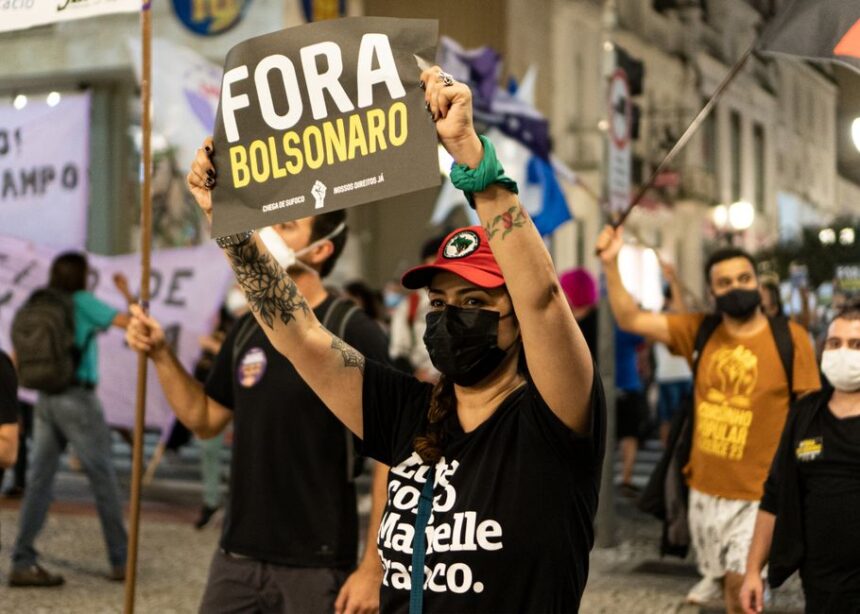
Brazil's 2026 presidential race is shaping up around a question that extends well beyond domestic politics. The clash between President Luiz Inácio Lula da Silva and Senator Flávio Bolsonaro over how to respond to Washington's tariff proposals has exposed a deeper tension in how emerging economies navigate an increasingly fragmented global trade environment. With the world economy still absorbing the aftershocks of aggressive monetary policy tightening and uneven GDP growth across regions, Brazil's internal debate carries weight far beyond Brasília.
The immediate trigger is the Trump administration's push to impose broad tariffs on imports, including goods from Latin American partners. Lula has positioned himself as a defender of multilateral frameworks, signaling preference for negotiated solutions through bodies like the WTO and closer alignment with BRICS partners. Flávio Bolsonaro, meanwhile, has advocated for a more accommodating posture toward Washington, arguing that preserving access to the US market outweighs the political cost of concessions. The contrast is sharp, and the economic stakes are real.
Brazil exported roughly $37 billion worth of goods to the United States in 2023, making it one of the country's top trading partners. Agricultural commodities - soybeans, beef, poultry - dominate that flow, and any disruption through new tariffs would ripple through supply chains that are already under pressure from currency volatility and domestic inflation. Brazil's inflation rate, while down from its 2022 peak above 12%, remained sticky through early 2025, complicating the central bank's room to maneuver on interest rates.
The Banco Central do Brasil has maintained one of the highest real interest rates in the world, with the Selic rate held at elevated levels to contain persistent price pressures. That policy stance has drawn criticism from Lula, who has publicly clashed with the central bank over what he views as excessive tightening that suppresses GDP growth. According to KeyToFinancialTrends analysts, this domestic friction between fiscal ambition and monetary restraint mirrors a broader global pattern, where governments and central banks are pulling in opposite directions as the post-pandemic adjustment continues.
The Federal Reserve's own trajectory adds another layer of complexity. With the Fed holding interest rates at restrictive levels longer than markets initially anticipated, capital flows toward the US dollar have kept pressure on emerging market currencies, including the Brazilian real. A weaker real makes US tariffs doubly painful - it raises the cost of imported inputs while simultaneously compressing margins for exporters who price in dollars but operate in reais.
The IMF's April 2025 World Economic Outlook revised global growth projections downward, citing trade fragmentation and policy uncertainty as primary risks. The World Bank has echoed similar concerns, flagging that developing economies face a narrowing window to attract investment as global capital gravitates toward higher-yielding, lower-risk assets in developed markets. Brazil, with its vast commodity base and large domestic market, is better positioned than most emerging economies - but political instability and inconsistent policy signals erode that structural advantage.
We at KeyToFinancialTrends note that the Lula-Bolsonaro divide over US tariffs is not purely ideological. It reflects two competing theories about where Brazil's long-term economic leverage lies. Lula's camp bets on multipolarity - deeper ties with China, the EU trade deal through Mercosur, and South-South cooperation - while the Bolsonaro camp sees alignment with Washington as the more reliable path to investment and market access. Both calculations carry genuine risk.
The Mercosur-EU agreement, finalized in principle after more than two decades of negotiations, remains unratified and faces resistance from European agricultural lobbies. China, Brazil's largest trading partner, is itself navigating a slowdown in domestic demand and its own trade tensions with the US. Betting heavily on either axis without hedging carries exposure that Brazil's current fiscal position - with public debt above 87% of GDP - makes difficult to absorb.
KeyToFinancialTrends analysts forecast that whichever candidate wins in 2026 will face a global trade environment that is structurally less open than the one Brazil benefited from during the commodity boom years. The architecture of global trade is being rewritten through tariffs, industrial policy subsidies, and geopolitical alignment - and emerging markets that lack a clear strategic posture will find themselves reactive rather than positioned.
The political debate in Brazil is, in that sense, a preview of choices that most middle-income economies will be forced to make explicitly in the coming years. The global economy is not returning to the low-inflation, low-rate, high-trade-volume equilibrium of the pre-2020 era. Central banks from the Federal Reserve to the Banco Central do Brasil are managing a more volatile baseline, and monetary policy alone cannot substitute for coherent trade strategy. We at KeyToFinancialTrends believe that Brazil's 2026 election will be as much a referendum on economic positioning as on domestic governance - and the outcome will matter to investors and policymakers well outside Latin America.