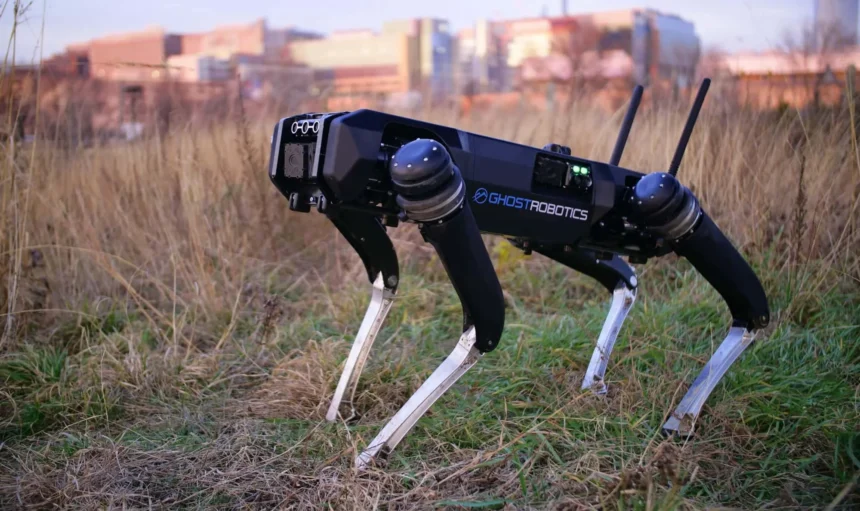
Ghost Robotics, known for its innovative solutions for complex and extreme conditions, continues to expand the capabilities of its robots. At the center of this new achievement is the manipulator for Vision 60 - a robot that has now become significantly more versatile and multifunctional. This manipulator transforms the robot into an ideal tool for a wide variety of tasks, ranging from rescue operations to industrial and military applications. At KeyToFinancialTrends, we note that this is an important step toward creating more advanced and autonomous systems capable of performing tasks that previously required human involvement.
The manipulator, equipped with six degrees of freedom, gives the robot unique capabilities for precise interaction with the surrounding environment. With a maximum gripping force of 11.3 kg and a payload capacity of 3.75 kg, it can handle various objects, open doors, move equipment, and retrieve items. This expands the range of tasks that Vision 60 can perform, making it a more flexible and versatile tool. Importantly, the manipulator also features a modular design, allowing for quick replacement of grippers or other components in case of damage, which significantly improves the robot's efficiency in extreme conditions.
The manipulator for Vision 60 not only increases the robot's functionality but also simplifies its operation. The device can be installed without the need for specialists, using standard fasteners, which significantly reduces preparation time and increases the robot's mobility in situations that require rapid response. The robot operates on its main battery, eliminating the need for an additional power source and simplifying maintenance, thus reducing operating costs.
According to analysts at KeyToFinancialTrends, this approach to design significantly improves the economic efficiency of the robot, as users can easily adapt the device to their needs. With each new improvement, robots are becoming more accessible and productive, making them more attractive to organizations working in the fields of rescue, defense, and industry.
The new manipulator also opens up additional opportunities for using Vision 60 in extreme conditions, such as disaster recovery, military operations, and inspections in hard-to-reach and hazardous areas. With the manipulator, the robot can perform tasks that were previously only possible for humans. Notably, the manipulator can also be used as a periscope to improve visibility and inspection of areas, further enhancing the robot's versatility. This expands its application in industries such as energy, oil and gas, and construction, where robots can conduct inspections in low-visibility conditions.
At KeyToFinancialTrends, we believe that with each new development in robots for emergency situations, their importance will only grow. Robots like Vision 60 open new horizons for technologies that can change the way operations are carried out in the most challenging and dangerous environments. The development of such technologies may also play a key role in automating processes where human presence is limited or impossible.
The future of robotics lies in flexible, multitasking systems capable of operating efficiently in a wide range of conditions. We forecast that robots equipped with such manipulators will be in demand not only in rescue and defense sectors but also in a wide range of industries and commerce. It is essential to understand that with each technological improvement, robots become more efficient and accessible, which in turn allows businesses and government organizations to reduce costs and enhance safety. At KeyToFinancialTrends, we see this as an important step in the future of robots and process automation, which will play an increasingly significant role in various sectors of the economy.
Overall, at Key To Financial Trends, we note that the manipulator for Vision 60 is not just a technical upgrade. It is an innovation that significantly expands the robot's capabilities and improves its efficiency in real-world operational conditions. With each new advancement in robotics, we observe crucial steps toward creating safer, more versatile, and autonomous solutions that will be in demand across various fields. We are confident that in the future, robots equipped with such manipulators will play a key role in maintaining safety, conducting rescue operations, and automating production processes.