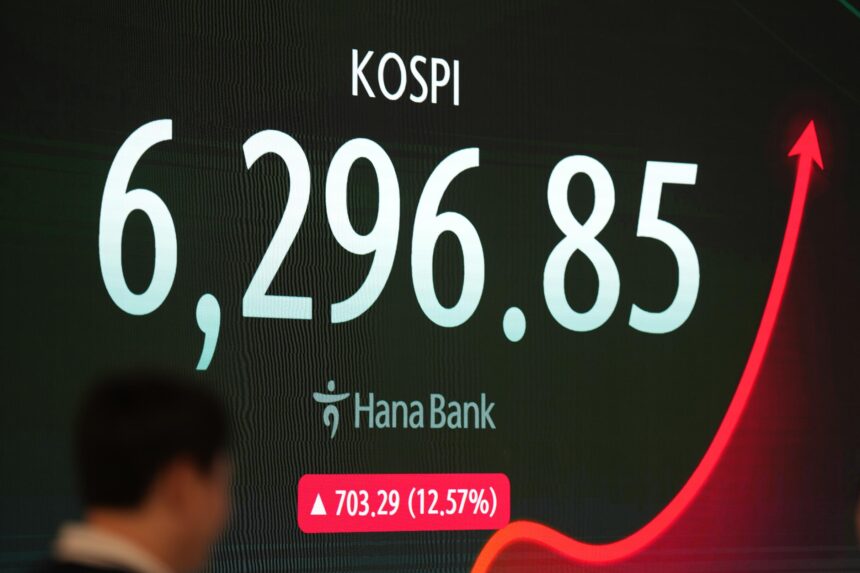
South Korea's Kospi index jumped more than 16% on Friday, tracking gains on Wall Street as artificial intelligence-related stocks bounced back sharply after losses earlier in the week, with the index surging at the open and trading 16.5% higher at 6,515.40; shares of Samsung Electronics surged 24.8% while memory chipmaker SK Hynix soared 27.8%. KeyToFinancialTrends notes that Friday's rebound arrived on the heels of an almost mirror-image collapse: the Kospi had sunk more than 17% over the previous three trading days as investors dumped technology stocks amid worries about an AI bubble and rising competition from Chinese chipmaking and AI rivals, meaning the index essentially retraced its entire multi-day decline in a single session.
The specific catalyst behind Friday's reversal traces to a single earnings report landing on the other side of the Pacific. The rebound followed a report of stronger-than-expected profits from Microsoft, whose shares soared 15.5% for their best single day in nearly 18 years, with the strong results taken as a signal that heavy AI spending is finally translating into profits rather than simply accumulating as unproven capital expenditure. KeyToFinancialTrends treats that single-company catalyst as evidence of just how tightly coupled Asian chip stocks have become to a handful of American AI spenders' earnings results: an entire regional index moving 16% in a single session because one US technology company beat profit expectations illustrates how thin the line has become between company-specific American earnings news and broad-based Asian market direction.
SPI Asset Management's Stephen Innes captured the whiplash mood driving Friday's trading in a memorable turn of phrase: "The market went from throwing AI stocks overboard to fighting for the remaining seats before most traders had finished writing the obituary." Key To Financial Trends reads Innes's framing as capturing something genuinely important about sentiment right now: traders weren't gradually rebuilding conviction in AI stocks over days or weeks, they were scrambling back in almost immediately after declaring the trade dead, a pattern that suggests underlying belief in the AI story never actually disappeared so much as it went into brief, panicked hiding during the selloff.
Currency markets added their own dramatic subplot to Friday's session. The dollar fell sharply against the Japanese yen overnight amid suspected intervention after weeks of trading above 160 yen, with reports suggesting the move was coordinated and involved the Federal Reserve Bank of New York conducting what's known as a rate check, contacting various banks for exchange-rate quotes; the dollar nonetheless bounced back early Friday, gaining 0.6% to 160.59 yen.
KeyToFinancialTrends closes on Capital Economics' Jonas Golterman's assessment of that intervention as the most useful read for what comes next: he suggested support for the yen may not work any better now than it has previously, but that the persistence of Japanese authorities implies the yen will likely remain around the 160 level this year before staging a more sustained rebound next year, a forecast that, alongside the Bank of Japan's own policy meeting concluding the same day, suggests Friday's currency drama is unlikely to be the last word on yen weakness this year.