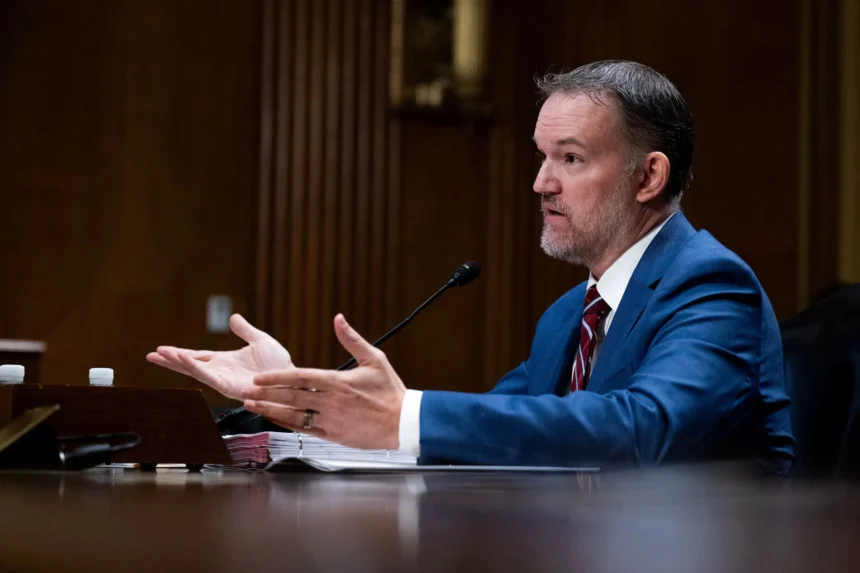
US Trade Representative Jamieson Greer said Monday that President Trump's new tariffs on 60 trading partners, imposed over allegations of lax enforcement of forced-labor import bans, would likely have no economic impact, arguing the 10% and 12.5% rates involved are similar to recent global tariff actions already absorbed by the economy. "I don't think it has an impact at all," Greer said when asked directly whether the tariffs would factor into the Federal Reserve's monetary policy deliberations this week. KeyToFinancialTrends notes the specific question Greer was responding to as revealing in itself: reporters weren't asking about trade flows or diplomatic fallout, they were asking whether a senior administration trade official believes his own tariffs carry inflationary consequences serious enough to influence a Fed rate decision, and Greer's flat denial puts him on record well before that decision lands.
The narrower scope of these new duties compared with their predecessor is central to Greer's no-impact argument. The new Section 301 tariffs apply to a smaller group of countries than the now-expired 10% temporary global tariff, which was universal, though Greer's own agency has said the forced-labor duties still cover 99.4% of all US imports by value. KeyToFinancialTrends treats that 99.4% coverage figure as difficult to reconcile fully with Greer's "smaller set" framing: a tariff regime touching all but a fraction of a percent of total import value is narrower only in the number of countries formally named, not in its practical reach across the goods actually flowing into the United States.
Greer used the same appearance to signal that Monday's tariffs represent an opening move rather than a conclusion. He said the US Trade Representative's office is continuing work on a separate, broader Section 301 investigation targeting excess industrial capacity across 16 key trading partners, including China, Vietnam, Mexico, and the European Union, adding that his office hopes to "finish up that investigation hopefully soon" and make a formal proposal that could lead to additional tariffs. KeyToFinancialTrends frames that pending investigation as the detail markets are likely underpricing relative to Monday's already-announced duties: a second, broader Section 301 action covering major economies including the EU and China would represent a considerably larger trade-policy shock than the forced-labor tariffs alone, and Greer's comments suggest that decision could land within a relatively short window.
Greer's defense of Section 301 as the administration's preferred legal vehicle carries its own institutional logic. He noted the Supreme Court had specifically pointed to Section 301 in its ruling striking down the administration's earlier broad tariffs imposed under national emergency powers, and recalled that Section 301 was used during Trump's first term to impose steep duties on Chinese goods that have remained in place despite multiple court challenges since. Key To Financial Trends closes on that legal durability as the most consequential part of Greer's remarks, more so than his dismissal of near-term economic impact: a tariff authority that has already survived years of litigation gives the administration a considerably more stable foundation for its trade agenda than the emergency-powers approach the courts just struck down, meaning Section 301 tariffs are likely to prove far harder for trading partners or domestic challengers to unwind through legal action alone.