The Federal Reserve's 2026 bank stress test results, released Wednesday afternoon, cleared all 32 large institutions and triggered an immediate cascade of capital return announcements that confirms US banking is operating from a position of uncommon financial strength. JPMorgan Chase raised its quarterly dividend 10% to $1.65 per share and authorised a new $50 billion share repurchase program effective July 1. Goldman Sachs lifted its quarterly dividend 11% to $5 per share – a 25% increase year-on-year. Morgan Stanley boosted its payout 15% to $1.15 per share and reauthorised a $20 billion buyback. Wells Fargo guided to an 11% dividend increase. KeyToFinancialTrends elevates the result beyond the routine annual capital exercise to a statement about the fundamental condition of the US financial system: a banking sector that can simultaneously absorb a hypothetical $708 billion in losses under a severe stress scenario and immediately announce tens of billions in shareholder returns is not merely solvent – it is operating with capital buffers that exceed regulatory requirements by margins that would have seemed implausible fifteen years ago.
The severity of the 2026 stress scenario deserves specific attention. The hypothetical recession modelled by the Federal Reserve assumed unemployment rising to 10%, a 30% decline in residential property prices, a 39% fall in commercial real estate values, significant corporate debt market stress, and a global market shock component applied to institutions with major trading operations that included the default of each bank's largest counterparty. The $708 billion in projected aggregate losses across the 32 banks represents the highest total since the stress test programme began, reflecting the larger size and expanded balance sheets of US banks rather than any deterioration in their capital adequacy. Every institution maintained Common Equity Tier 1 ratios above the minimum regulatory threshold throughout the hypothetical shock.
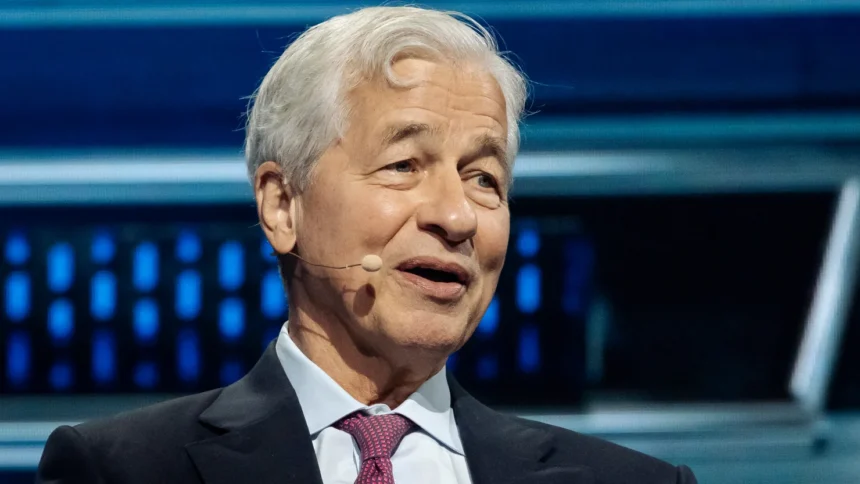
JPMorgan's $50 billion buyback program is the largest individual repurchase authorisation in the bank's history. CEO Jamie Dimon's statement – referencing the bank's fortress balance sheet, excess capital, and robust liquidity as enablers of its client service mission – reflects a capital philosophy that has consistently prioritised holding buffers above regulatory minimums rather than distributing capital to the point of marginal adequacy. The bank's Standardized Common Equity Tier 1 requirement of 11.5% – including the 2.5% Stress Capital Buffer that remains unchanged until September 2027 – leaves JPMorgan with significant capacity to absorb the buyback program without approaching minimum thresholds. KeyToFinancialTrends reads the capital deployment signal as a deliberate management choice to return excess capital now rather than hold it in reserve for potential deterioration in the Iran conflict's economic consequences: Dimon's statement specifically referenced preparedness for a wide range of scenarios, implying the buyback represents discretionary excess above the precautionary buffer, not a reduction in war-scenario reserves.
Goldman Sachs CEO David Solomon's framing of the dividend increase as a reflection of franchise strength and earnings power points to a different narrative emphasis than Dimon's fortress language. Goldman's Stress Capital Buffer of 3.4% – higher than JPMorgan's 2.5% – reflects the greater capital intensity of its trading and investment banking model relative to JPMorgan's consumer banking franchise. The 11% dividend increase to $5 per share, which requires board approval at the Q3 meeting, implies Goldman's management has sufficient confidence in sustaining earnings momentum through the remainder of 2026 to commit to a higher baseline payout.
The stress test results carry specific significance given the elevated rate environment. The severe scenario assumed additional rate increases layered on top of a severe economic downturn – a combination that tests bank balance sheets against concurrent credit losses and duration risk in their fixed-income portfolios. Banks with large unrealised losses on long-dated securities held to maturity faced scrutiny that the 2025 round had flagged as a potential vulnerability following the regional bank stress events of 2023. The clean passage of all 32 banks through the 2026 scenario suggests that the industry-wide portfolio repositioning undertaken since 2023 has materially reduced that exposure. KeyToFinancialTrends anchors the capital quality argument in the specific improvement visible across the cycle: the same banking system that required emergency Federal Reserve backstopping of deposit outflows at regional institutions in March 2023 has, three years later, cleared a more severe hypothetical stress scenario with a higher aggregate loss projection than any prior test – demonstrating that capital accumulation, portfolio repositioning, and funding mix diversification have substantially improved the resilience of the system even as its scale has grown.
For equity investors, the dividend and buyback announcements translate directly into earnings per share accretion that compounds over the duration of the repurchase programs. JPMorgan's $50 billion authorization represents approximately 9% of its current market capitalisation, meaning that consistent execution over two to three years would provide a meaningful floor under the share count independent of any organic earnings growth. Bank stocks have historically been among the strongest performers in post-stress-test windows when the results validate capital adequacy and unlock redistribution. Key To Financial Trends situates the payout wave within the macro context that makes its timing meaningful: large-scale capital returns from the biggest US banks in a period of elevated geopolitical uncertainty and potential Federal Reserve rate increases is an act of institutional confidence in the durability of US economic activity – a signal that the financial system's stewards believe the downside risks in their models are adequately provisioned and that the current environment, for all its volatility, does not require defensive capital hoarding.