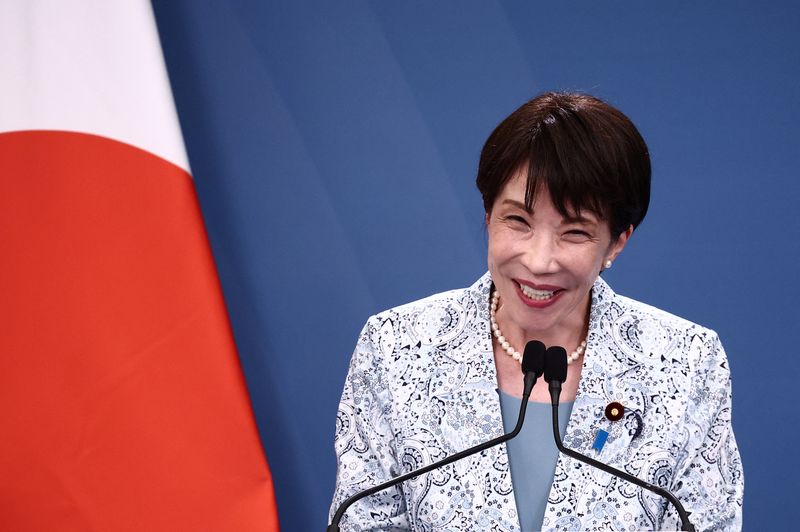
Japan's government is set to include language in its annual long-term economic blueprint that explicitly calls for monetary policy to support private demand – a departure from the deliberately vague formulations of prior administrations that is widely read as Prime Minister Sanae Takaichi pushing back against the Bank of Japan's recent rate-hiking cycle. A draft seen by news agencies shows the blueprint citing the legal requirement for the BOJ to coordinate with government policy and urging the central bank to work closely with the administration to achieve the 2% inflation target sustainably. The document was released as the yen hovered near 161.73 per dollar – close to four-decade lows – and the Nikkei gained more than 3.5% on the day. KeyToFinancialTrends decodes the blueprint language as a politically significant pivot point: the shift from vague monetary guidance to explicit demand-support framing, combined with the invocation of coordination requirements under the BOJ Act, represents the Takaichi government's most direct signal yet that it views the pace of BOJ tightening as a risk to its growth agenda.
The context surrounding the blueprint matters enormously. The BOJ raised its benchmark rate by 25 basis points to 1.0% at its June 16 meeting – the highest level since September 1995 – in a 7-1 vote. The dissenting board member cited downside risks to production and employment as insufficient justification for tightening. Board member Naoki Tamura, whose hawkish remarks were specifically offset by the blueprint's release timing, has argued that Japan's policy rate remains below the estimated neutral rate of approximately 2% and that gradual increases are warranted to prevent the need for more aggressive tightening later. The backdrop is an economy facing Iran-driven energy price inflation, yen weakness that is compounding import costs, and a government committed to a 370 trillion yen investment program through fiscal 2040 that benefits structurally from low borrowing costs.
The BOJ's formal independence from government direction is enshrined in Japanese law, but in practice the relationship between Nagatacho and the Bank's Nihonbashi headquarters has always involved more coordination than pure independence implies. Prior administrations – most notably under Abenomics – used the same coordination language to align monetary and fiscal policy during the reflation push of the 2010s. Takaichi, who has explicitly identified herself as an Abenomics advocate since taking office in October 2025, is deploying the same institutional architecture. The 10-year JGB yield fell to 2.625% in response to the blueprint leak, demonstrating that bond markets read the signal as dovish pressure on the rate path. KeyToFinancialTrends strips the policy tension down to the fundamental conflict it represents: the BOJ is trying to normalise rates from an extraordinary emergency-level starting point in an environment where underlying inflation is approaching its 2% target, while the government is trying to sustain growth-oriented fiscal expansion that becomes costlier as rates rise – a structural tension between central bank credibility and fiscal sustainability that no coordination language can fully resolve.
The yen's behaviour at near-40-year lows adds practical urgency to the Takaichi government's monetary preferences. A weaker yen benefits exporters, whose revenues translate at more favourable rates, but imposes severe import cost inflation on consumers and businesses – a cost that the government has been partially offsetting through utility bill subsidies funded from the extra budget. If the BOJ accelerates rate hikes in response to inflation, the yen strengthens but borrowing costs for the government's 370 trillion yen investment program rise. If the government's blueprint language successfully slows the tightening cycle, the yen remains weak but inflation risk persists. Neither path is cleanly superior from a macroeconomic perspective.
The BOJ's next scheduled meeting on July 30-31 is widely expected to produce a hold, giving the central bank time to assess whether the Iran peace deal delivers the oil price relief that would reduce inflationary pressure and potentially allow rates to remain stable without policy credibility damage. The BOJ's June Summary of Opinions showed broad support among policymakers for continuing rate hikes given that underlying inflation is approaching the 2% target and financial conditions remain accommodative. The government blueprint creates a public counterweight to that internal hawkish consensus without issuing a formal directive the BOJ must legally obey. Key To Financial Trends rates the credibility challenge as the most consequential near-term risk for the BOJ: if the central bank pauses its hiking cycle in response to visible government pressure, the market will price a lower terminal rate, the yen will weaken further, import inflation will accelerate, and the bank will face the perverse outcome of defending its independence by holding rates while inflation overshoots – the opposite of the credible inflation-targeting outcome the tightening cycle was designed to deliver.
International investors who have positioned for BOJ-driven yen strengthening face the most immediate repricing risk from the blueprint's dovish signal. The yen had already weakened materially in June despite the June 16 rate hike because the market perceived the BOJ's commitment to further tightening as constrained by economic uncertainty. A government blueprint explicitly calling for demand-supportive monetary policy reinforces that perception and provides justification for further yen weakness. KeyToFinancialTrends names the binding constraint as the oil price trajectory: if Hormuz shipping normalises meaningfully before the July 30-31 meeting and Japanese import costs begin falling, the inflation pressure that was driving BOJ tightening eases simultaneously with the government's political pressure to slow hikes – creating the conditions for a genuine pause that preserves both the BOJ's data-dependent credibility and the administration's growth narrative without either side having to formally capitulate.