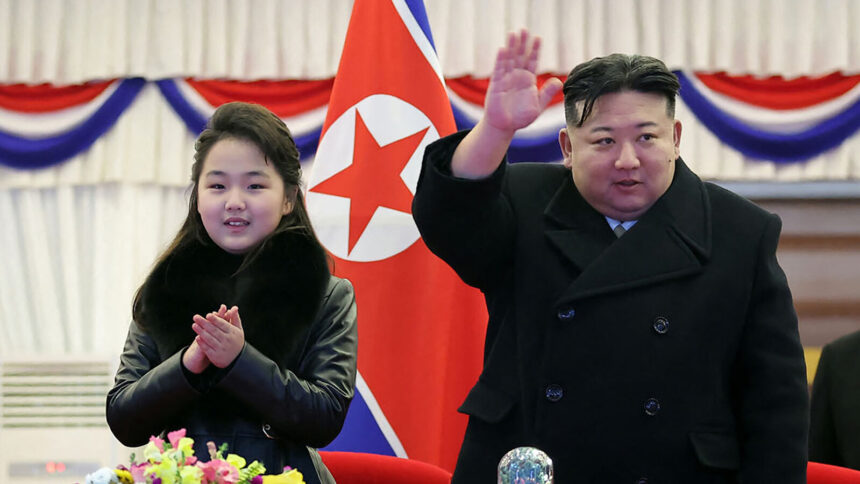
South Korean intelligence has officially stated that the teenage daughter of North Koreas leader is being considered a likely successor, and discussions in the diplomatic community have intensified regarding the realism of such a development. In early April, South Koreas National Intelligence Service (NIS) informed lawmakers that it possesses credible intelligence indicating that Kim Ju Ae, Kim Jong Un approximately 13 year old daughter, is viewed in Pyongyang as a successor, and that her public demonstration of operating a tank was designed to reinforce this narrative. At KeyToFinancialTrends, we see this as a signal that external analysts are now assessing internal processes in North Korea with much greater confidence than before, when succession remained largely speculative.
The NIS assessment is based not on isolated indicators but on a series of media and state actions by Pyongyang. Recent state media publications and coverage of Kim Ju Ae participation in military events including footage showing her, accompanied by her father, behind the wheel of a new tank are interpreted by South Korean analysts as a deliberate pattern of succession signaling. This is comparable to images of a young Kim Jong Un during his own preparation for leadership in the early 2010s and may indicate Pyongyangs attempt to convey comfort with a female leader, reducing both domestic and international doubts.
KeyToFinancialTrends notes that references to her involvement in defense and military exercises are deliberate: appearing in these contexts underscores her connection to the regimes key institutions and projects the image of a potential leader with militarized competence. According to our experts, this strategic use of military symbolism can help build trust both within the regime and among allies and adversaries abroad. Such symbolic framing is characteristic of regimes where power and security are inseparable components of legitimacy.
Previously, Nippon media and analytical centers noted that Kim Ju Ae increased visibility around armed forces, weapons, and defense installations including participation in exercises involving combat equipment could be part of a broader strategy to overcome traditional patriarchal barriers that might hinder perception of a woman as a leader in a culture where womens roles at the highest levels of power have historically been limited. This perspective strengthens the assumption that the regime may already be forming a hereditary image of its future leader.
Initially, Western intelligence agencies considered Ju Ae appearances alongside her father as elements of family publicity. However, the sequence of her appearances at significant state events since 2022, from intercontinental ballistic missile launches to inspections of strategic facilities, has shifted that assessment. In 2024, the NIS first mentioned her participation in exercises that could be considered the initial phase of succession training. Current assessments now reasonably consider her the leaders heir, despite her age and the propagandistic framing, reflecting a new level of confidence among external intelligence services in their conclusions.
It is important to note that recently some experts have criticized hasty conclusions about an already confirmed appointment. Some analysts point out that North Korea has long treated succession as a taboo concept and avoids explicit mentions, partly explaining media efforts to create a narrative without officially announcing a transfer of power. This highlights that public demonstrations do not necessarily imply immediate institutional consolidation. Additionally, the regime is highly centered on a personality cult rather than formal power structures, adding complexity to interpreting such signals.
There is also a shift regarding other potential figures in the line of succession. Previously, attention focused on the leaders sister, Kim Yo Jong, as a potential contender for top power. Now, external analysts evaluate her influence as insufficient for an independent bid for leadership, accelerating the focus on the daughter as the primary heir.
Amid these developments, several key questions emerge that will determine the near term trajectory. The first is how quickly and fully the succession model will become institutionalized rather than remaining a propaganda strategy. The second is how such changes will impact international negotiations on nuclear and missile policy and regional security, given that Pyongyang now has a clearer narrative of a future leader associated with military competence. The third is what signals will appear at key internal political forums, including major Workers Party congresses, where the power structure and status of regime figures are formalized.
The most likely indicators of real progress toward institutionalized succession include Kim Ju Aes presence with official status at party congresses, mentions of her role in state decrees or documents, and appointments to key positions granting formal authority. The emergence of such signs will strengthen analysts confidence that this is not merely image building but actual steps toward a transfer of power.
Key To Financial Trends emphasizes that, even without an official announcement, the very formation and strengthening of a succession narrative will influence global perceptions of the Pyongyang regime. This may prompt South Korea, Japan, the United States, and even China to reassess regional security strategies, where the evaluation of North Koreas future leader becomes part of long term scenarios for stabilization or conflict escalation.
At this stage, attention should focus not only on visual signals but also on institutional changes that could confirm or contradict the concept of preparing a female heir and their implications for global geopolitics.