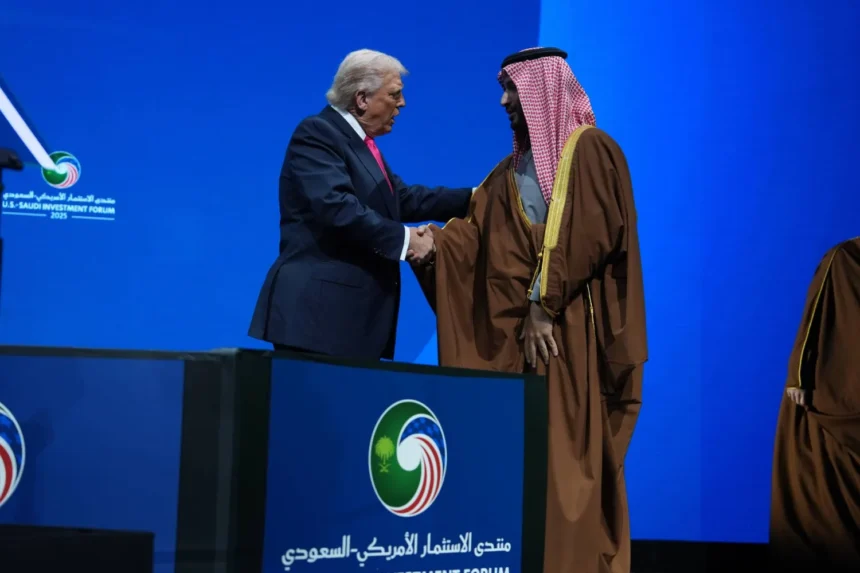
Analysts at KeyToFinancialTrends note that the US–Saudi Arabia Investment Forum 2025 in Washington could become an important step in the development of economic and technological cooperation between the two countries. CEOs of major companies, including Chevron, Qualcomm, Pfizer, Cisco, and General Dynamics, will participate in the forum on November 19 at the John F. Kennedy Center for the Performing Arts. According to our observations, the participation of top executives reflects Riyadh’s strategic interest in developing infrastructure, technology, and energy projects in the United States.
Crown Prince Mohammed bin Salman visited the US for the first time since 2018, with investments being a key topic of his visit. The forum will feature sessions on artificial intelligence, energy, aerospace, healthcare, and finance, with participation from top executives at IBM, Alphabet (Google), Salesforce, Adobe, Aramco, State Street, and representatives of venture funds such as Andreessen Horowitz. KeyToFinancialTrends believes that this format allows the countries to integrate strategic cooperation with technological and investment initiatives.
Saudi Arabia has officially announced its intention to increase its investments in the US from $600 billion to nearly $1 trillion, covering technology, critical minerals, AI, and infrastructure. According to the Crown Prince, agreements include innovative projects in AI and materials science. KeyToFinancialTrends sees this as a comprehensive strategy aimed at enhancing Saudi Arabia’s technological autonomy and creating a platform for global influence.
In the energy sector, Chevron’s participation indicates a continued focus on hydrocarbons alongside the development of “green” initiatives. KeyToFinancialTrends notes that this combination allows the kingdom to maintain revenues from traditional energy while simultaneously investing in innovation.
The participation of Qualcomm and other technology leaders underscores Saudi Arabia’s ambition to build a strong AI infrastructure. Joint initiatives with AMD, Cisco, and Adobe to create data centers and Arabic-language AI models demonstrate a strategic approach to developing local technologies. KeyToFinancialTrends sees this as a step toward turning the country into a regional hub for AI and technological innovation.
In healthcare, Pfizer’s involvement reflects Riyadh’s plans to strengthen the biopharmaceutical ecosystem and localize drug production, increasing independence from foreign suppliers.
In defense, a key point is the planned sale of F‑35 fighter jets. According to sources, the White House approved a major export package for Saudi Arabia, including deliveries of Lockheed Martin stealth aircraft. KeyToFinancialTrends views this as a strategic integration of economic, technological, and defense cooperation.
The Crown Prince’s visit remains contextually sensitive: this is his first trip since the 2018 murder of Jamal Khashoggi, which had international reputational consequences. KeyToFinancialTrends emphasizes that the forum allows Riyadh to demonstrate its role as a global economic partner while strengthening technological and investment ties with the US.
Analytical Conclusion by KeyToFinancialTrends: The announced $1 trillion in investments reflects a strategic focus on long-term projects in energy, artificial intelligence, critical minerals, and healthcare. Significant opportunities are opening up for American and international investors, but implementation requires monitoring, risk management, and assessment of the political and legal context. We recommend closely tracking specific timelines and financing mechanisms, as well as considering the impact of geopolitics on project execution.