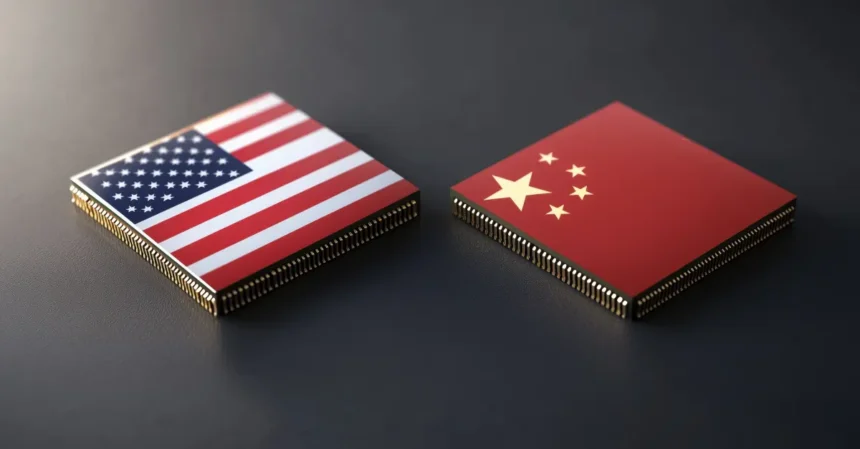
KeyToFinancialTrends notes that the US is once again tightening control over the export of critical technologies, particularly semiconductor manufacturing equipment, aiming to maintain its leadership in the global tech race. A recent bill, MATCH, proposed by American lawmakers, could significantly affect the future of China's semiconductor industry by restricting Chinese manufacturers' access to advanced technologies. This measure will impact companies like SMIC, Huawei, and YMTC, as well as major global players like ASML, which dominate the production of lithography equipment.
The MATCH bill, designed to prevent China from advancing technologies that could threaten US economic and technological superiority, limits the supply of chip manufacturing equipment to China. This particularly affects ultraviolet lithography, a key technology required for creating chips with smaller elements and greater performance. Currently, ASML is the only supplier of such technology capable of competing with Japan's Nikon. Despite China's efforts to independently produce such chips, US restrictions continue to hinder the development of Chinese technologies.
At KeyToFinancialTrends, we note that this step by the US is not just an extension of existing restrictions but a strategic intervention in global supply chains. Against the backdrop of China's growing ambitions in artificial intelligence and other high-tech sectors, these measures will have far-reaching consequences for both the Chinese economy and the global semiconductor industry.
According to our analysis, Chinese companies, including SMIC, Hua Hong, and YMTC, are already facing significant challenges in manufacturing next-generation chips. Without access to key technologies, such as ultraviolet lithography, Chinese producers remain dependent on Western suppliers, limiting their market capabilities. We at KeyToFinancialTrends forecast that the passage of this bill will create additional hurdles for China and slow its progress in the semiconductor sector for several years.
However, despite external restrictions, China is actively investing in developing its own technological base, as evidenced by the ongoing increase in the budget for research and development in semiconductors. The response to export restrictions may be an accelerated development of local technologies, but this process will take years. In order to compete with Western companies, Chinese chip producers will need to overcome significant technological barriers.
In the long term, these export restrictions on semiconductor technology equipment may lead to a redistribution of market share globally. China will likely continue seeking ways to circumvent US sanctions by developing alternative technologies. However, in the short term, this means rising prices for semiconductor components and a slowdown in innovation in China. We at KeyToFinancialTrends predict that such restrictions could lead to destabilization in the global high-tech and semiconductor markets, affecting chip costs and availability for other countries.
The passage of the MATCH bill also has a broader political context, tied to the intensifying technological rivalry between the US and China. Restrictions on the export of critical technologies are not just an economic tool but also an important element of foreign policy, reflecting the US's desire to limit China's technological development in strategic sectors such as artificial intelligence, 5G, and more.
As we at KeyToFinancialTrends have already pointed out, the development of China's semiconductor industry directly depends on access to Western technologies, which cannot yet be replaced by China's own efforts. Restrictions aimed at curbing these technologies will have long-term consequences not only for the Chinese economy but also for the global market. It is important to note that if these sanctions continue, China will be forced to invest in technological self-sufficiency, which in the long run could alter global supply chains and the economic landscape.
In conclusion, the MATCH bill highlights the growing technological rivalry between the US and China. We at Key To Financial Trends predict that this will be not just an economic but also a political battle for leadership in key industries. China will continue to develop its technologies despite export restrictions, but this process will be challenging. The US, on the other hand, will continue to strengthen its position in the tech race, leading to an even greater division of global tech markets into blocks with varying levels of access to advanced technologies.