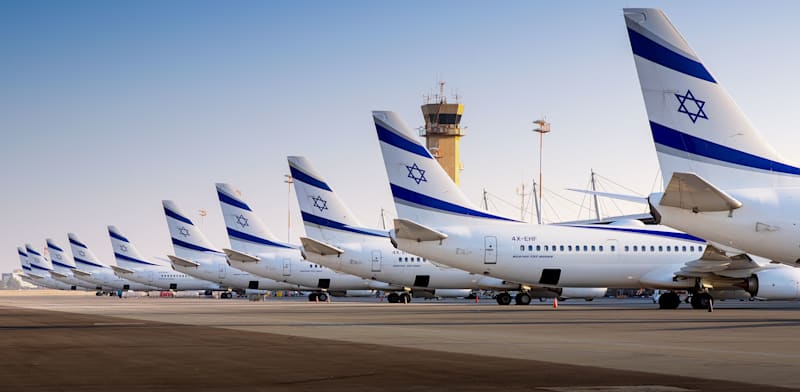
Via the Economic Arrangements Bill that accompanies the state budget, the Ministry of Finance is promoting several moves that will affect the aviation industry, such as a new travel tax, a revision of the way aircraft are depreciated, and a classified section on making the security system more efficient.
The first measure is a revision of the method of depreciating aircraft. At present, airlines benefit from an annual rate of depreciation of 30%, enabling them to spread the value of an aircraft for tax purposes over a fairly short period - 3.3 years. The Ministry of Finance says that this does not reflect the economic life of an aircraft, which can be twenty years or longer, and is unusually high in comparison with rates of depreciation allowed in other countries.
The Ministry of Finance therefore proposes reducing the annual rate of depreciation to 5%, such that the value of the aircraft will be written down over twenty years. The change will apply to aircraft purchased from January 1, 2026 onwards. The gain in tax collection is estimated at NIS 180 million in 2029 rising to NIS 260 million by 2032.
New flight tax
The second initiative is a new tax on passenger flights leaving Israel whereby each flight will bear a fixed tax intended to reflect the environmental costs of greenhouse gas emissions. The tax will be calculated in accordance with the maximum take-off weight of the plane and the distance of the flight: a short-haul flight up to 500 kilometers; a mid-distance flight of 500-4,000 kilometers; and a long-haul flight of over 4,000 kilometers. The tax will range from 1,200 for a light plane on a short flight to some NIS 95,000 for heavy aircraft on long-haul flights.
According to Ministry of Finance data, aviation is responsible for 3.4% of Israel’s greenhouse gas emissions, and the tax is designed to price the costs of the emissions, in line with practice in countries such as the UK, France, Sweden, Germany, and Austria. Annual revenue from the tax is estimated at about NIS 1 billion in a full year of implementation.
Flight security
The third measure, for making flight security arrangements more efficient, is a classified chapter. The state currently subsidizes 95% of the security costs of Israeli airlines. In March, the government revised the arrangement for the state’s participation in these costs such that it will fall from 95% to 92.5% from 2029. El Al, which, through its Ofek division, provides security services for all Israeli airlines, will be entitled to the rate of participation set. If El Al’s security annual costs exceed $13 million, the state will bear 97.5% of the excess.
A similar arrangement will apply to Israir and Arkia, but with much lower ceiling: $2 million for each company, with a possible annual supplement of $500,000 (versus $1 million for El Al).
RELATED ARTICLES
Short-haul fares lower, long-haul fares higher
Israel-US fares stay high despite return of foreign carriers
Sources in the aviation industry warn that these changes are liable to lead to higher operating costs for the airlines, which will be rolled onto air fares.
Published by Globes, Israel business news - en.globes.co.il - on November 10, 2025.
© Copyright of Globes Publisher Itonut (1983) Ltd., 2025.