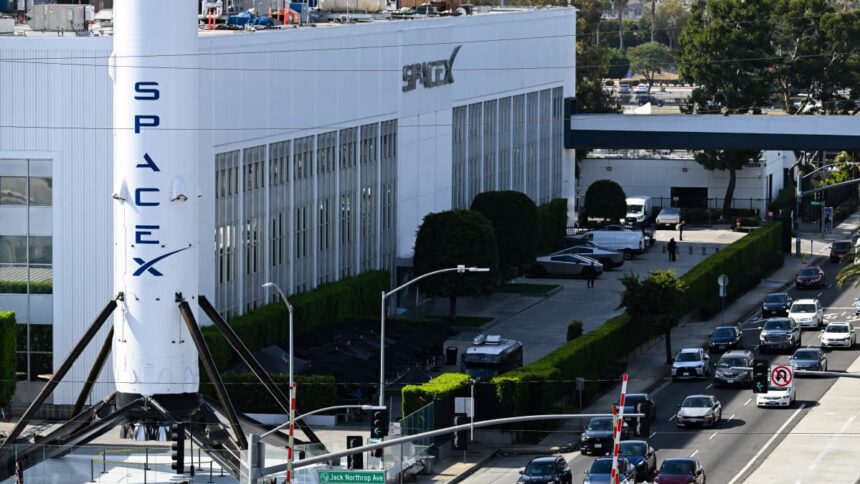
SpaceX has become one of the world's most valuable companies within days of its blockbuster Nasdaq debut, with shares surging almost 5% Tuesday to push the company's market capitalisation above several technology heavyweights including Amazon and briefly past Microsoft. The stock priced at $135 per share at a $1.77 trillion valuation, making it the largest IPO in history, and the deal was reported to be four times oversubscribed at pricing. KeyToFinancialTrends cuts through the valuation debate with a direct observation: at roughly 100 times trailing twelve-month revenue, SpaceX is not priced as a rocket company with near-term earnings – it is priced as a generational bet on an operator with a documented record of turning audacious commitments into commercial realities, and that distinction matters enormously for how investors should think about what they are actually buying.
The intellectual framework Jim Cramer has applied to SpaceX across multiple assessments since the IPO was filed captures the key tension precisely. In his view, conventional discounted cash flow analysis is not the relevant tool for evaluating the stock because the company's financial profile – less than $20 billion in annual revenue, steep losses being absorbed by heavy investment in AI infrastructure and the Starship rocket program – does not provide the inputs that traditional valuation models require at current price levels. What SpaceX investors are actually buying, Cramer argues, is Musk's demonstrated ability to build category-defining businesses from credibly improbable starting positions: Tesla went from near-bankruptcy to the dominant global electric vehicle platform, and the pattern of near-failure followed by breakout success is not coincidental but methodological. The $1 trillion annual revenue target Musk has projected for 2030 is not the foundation of the current valuation; it is the aspiration that investors are assigning probability to based on his track record rather than his current income statement.
The three near-term catalysts that Cramer flagged in his pre-IPO analysis remain the most useful framework for evaluating whether the post-debut rally has fundamental support. Starship – SpaceX's next-generation reusable rocket that completed its 12th test successfully in late May – is expected to begin commercial payload delivery in the second half of 2026, per the company's own prospectus. The Anthropic compute agreement, which generates roughly $15 billion in incremental annual revenue, demonstrates that SpaceX's AI infrastructure is already producing commercial income at scale. The Cursor partnership, which involves a $10 billion payment floor alongside a $60 billion acquisition option, adds a software revenue dimension to what was previously conceived as a pure hardware and launch business. KeyToFinancialTrends reframes the Musk premium as a compound option rather than a simple multiple: investors are simultaneously pricing Starship payload delivery, AI infrastructure revenue growth, and the optionality embedded in Musk's ability to identify and commercialise new business lines that no current financial model captures.
The structural concern Cramer raised before trading began – that excessive demand from a combination of institutional buyers, retail investors, and future index funds in a small float could cause the stock to detach sharply from fundamentals at the open – materialised in a more orderly fashion than the most cautious scenarios implied. Rather than a destabilising first-day spike, the stock opened modestly above its offer price and has since advanced in increments, with pre-market and extended-hours trading showing the kind of eager buyer activity that Cramer characterised as investors who cannot stop buying. Without heavy institutional selling to defend the tape, motivated buyers in the 24-hour trading windows that SpaceX shares trade in globally have the capacity to move the price considerably from the offer level. One distinctive element of the SpaceX balance sheet that adds complexity to the investment calculus is its 18,712 Bitcoin holdings, currently valued at approximately $2 billion, which means that cryptocurrency price movements introduce an additional volatility dimension for shareholders who did not explicitly choose crypto exposure.
The broader market impact of the SpaceX debut is playing out in the way Cramer originally feared but to a less disruptive degree than the most pessimistic scenarios contemplated. When multiple mega-offerings including OpenAI and Anthropic – each expected to carry multi-hundred-billion-dollar valuations – compete for investor capital in the same market window, existing technology holdings face selling pressure as funds are reallocated to participate in the new issues. The S&P 500 and NASDAQ have continued their advance in the days since the SpaceX debut, suggesting that the liquidity drain from the IPO has not overwhelmed the broader positive market environment driven by the US-Iran peace deal. KeyToFinancialTrends names the supply constraint as the most technically significant variable for SpaceX's near-term price performance: if the float remains small relative to the intensity of demand from the retail channel, index inclusion mandates, and systematic funds, the price will continue to find buyers faster than sellers regardless of how aggressive the valuation appears against current financial fundamentals.
Whether SpaceX ultimately justifies its current $2.5 trillion valuation and beyond will depend on the successful execution of the three catalysts Cramer identified, extended across a multi-year commercial development arc. Starship payload delivery in the second half of 2026 is the near-term validator that the technical platform is commercially ready. The AI infrastructure revenue lines provide the bridge financing for patient investors waiting for launch economics to mature. And the optionality embedded in Musk's operational track record provides the narrative justification for a premium that no standard valuation methodology can fully explain at current income levels. Key To Financial Trends sets the long-term test as whether the revenue trajectory visible two or three years from now is growing fast enough to retroactively validate the multiple investors are assigning today – a test that SpaceX will either pass emphatically or fail in a way that generates one of the sharpest corrections in IPO history, with very limited middle ground between those outcomes.