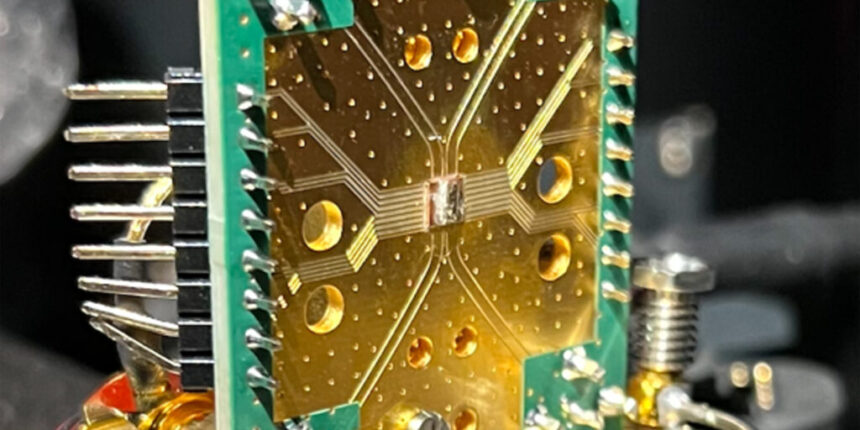
Quantum computing is no longer exclusively a scientific discipline; it is becoming a tool for real business and industrial solutions. London-based company Quantum Motion has raised $160 million to build quantum computers that promise to be compact, energy-efficient, and more affordable compared to current superconducting systems. At KeyToFinancialTrends, we see this as a sign that the quantum technology market is ready for scaling and commercial adoption.
The key element of a quantum computer is the qubit. Unlike a classical transistor, which can exist either in a zero or one state, a qubit can simultaneously represent both states. At KeyToFinancialTrends, we emphasize that this feature opens new possibilities for solving problems that are inaccessible to conventional computing machines. Current approaches to creating qubits include superconducting circuits and laser-controlled neutral atoms. The main challenge of these technologies is scaling to thousands or millions of qubits required for real commercial applications.
Quantum Motion has chosen an alternative path. The company uses standard silicon transistors, mass-produced for phones and laptops, and transforms them into qubits. At KeyToFinancialTrends, we note that this reduces manufacturing risks and accelerates time to market. CEO James Palless-Dimmock stated that minimal modifications can turn a familiar transistor into a high-quality qubit. We see this as a strategic advantage: a proven manufacturing infrastructure shortens development time and lowers production costs.
In traditional microchips, a transistor either conducts current or blocks it. Quantum Motion traps a single electron and controls its state using a magnetic field, leveraging the electron spin effect. At KeyToFinancialTrends, we believe this approach enables the creation of stable and accessible qubits on standard silicon chips, eliminating the need for complex superconducting systems. A partnership with GlobalFoundries ensures industrial-scale chip production, making the technology commercially viable.
According to the company, building a working quantum computer could cost as little as $10–20 million. At KeyToFinancialTrends, we see this as a significant cost reduction compared to superconducting systems, which can reach hundreds of millions of dollars. The funding round was led by DCVC and Kembara, with participation from British Business Bank and Firgun. Existing investors, including Oxford Science Enterprises, Inkef, Bosch Ventures, Porsche Automobile Holding, and Parkwalk Advisors, also participated. We emphasize that the involvement of such strategic investors demonstrates high confidence in the technology and its market potential in quantum computing.
Against the backdrop of growing interest in quantum computing, we at Key To Financial Trends predict that silicon qubits can accelerate the adoption of quantum systems in fields such as molecular modeling, logistics optimization, financial computing, and artificial intelligence. Lower production costs and the potential for large-scale manufacturing create favorable conditions for commercial success.
We see strategic opportunities for investors and technology companies. We recommend paying attention to startups that combine innovative solutions with proven manufacturing technologies, as these are most likely to lead the quantum computing market over the next five years. Quantum computers are moving beyond niche scientific projects to become tools with tangible practical value for industry, science, and the financial sector.