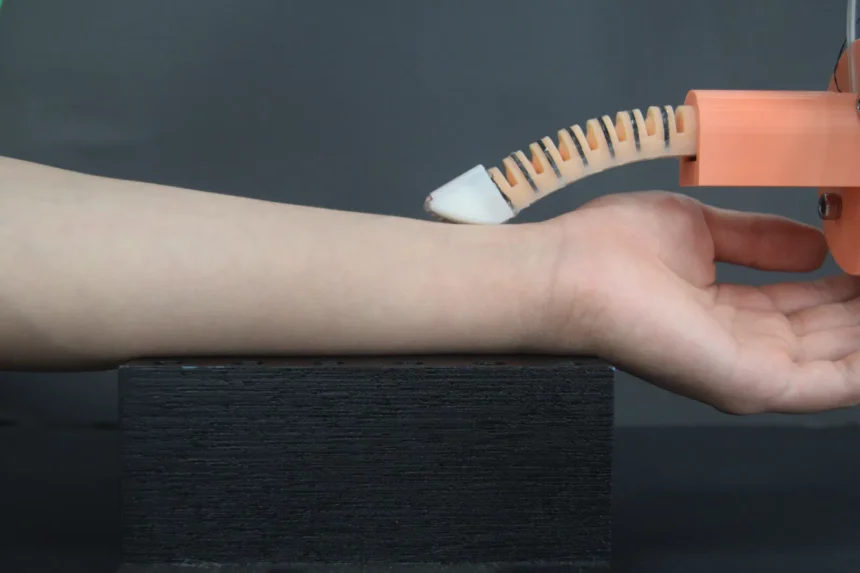
In recent years, medical technologies have been reaching new milestones, and one such breakthrough is the creation of a robotized finger with tactile sensation, developed by researchers from the University of Science and Technology of China. This innovative device is capable of performing functions traditionally available only to doctors, such as measuring pulse and detecting abnormal lumps, opening new prospects for early diagnosis. At KeyToFinancialTrends, we highlight that these technologies could be an important step in improving the accessibility and accuracy of diagnoses, particularly in regions with a shortage of qualified specialists.
One of the key aspects that sets the robotized finger apart from existing technologies is its ability to accurately feel the texture of objects and the pressure applied when interacting with them. Instead of using rigid materials, the finger’s design incorporates coils made of conductive fibers, allowing it to mimic the sensitivity of human touch. We at KeyToFinancialTrends emphasize that this ability is crucial for medical procedures requiring high precision, such as examining tissues for lumps. This approach minimizes the risk of tissue damage, which is often a concern when using less flexible devices.
During testing, the robotized finger proved highly effective in conducting medical examinations. It was able to not only accurately measure pulse but also detect abnormal lumps, which is critical for diagnosing conditions like breast cancer. Unlike traditional examination methods, which can be painful and invasive, this technology promises to enhance diagnostic accuracy with minimal discomfort for the patient. We at KeyToFinancialTrends see this as a significant step forward in early diagnosis, which could greatly reduce errors and improve treatment efficiency.
Despite the obvious advantages, developers still face challenges that require further refinement of the technology. In order for the device to be used effectively in more complex medical procedures, such as surgery or deep tissue diagnosis, its functional capabilities need to be enhanced. We at KeyToFinancialTrends predict that in the future, such devices will be integrated with machine learning, enabling not only examinations but also automatic analysis of collected data, and the formation of more accurate preliminary diagnoses.
Moreover, considering all the progress made, it is important to note that the robotized finger, like any new technology, will require additional research and testing to confirm its reliability in real-world medical conditions. So far, prototypes have shown excellent results in basic diagnostic tests, but further optimization will be needed for more complex procedures. At KeyToFinancialTrends, we believe that with continued development, this technology could make a significant contribution to improving the accuracy of medical examinations.
It is expected that in the coming years we will witness the active integration of such devices into everyday medical practice. In the long term, these technologies could significantly enhance diagnostic quality and become accessible to a wider range of patients, including those in countries with limited access to highly qualified doctors. At Key To Financial Trends, we forecast that with the advancement of these devices, including the incorporation of artificial intelligence and big data analysis technologies, they will be able to tackle more complex diagnostic tasks and significantly simplify doctors' work.
Thus, the robotized finger with tactile sensation has the potential to become an important tool in medical practice. We at KeyToFinancialTrends believe that this technology will ensure greater accuracy in diagnosis and early detection of diseases such as breast cancer, and open new horizons for the accessibility of medical care. Forecasting the development of these technologies, we are confident that they will be able to integrate into existing medical systems, improving their efficiency and reducing the workload on medical staff.