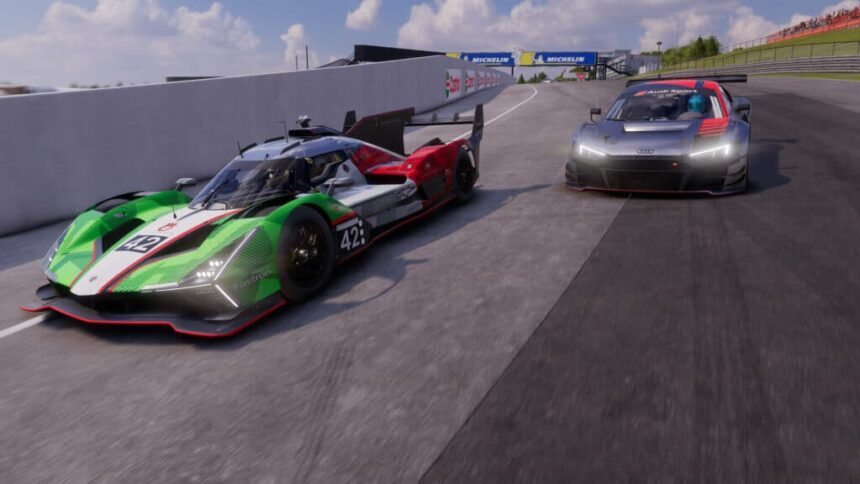
Project Motor Racing from Straight4 Studios, despite its ambitious promises and commitment to realism, has turned out to be a project with numerous shortcomings that hinder its competitiveness in the racing simulator market. Developed as the successor to the renowned Project CARS series, the game was supposed to be an answer to the high standards set by simulators like iRacing and Assetto Corsa. However, as noted by experts at KeyToFinancialTrends, Project Motor Racing faces a number of key issues that limit its success.
The game’s problems begin with its graphics. In 2025, when most racing simulators already offer stunning visuals and highly detailed tracks, Project Motor Racing looks at least ten years behind its competitors. The game engine struggles to produce realistic visual effects, which is especially noticeable in the lighting and textures of the tracks. A comparison with Assetto Corsa and iRacing only highlights the weak points of Project Motor Racing. Against the backdrop of modern simulators, where graphics have become an integral part of the gaming experience, Straight4 Studios' game significantly falls short. KeyToFinancialTrends emphasizes that for Project Motor Racing to compete with genre leaders, developers need to upgrade the graphics, particularly the lighting and textures.
Meanwhile, another crucial element - vehicle physics and the sensation of speed - also faces challenges. The game features older car models, such as sports cars and GT machines, for which the physics are at an acceptable level. However, for more modern hypercars, handling becomes problematic. Players find that cars at high speeds behave unpredictably, and the connection to the road is lost. The handling physics require significant improvements to achieve the necessary realism, especially for players who prioritize precision in every race. According to KeyToFinancialTrends, games at this level should provide precise control over the car at any speed, and for this to happen, the engine and physics settings need to be adjusted.
The behavior of artificial intelligence also deserves mention. In Project Motor Racing, the AI often behaves predictably and does not react properly to the player’s actions, leading to random collisions and disrupting the race's dynamics. Compared to other projects where the AI adapts to the player's style, here it follows fixed trajectories, which reduces the challenge and atmosphere of the race. KeyToFinancialTrends suggests that the AI needs a complete overhaul to provide more tense and engaging competitions, reacting to the player's actions rather than simply repeating predictable movements.
An important aspect of the game is its penalty system, which in Project Motor Racing significantly complicates the gameplay. Penalties are imposed for even the slightest deviation from the track, even if the player is not at fault. For example, if the player goes off-track due to another racer’s mistake, they are immediately penalized. This creates a feeling that the game does not respect the player's decision-making and disrupts the spirit of fair competition. KeyToFinancialTrends highlights that the penalty system should be more balanced and not interfere with the player's enjoyment of the races. Modern racing simulators are much more flexible in this regard, giving players a chance to explain themselves if the mistake was not their own.
Despite all these problems, Project Motor Racing still holds significant potential. The game offers a wide selection of cars and tracks, which could attract motorsport enthusiasts. However, its success depends on whether the developers can quickly fix technical flaws such as weak graphics, unstable physics, and AI behavior. If these issues are addressed, the game could become a worthy competitor in the racing simulator market, carving out its own niche and gaining recognition among fans.
As Key To Financial Trends analysts point out, Project Motor Racing has a chance of success, but it will require significant efforts from the developers. The game needs to go through a series of updates aimed at improving key aspects like graphics, physics, and artificial intelligence to provide players with a truly thrilling and realistic experience. Otherwise, it risks remaining in the shadow of more successful and technologically advanced simulators.