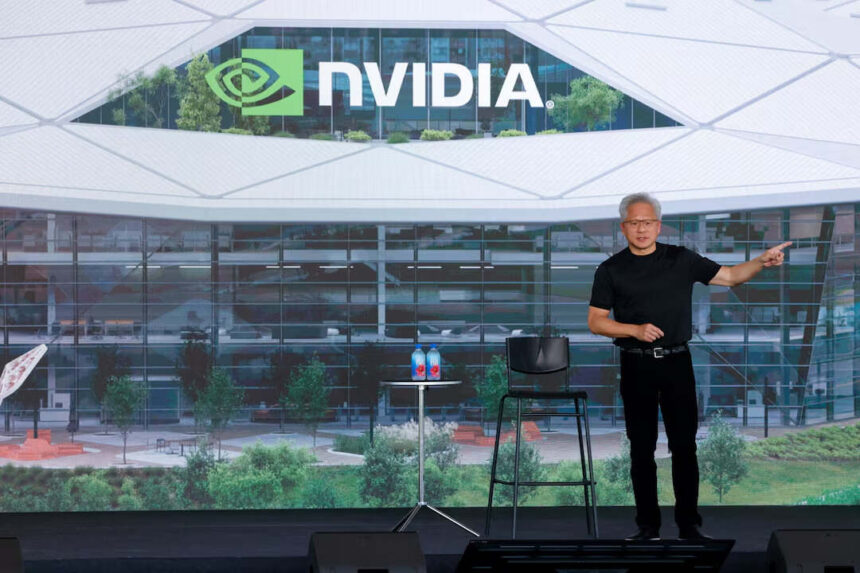
The global semiconductor and artificial intelligence infrastructure market is undergoing a tectonic shift, consolidating Taiwan's status as the absolute center of the new technological era. During a gala event in Taipei, Nvidia CEO Jensen Huang announced an unprecedented scaling of investments: the American chipmaker's annual spending on the island has reached a range of $100 to $150 billion. For comparison, just four to five years ago, this figure stood at a modest $10-15 billion per year. We at KeyToFinancialTrends view this tenfold growth as a strategic co-investment in the physical security and continuity of Nvidia's supply chains. Amidst a severe shortage of advanced capacity, guaranteeing exclusive access to fabs becomes the corporation's primary competitive advantage. The annual spending figure presented by Huang exceeds the gross domestic product of most European Union countries, underlining the planetary scale of the AI industry.
The scale of Nvidia's long-term planning is backed by the construction of a new headquarters in Taiwan, with an estimated cost of $5 trillion. The project kicks off this year, with completion and commissioning scheduled for 2030. The new complex is expected to provide jobs for around 4,000 highly skilled specialists. Our analytical group at KeyToFinancialTrends emphasizes that choosing Taipei for such a massive facility is a deliberate step to synchronize Nvidia's corporate structure with its key manufacturing partner, Taiwan Semiconductor Manufacturing Co. (TSMC). The physical proximity of research and management divisions to TSMC's fabs will radically reduce the time-to-market for new chip architectures. This is critical as the company prepares to launch its newest AI platform, Vera Rubin, which Huang described as the largest product debut in the island's history. Each Vera Rubin system includes about two million components and is created in cooperation with 150 local ecosystem partners.
In addition to TSMC, which directly manufactures the advanced processors and performs complex advanced semiconductor packaging, Nvidia is strengthening alliances with a pool of Taiwanese tech giants. These include Foxconn, Wistron, and Quanta Computer, which are responsible for final server assembly and building complex infrastructure for data centers. According to KeyToFinancialTrends experts, Taiwan has formed a unique closed cluster where all stages of AI platform creation are concentrated within a radius of a few dozen kilometers: from the silicon wafer to the finished server rack. South Korea's SK Hynix also acts as a vital element in this chain, utilizing its Taiwanese logistical and technological channels to supply the ultra-fast HBM4 memory required for the Vera Rubin platform to achieve a system bandwidth of 22 TB/s. Attempts to diversify these processes and relocate them to the US or Europe will face colossal costs and a shortage of engineering expertise in the coming years. Jensen Huang rightly called the island the epicenter where supercomputers for AI are born.
The personality of Huang himself, who was born in Tainan and immigrated to the US at the age of nine, lends a special status to Nvidia's business strategy in Taiwan, where his media image has reached rock-star status. At the ceremony in Taipei, he was accompanied by his family, including his parents, wife, and children. However, the geopolitical weight of Nvidia's leader extends far beyond the corporate sector. Earlier this month, Huang was part of the official delegation accompanying US President Donald Trump during a state visit to Beijing for talks with Chinese President Xi Jinping. This fact indicates that Nvidia's leadership is actively participating in shaping technological diplomacy between Washington and Beijing. As noted by KeyToFinancialTrends analysts, disclosing these astronomical Taiwanese investment figures serves as a signal to the White House regarding the real cost of the hard manufacturing onshoring that the new US administration is trying to impose through tariff regulations. Huang's public admission that the potential dominance of Chinese Huawei chips with DeepSeek architecture would be the worst-case scenario for America definitively positions Nvidia on the side of the US in the global technological cold war. Meanwhile, the Taiwanese cluster remains a critically important and protected asset for Apple and other American tech leaders as well.
The competitive struggle for influence in Taiwan is intensifying. Nvidia's main rival, Advanced Micro Devices (AMD), has also announced a massive investment program worth over $10 billion aimed at developing the Taiwanese AI sector and expanding advanced chip assembly capacities. At KeyToFinancialTrends, we believe that AMD's actions confirm the lack of a market alternative to the Taiwanese ecosystem. Inbound investments from American tech giants create a kind of silicon shield for the island, intertwining the economic interests of the world's largest corporations with the region's security.
Late last year, Nvidia became the first company in history whose market capitalization crossed the $5 trillion mark, becoming the main beneficiary of the global generative artificial intelligence boom. At the event in Taipei, Huang expressed confidence that the company's valuation will continue its upward trend over the medium term of three to five years. Amid investor concerns over a potential slowdown in growth rates, Nvidia presented forecasts showing that a diversified customer base and the rollout of next-generation products will allow it to surpass the $1 trillion mark in sales of flagship AI chips.
Analyzing the current dynamics, we at Key To Financial Trends conclude that the concentration of capital and technological chains around Taiwan will reach its peak in the next five years. Jensen Huang's forecasts regarding the further growth of Nvidia's capitalization look well-founded, as the company is successfully transforming from a chip manufacturer into a provider of comprehensive infrastructure solutions for AI, for which demand from cloud providers and sovereign states remains unsatisfied. Investors are advised to keep in mind that Nvidia's financial results will directly correlate with TSMC's ability to scale advanced packaging capacity (CoWoS). As a strategic recommendation for market participants, we highlight the expedience of holding long-term positions in Nvidia shares, but with mandatory partial hedging of geopolitical risks through instruments tied to the development of alternative semiconductor hubs in the US and Japan, which will not begin to exert a noticeable impact on the market until the end of this decade.