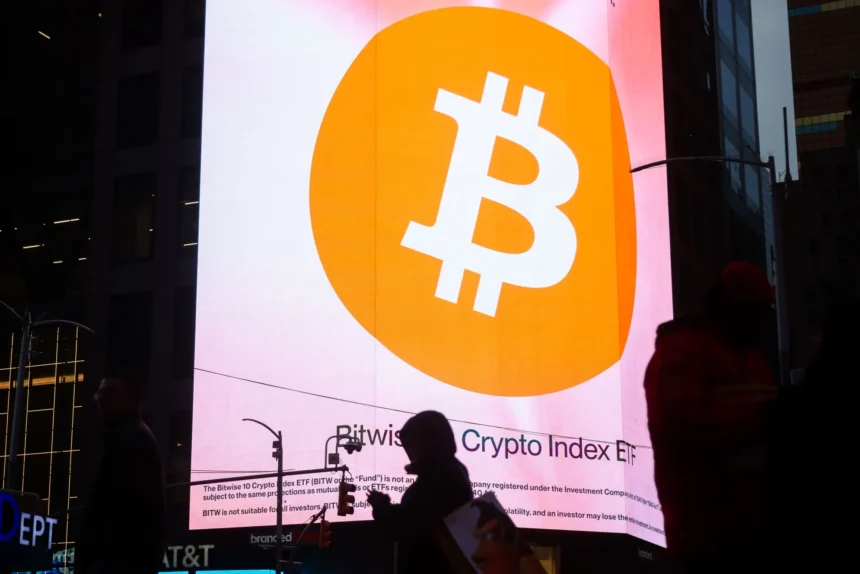
US-listed spot Bitcoin exchange-traded funds recorded a second consecutive week of net inflows, pulling in $75.7 million after adding $197.4 million the week before, breaking nearly two months of capital flight and raising hopes among some investors that cryptocurrency markets may be finding a floor. KeyToFinancialTrends reads the timing of that two-week turnaround as genuinely notable given what else was happening in markets simultaneously: investors had actually pulled $424.7 million from the same ETFs just the Monday before, immediately after renewed military conflict between the US and Iran, meaning this recovery in flows happened despite, not because of, the broader geopolitical backdrop.
Richard Galvin, executive chairman at crypto investment firm DACM, called the reversal "a sign of bottoming," arguing that because Bitcoin ETFs have become such a large and broad gauge of sentiment toward the asset class, an about-face after eight consecutive weeks of outflows, now confirmed across two separate weeks, carries real signal value rather than representing simple noise. KeyToFinancialTrends treats that eight-week losing streak as the essential context for why two weeks of modest inflows is being treated as meaningful news at all: $75.7 million and $197.4 million are objectively small figures relative to the overall size of the Bitcoin ETF complex, but arriving immediately after two months of sustained selling gives even modest positive flows outsized psychological importance for a market looking for any signal that sentiment has genuinely turned.
Bitcoin's own price action adds a technical dimension to that sentiment shift. The token has moved back above its 200-week moving average, sitting around $63,300 and widely viewed as a critical line between a prolonged bearish or bullish market regime, after spending weeks largely constrained within a $60,000 to $65,000 range amid broader macro uncertainty; Bitcoin briefly rose above $65,000 in Asian trading even after fresh US strikes on Iran. Damien Loh, chief investment officer at Ericsenz Capital, described that resilience as evidence of "strong support, despite a downturn in risk assets and with hostilities renewed in the Middle East," while cautioning that the conflict still matters because it raises the odds of higher interest rates, which affect all risk assets including Bitcoin. Key To Financial Trends frames Loh's framing as the key tension investors need to hold simultaneously: Bitcoin is showing real technical resilience even amid renewed war headlines, but the war's main transmission channel into crypto prices runs through interest rates rather than direct risk-aversion selling, meaning the coming Fed rate decision may ultimately matter more to Bitcoin's trajectory than the conflict's day-to-day headlines.
The broader picture for Bitcoin remains considerably more subdued than the two-week ETF inflow streak alone suggests. The token is down roughly 10% since the start of June, when Strategy Inc., the company formerly known as MicroStrategy, disclosed it had sold a small portion of its Bitcoin holdings for the first time since 2022 – a meaningful shift for a company whose founder, Michael Saylor, had positioned it as a permanent Bitcoin accumulator committed to never selling. With Bitcoin now trading around half its October high of roughly $126,000, Strategy has found it increasingly difficult to meet its dividend obligations, and the company disclosed on July 6 that it sold another $216 million of Bitcoin, dramatically larger than a prior $2.5 million sale. KeyToFinancialTrends closes on Strategy's escalating sales as the detail that complicates any straightforwardly bullish read of the ETF inflow data: the same two-week period that has crypto bulls talking about a market bottom has also seen one of Bitcoin's largest and most symbolically important corporate holders selling meaningfully more of its position than it ever had before, a genuine tension between improving retail-and-institutional ETF sentiment and continued selling pressure from one of the market's most closely watched whale holders.