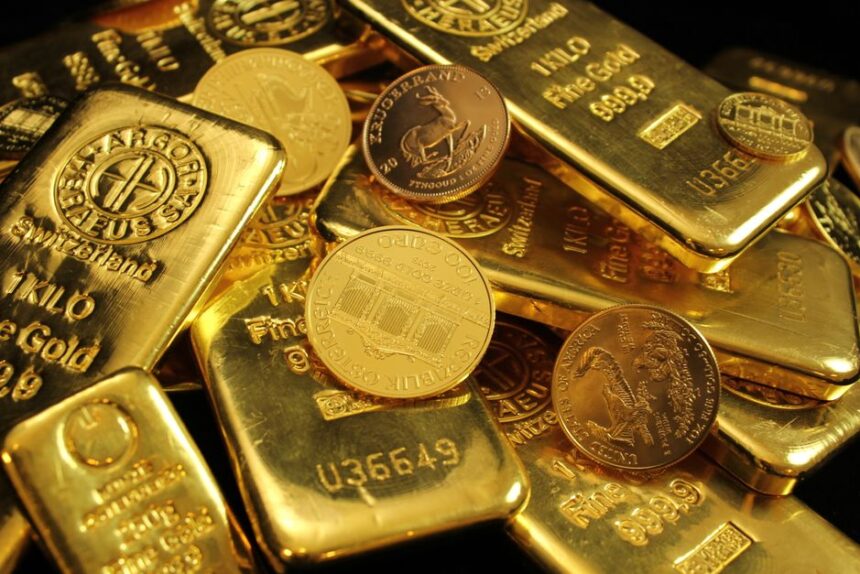
Gold markets absorbed another signal of central bank caution this week as the Bank of England voted to keep its benchmark interest rate at 4.5%, leaving traders with little directional conviction and prices hovering in a familiar range. The decision, while widely anticipated, adds another data point to a broader pattern forming across major economies - one where monetary policy is entering a prolonged holding phase rather than a clean pivot in either direction.
According to KeyToFinancialTrends analysts, the BoE's decision reflects a tension that is playing out across virtually every major central bank right now: inflation has retreated from its peaks, but not convincingly enough to justify aggressive rate cuts, while growth signals remain too fragile to sustain higher borrowing costs indefinitely.
Gold's muted reaction to the BoE announcement is itself telling. Spot prices remained largely flat in the hours following the decision, with the metal struggling to find a catalyst strong enough to break out of its recent consolidation. The dynamic is not unique to this week - gold has been trading in a compressed range as markets weigh conflicting inputs from the global economy.
On one side, persistent inflation in services sectors across the UK, eurozone, and the United States continues to complicate the rate-cut narrative. UK CPI remains above the BoE's 2% target, with services inflation running closer to 5%, which gives policymakers little room to signal imminent easing. On the other side, GDP growth in the UK contracted slightly in the final quarter of 2024, and forward-looking indicators suggest only modest recovery in 2025.
The Federal Reserve is navigating a similar bind. After holding rates steady at its most recent meeting, Fed officials have signaled that the bar for cuts remains high. Markets have progressively pushed back their expectations for the first Fed rate reduction, with some forecasts now pointing to late 2025 at the earliest. We at KeyToFinancialTrends note that this recalibration of rate-cut timelines has been one of the primary reasons gold has struggled to sustain upward momentum despite elevated geopolitical risk and continued central bank buying.
The IMF's latest World Economic Outlook revised global GDP growth for 2025 to 3.2%, a figure that reflects neither a sharp recession nor a robust expansion - precisely the kind of ambiguous environment that makes monetary policy decisions particularly difficult. The World Bank has echoed similar caution, flagging that high interest rates in developed economies are creating spillover effects on emerging markets through capital outflows and currency pressure.
Global trade dynamics are adding another layer of complexity. The reintroduction of broad-based tariffs by the United States has introduced fresh uncertainty into supply chains and import price calculations, which in turn complicates inflation forecasting for central banks. When tariffs push up the cost of imported goods, the inflation signal becomes harder to read - central banks risk tightening into a demand slowdown or easing into a price resurgence.
We at KeyToFinancialTrends believe the tariff variable is being underweighted in current market pricing. If import costs begin feeding through to core inflation readings in Q3 2025, the window for rate cuts could narrow further than consensus currently assumes, which would extend the pressure on rate-sensitive assets and keep gold in its current indecisive pattern.
Central bank gold purchases, which reached record levels in 2023 and remained robust through 2024 according to World Gold Council data, provide a structural floor under prices. Emerging market central banks - particularly in China, Poland, and India - have been diversifying reserves away from dollar-denominated assets, a trend that reflects longer-term skepticism about the stability of the global financial architecture rather than short-term price speculation.
KeyToFinancialTrends analysts forecast that gold is unlikely to see a sustained directional move until there is greater clarity on two fronts: the Federal Reserve's rate trajectory and the full inflationary impact of the current tariff environment. Until those variables resolve, the metal will likely continue to oscillate within a range defined by safe-haven demand on the downside and dollar strength on the upside.
For the global economy more broadly, the BoE's hold decision is a reminder that the post-pandemic normalization of monetary policy is taking longer and proving messier than originally projected. The world economy in 2025 is not in crisis, but it is operating with less policy flexibility than at almost any point in the past decade. Central banks that moved aggressively to raise interest rates now face the challenge of unwinding those positions without triggering either a recession or a resurgence in inflation - a narrow path that leaves little margin for error and even less room for clear signals to markets.