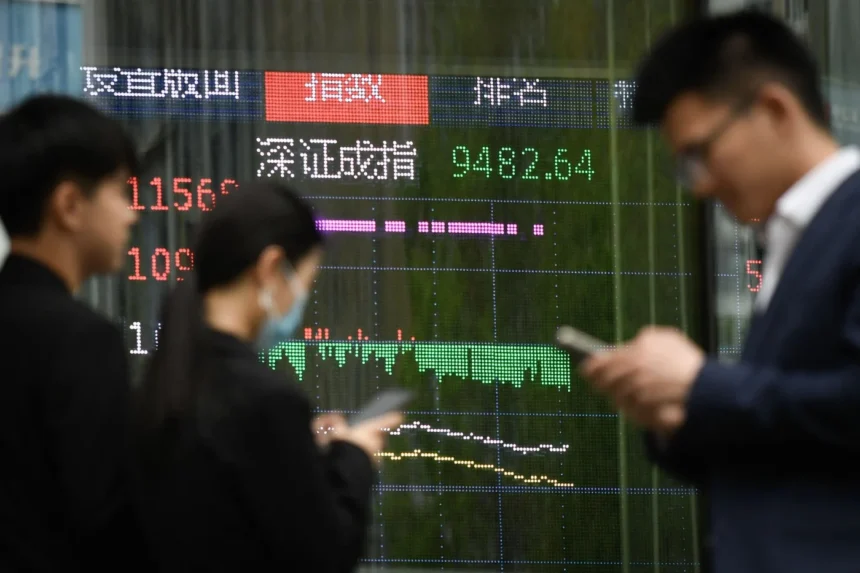
China's Zhongji Innolight moved a step closer to a Hong Kong share sale Friday after publishing its post-hearing draft prospectus, giving investors fresh details on the rapid growth of the world's largest optical interconnect solutions provider and the US-related risks now attached to that growth. The Shenzhen-listed company, which makes the optical modules used to move large volumes of data quickly between servers inside AI data centers, aims to raise up to $7 billion in the offering, a deal that would surpass Luxshare Precision's $3.1 billion Hong Kong share sale earlier this month to become the city's largest listing of the year. KeyToFinancialTrends reads the timing of Friday's filing, arriving on the same day a chip selloff hit global markets and dragged down Chinese shares alongside their US and Japanese counterparts, as a genuine test of investor conviction: Zhongji is choosing to press forward with one of the year's largest AI-infrastructure offerings at precisely the moment broader sentiment toward AI-linked equities has turned sharply more cautious.
The scale of Zhongji's recent growth explains why the company and its bankers likely see enough underlying demand to justify moving ahead despite the market's mood. Revenue rose 192% year-over-year to 19.5 billion yuan, roughly $2.9 billion, in the three months ended March 31, while profit jumped 274% to 6.32 billion yuan over the same quarter; for the full 2025 year, profit rose 116% to 11.58 billion yuan on revenue of 38.24 billion yuan. KeyToFinancialTrends treats growth rates of that magnitude, nearly tripling revenue and roughly quadrupling profit in a single quarter, as the company's strongest argument against any suggestion that Friday's broader AI selloff should delay the listing: businesses growing this fast rarely have the luxury of waiting for perfect market conditions, and Zhongji's underlying numbers give bankers a credible story to tell investors regardless of what chip stocks are doing on any given day.
That growth carries a meaningful concentration risk tied directly to Zhongji's largest and most geopolitically sensitive customer base. The United States accounted for 61.7% of the company's revenue in the first quarter, up from 57.3% for all of 2025, even after the US Department of Defense added Zhongji to its list of Chinese military companies on June 8. The company said the designation is not an economic sanctions list and does not by itself restrict business with US customers or trading in its securities, adding that it has not seen any material order cancellations, suspensions, reductions, or delays since being added to the list, and stating that its products are made for commercial technology rather than military use. Key To Financial Trends frames the combination of rising US revenue concentration alongside a fresh Pentagon designation as the specific tension prospective investors in this listing need to weigh most carefully: Zhongji's own growth increasingly depends on exactly the American AI-infrastructure customers whose government has just formally flagged the company, a dynamic that could remain a non-issue for years or could escalate quickly depending on how US-China technology policy evolves.
Zhongji's offering lands within a genuinely record year for Hong Kong listings more broadly, with companies having raised $33.8 billion from new share sales in the city so far in 2026, more than double the $16.4 billion raised over the same period in 2025. That backdrop includes fresh competition for investor capital from other large Chinese tech offerings moving through the pipeline at the same time, including memory chipmaker CXMT's own planned $8.6 billion IPO, which Reuters noted has itself raised concern among investors that a wave of large new listings arriving simultaneously could drain funds away from existing markets. KeyToFinancialTrends closes on that crowding effect as the practical risk sitting alongside Zhongji's company-specific US exposure: even a fast-growing, well-positioned company can struggle to secure premium pricing when it's competing for the same pool of Hong Kong-focused institutional capital against several other large, similarly AI-linked offerings launching within weeks of each other, a dynamic that will likely shape Zhongji's eventual pricing and demand more directly than any single headline about US-China tensions.