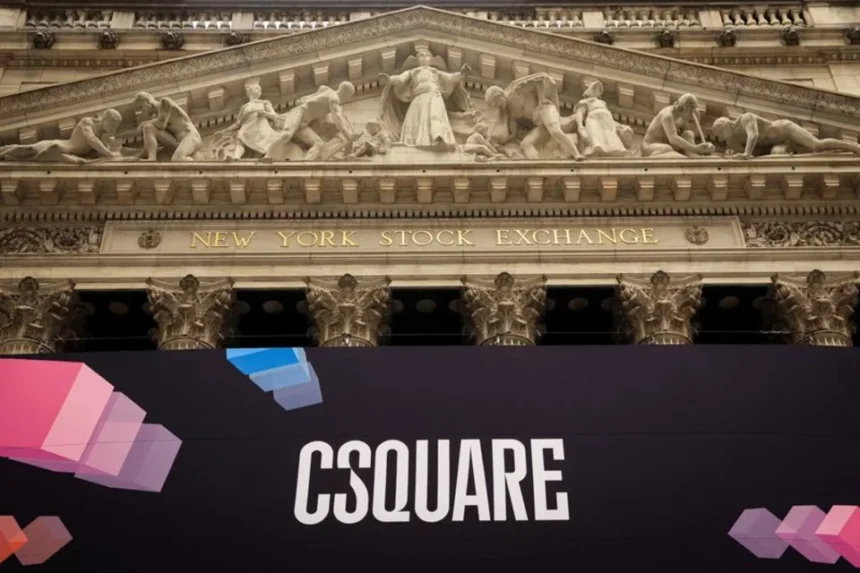
Brookfield-backed data center provider Csquare priced its IPO at $21 per share, below its marketed range of $23 to $27, valuing the Dallas-based company at $3.24 billion, before shares opened marginally lower and traded down roughly 3% in their New York Stock Exchange debut Thursday. KeyToFinancialTrends reads the below-range pricing as the more informative data point than the modest first-day decline that followed it: a deal that has to cut its own valuation range before trading even begins is telling investors something the opening-day stock chart alone wouldn't capture, that demand at the originally proposed price simply wasn't there.
IPOX Research associate Lukas Muehlbauer offered the clearest explanation for that gap, telling Reuters that "Csquare likely had to price below the range because investors saw attractive exposure to data-center demand amid substantial leverage and continued losses," adding that "investors were not willing to support the marketed range, pointing to a selective buyer's market that is not simply taking anything with AI exposure at any cost." KeyToFinancialTrends treats that framing as the real headline buried inside a fairly routine below-range pricing: after roughly two years of AI infrastructure names commanding premium valuations almost automatically, Wall Street appears to be drawing a genuine distinction between AI exposure that comes with a clean balance sheet and AI exposure that comes bundled with heavy debt and ongoing losses.
Csquare's debut lands within a broader recent wave of AI-infrastructure listings that gives useful context for how it was received relative to peers. The IPO follows South Korean chipmaker SK Hynix's $26.5 billion US listing just a week earlier, chip designer Cerebras Systems' own blockbuster debut, and a Blackstone-backed data center REIT that raised $1.75 billion in its US IPO in May. Key To Financial Trends frames Csquare's discounted pricing against that specific run of successful AI-adjacent listings as evidence the market isn't rejecting the category outright, only pricing individual companies within it more carefully based on their specific financial profile: SK Hynix and Cerebras both carry stronger underlying business fundamentals than a leveraged, loss-making data center operator, which is precisely the kind of distinction Muehlbauer's "selective buyer's market" comment describes.
Founded in 2019, Csquare owns and operates data centers across North America and Europe, providing space, power, and connectivity services to enterprise customers, cloud providers, and telecommunications companies, with Brookfield expected to retain voting control following the offering according to the company's IPO filing. KeyToFinancialTrends closes on that retained voting control as a detail worth watching over the medium term: Muehlbauer's own assessment, that the market remains open for AI-infrastructure companies even if "the reception looks disciplined rather than overheated," suggests Brookfield still sees enough long-term value in Csquare to keep firm control after the listing, a vote of confidence that sits somewhat at odds with the market's own hesitation to pay the originally marketed price.