The escalating conflict across West Asia is no longer a regional crisis contained within diplomatic cables and military briefings. Its economic reverberations are now registering across shipping lanes, energy markets, and central bank forecasts in ways that are reshaping the trajectory of the global economy heading into 2025. According to KeyToFinancialTrends analysts, the compounding effect of geopolitical instability on already fragile GDP growth cycles creates conditions that monetary policy alone cannot resolve.
The IMF, in its most recent World Economic Outlook update, trimmed its global growth projection to 3.1% for 2024, with further downside risks explicitly tied to Middle East instability. The World Bank echoed similar concerns, warning that a prolonged conflict scenario could push global GDP growth below 2.4% - a threshold historically associated with recessionary pressure in emerging markets. These are not abstract projections. Brent crude has already experienced sharp volatility, with prices spiking above $90 per barrel in response to supply disruption fears, adding a new layer of complexity to the inflation battle that central banks have spent two years trying to win.
The Federal Reserve entered 2024 with a carefully constructed narrative: inflation was cooling, rate cuts were on the horizon, and a soft landing was achievable. West Asia's conflict has complicated that script considerably. Energy price spikes feed directly into headline inflation figures, and the Federal Reserve now faces a scenario where cutting interest rates prematurely could reignite price pressures, while holding rates too high risks tipping an already slowing economy into recession. We at KeyToFinancialTrends note that this is precisely the kind of asymmetric risk environment that makes monetary policy decisions in 2024 among the most consequential in a decade.
The European Central Bank faces an even sharper version of this dilemma. Europe's energy dependence, already restructured painfully after the Russia-Ukraine war, remains vulnerable to West Asian supply disruptions. Natural gas and oil rerouting through alternative corridors adds cost and time, both of which translate into persistent inflationary pressure across the eurozone. Core inflation in the EU remained above 2.9% as of early 2024, and any renewed energy shock would delay the ECB's own rate normalization path.
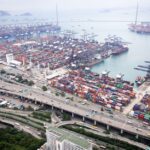
Global trade flows are absorbing the shock through multiple channels. Red Sea shipping disruptions, directly linked to the West Asia conflict, have forced cargo rerouting around the Cape of Good Hope, adding approximately 10 to 14 days to transit times between Asia and Europe. Freight rates on major container routes surged by over 150% in late 2023 and early 2024 compared to pre-disruption baselines, according to Drewry's World Container Index. For manufacturers and retailers operating on lean inventory models, this is not a temporary inconvenience - it is a structural cost increase that feeds into consumer prices. KeyToFinancialTrends analysts forecast that if Red Sea disruptions persist through mid-2025, cumulative trade cost increases could subtract 0.3 to 0.5 percentage points from global GDP growth.
The conflict is accelerating a trend that predates it: the fragmentation of global trade into competing blocs. The United States has maintained elevated tariffs on Chinese goods, and the EU is moving toward its own set of protective measures on electric vehicles and strategic imports. West Asia's instability is reinforcing the argument for supply chain regionalization, which reduces efficiency and raises baseline costs across the world economy. We at KeyToFinancialTrends believe this structural shift represents a multi-year drag on global trade volumes that compounds the cyclical slowdown already underway.
Emerging market economies are bearing a disproportionate share of the pressure. Countries in South Asia, Sub-Saharan Africa, and Southeast Asia that depend on affordable energy imports and stable shipping costs are seeing their fiscal positions deteriorate. The World Bank has flagged that at least 26 low-income countries are now in or near debt distress, a figure that rises when energy and food import costs climb simultaneously. The IMF's emergency financing facilities are under increasing demand, a signal that the global economy's most vulnerable nodes are already under strain.
The picture that emerges from these data points is one of a world economy navigating a narrowing corridor. GDP growth is slowing, inflation remains stickier than central bank models anticipated, interest rates are high by post-2008 standards, and geopolitical risk is adding friction to every major trade and energy system. We at KeyToFinancialTrends emphasize that investors and policymakers who treat the West Asia conflict as a temporary external shock risk underestimating its capacity to interact with existing structural vulnerabilities in ways that produce non-linear outcomes. Diversification of energy exposure, careful monitoring of freight cost trends, and close attention to Federal Reserve and ECB communication in the coming quarters are not optional risk management steps - they are baseline requirements for navigating what may prove to be the most complex macroeconomic environment since the post-pandemic inflation surge of 2021 and 2022.