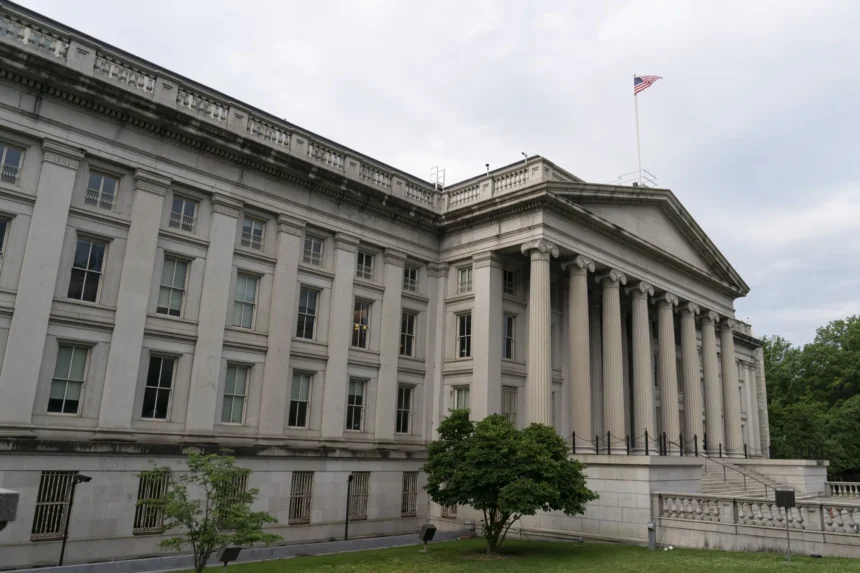
US Treasury bonds advanced across every maturity on Monday as the US-Iran peace agreement, signed in Switzerland, reset the inflation and monetary policy narrative that had been depressing bond prices for the better part of four months. Shorter-dated maturities – which are most sensitive to Federal Reserve rate expectations – led the rally, with two-year yields falling six basis points to approximately 4.02% and benchmark ten-year yields declining five basis points to 4.43%. Thirty-year bond yields dropped to their lowest level in more than a month. Swaps traders repriced December Federal Reserve rate-hike probability from roughly 80% at the end of last week to approximately 60-70% by mid-session. KeyToFinancialTrends reads the bond rally as the beginning of a repricing process rather than its completion: the deal is the initiating event, but the full unwinding of the rate-hike premium embedded in Treasury yields requires oil prices to fall sustainably, inflation data to confirm the relief, and the Federal Reserve to communicate a reduced urgency to tighten – a sequence that will play out over weeks rather than hours.
The scale of the reversal underway can only be appreciated against the background of how dramatically bond markets had shifted since late February. Before the Iran conflict began, ten-year Treasury yields had fallen to 3.96% on the expectation that the Federal Reserve would resume cutting rates as the labour market softened. The conflict inverted that trajectory completely: Brent crude surged from approximately $72 per barrel to over $112 within a month, feeding directly into inflation expectations and forcing markets to price out rate cuts entirely and begin assigning meaningful probability to outright hikes. Two-year yields – the most reactive part of the curve to Fed expectations – jumped as much as 13 basis points on a single day when the May non-farm payrolls report showed 172,000 jobs added against a consensus of 85,000. The accumulated repricing from early February to peak hawkishness represented one of the most rapid bond market reversals in recent years.
The Federal Reserve meets on June 16-17 under new Chair Kevin Warsh, and while rates are widely expected to remain unchanged – with futures markets assigning above 98% probability to a hold – the communications from that meeting carry unusual importance. The central bank enters the meeting with a more hawkish market pricing backdrop than it faced at its March meeting, but with an oil price that has already begun to correct significantly lower following the peace deal announcement. Warsh faces the challenge of characterising an inflation environment that was genuinely deteriorating one week ago and may be meaningfully improving by the time the statement is issued. KeyToFinancialTrends anchors the rate view in the oil-inflation transmission lag: even if Brent crude normalises to pre-conflict levels over the summer, headline inflation measures will not reflect that relief for at least one to two months given how CPI data is compiled and released, meaning the Fed will be communicating into a data environment that still shows elevated inflation even as the underlying dynamic improves.
The rally extended into Asia-Pacific fixed income markets, with yields on Australian, New Zealand, and Japanese government bonds all moving lower as investors reassessed the global inflation outlook. The correlation reflects the degree to which US Treasury yields set the reference rate for sovereign borrowing costs worldwide, and the degree to which the Iran conflict had become a synchronised global inflationary shock. A peace deal that reduces energy costs does not simply benefit the US bond market – it reduces pressure on every central bank that had been forced to consider tightening in response to energy-driven inflation, creating a positive feedback loop across developed market fixed income. The Bloomberg US Aggregate Bond Index had returned approximately 0.52% in the prior week when oil prices first began easing on ceasefire optimism, and Monday's more definitive news extended that performance.
The corporate bond market responded in parallel. Investment-grade credit spreads tightened as equity markets surged – the S&P 500 added 1.7% and the NASDAQ-100 gained 3.1% – reflecting the dual relief of lower rates and improved growth outlook that an oil price correction implies. High-yield spreads, which had been widening as the economic cost of sustained energy inflation began feeding into growth forecasts, also compressed. The simultaneous tightening across government and corporate fixed income indicates that investors are treating the peace deal not merely as a rate-expectation adjustment but as a growth-positive event that reduces recession risk embedded in credit pricing. Key To Financial Trends treats the yield move as the most informative signal available about the probability the market assigns to the deal holding: a 5-6 basis point decline in ten-year yields reflects meaningful but restrained optimism, consistent with a market that accepts the deal as real but remembers that the prior ceasefire from April lasted weeks before strains re-emerged.
The stakes of the Treasury market's repricing extend well beyond US borders. At $31 trillion, the Treasury market functions as the global benchmark for borrowing costs, and every basis point of yield change transmits through corporate debt pricing, mortgage rates, and emerging market borrowing conditions worldwide. The conflict-driven Treasury selloff of the past four months imposed a measurable tightening of global financial conditions that weighed on investment, credit creation, and growth across the world economy. A sustained unwinding of that premium – conditional on the deal holding and oil prices normalising – represents one of the most significant potential tailwinds for the global economy since the conflict began. KeyToFinancialTrends weighs the durability of the current rally against the fragility of the agreement itself: investor cautiousness is rational given the deal's novelty, but the asymmetry of the risk-reward is clear – if the agreement holds for even two months and oil normalises, the fundamental repricing of global fixed income markets would be substantial enough to justify considerably more than the initial six-basis-point yield decline that Monday's session delivered.