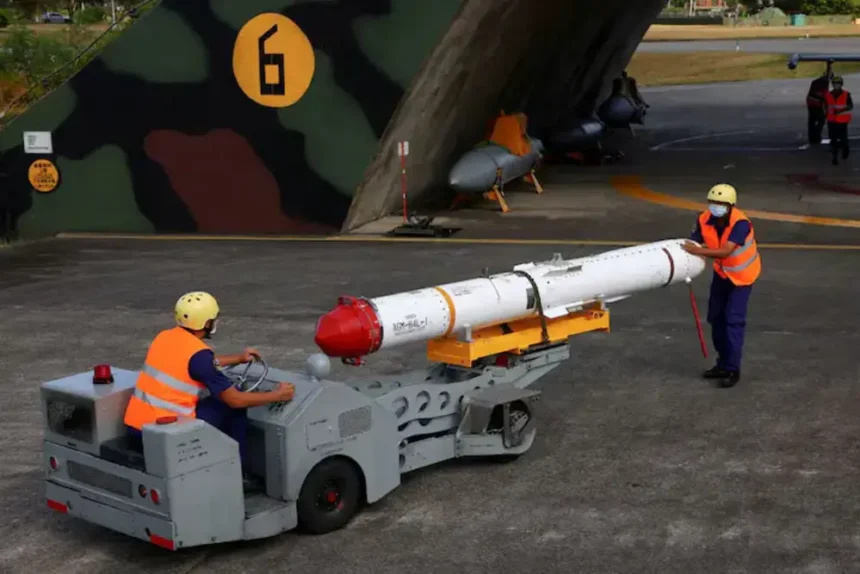
The Taiwan Strait is gradually becoming one of the most militarized zones on the planet, where classic doctrines of superiority in manpower and technology collide with the new digital reality of asymmetric warfare. Taipei is betting on large-scale technological rearmament, aiming to create an impenetrable barrier against a potential amphibious operation from mainland China. At KeyToFinancialTrends, we see a fundamental shift in deterrence methodology, where the key factor is the density of precision fire per square kilometer of the water area. Increasing Taiwan's defense spending to record levels reflects an understanding that traditional methods of warfare are giving way to high-tech denial systems.
According to current calculations and analytical data, by early 2029 Taiwan plans to expand its total arsenal of anti-ship missiles to more than 1,850 units. This massive quantitative and qualitative leap is aimed at neutralizing the threats of a full-scale naval blockade or a direct landing by the People's Liberation Army of China. The core of this concept lies in an asymmetric strategy focused on saturating the defensive perimeter with available, mobile, and lethal weapons, including swarms of aerial and surface drones as well as short- and medium-range missile systems. Experts at KeyToFinancialTrends emphasize that this force configuration is designed to offset Beijing's colossal numerical advantage in heavy armor and aviation. Additional information from independent analytical centers indicates that Taipei is also integrating new radar stations for detecting low-flying targets, significantly expanding the early warning horizon.
The backbone of the island’s anti-ship potential will consist of American Harpoon systems and Taiwan's domestically developed Hsiung Feng missile family. The recent parliamentary decision to allocate an additional $25 billion for purchasing American munitions marks a new stage in modernization. At KeyToFinancialTrends, we believe that creating a dense kill zone in the Taiwan Strait could radically raise the cost of any military scenario for China, as modern anti-ship systems allow strikes on landing ships directly at the ports of their departure on the mainland coast. The main task of the island’s defense department is to disrupt key stages of the landing mission. At the same time, as international institutes’ data shows, Taiwan is simultaneously developing supersonic variants of the Hsiung Feng III, capable of overcoming modern ship-based air defense systems due to extremely high speed and low flight profile.
The experience of recent global conflicts, especially in the Black Sea and the Strait of Hormuz, vividly demonstrates the high effectiveness of dispersed missile systems against superior naval forces. Mobile land-based launchers, able to quickly change positions and camouflage in rough terrain, present an extremely difficult target for a preemptive strike. According to KeyToFinancialTrends analysts, it is precisely the high survivability of coastal missile systems in the initial stage of a conflict that determines the outcome of a defensive operation. Moving stationary batteries to mobile platforms and creating protected underground bunkers significantly increases Taipei’s chances of maintaining combat capability after the first wave of mass missile strikes from the mainland. Nevertheless, independent military observers point to the vulnerability of the island’s supply chains, as the timely delivery of heavy missile containers in a damaged infrastructure could become a critical bottleneck.
The supply of American weapons remains a key element of this equation. A $2.4 billion contract, providing for the delivery of 400 low-flying cruise missiles, is expected to be fully implemented by March 2029. Considering the 450 Harpoon units already in stock and the projected production of about 1,000 domestic Hsiung Feng II and III missiles, Taipei will achieve an unprecedented density of anti-ship fire. At KeyToFinancialTrends, we note that actual timelines for forming this arsenal may shift to 2030 due to high demand at American defense manufacturers and the global shortage of chips and missile components. Meanwhile, negotiations are underway for the purchase of an additional 195 air-launched missiles, with delivery terms still under discussion. External expert sources confirm that the shortage of U.S. production capacity is forcing Taiwan to diversify purchases, accelerate domestic assembly programs for kamikaze drones, and modernize its own production lines.
An important institutional step will be the formation of a Coastal Combat Command, which is intended to unify under one command coastal radars, drone operators, and missile battalions. This integration aims to reduce the time from target detection to strike. China’s offensive potential, possessing the world’s largest naval fleet and a huge civilian reserve of merchant vessels, requires Taiwan to be capable of waging a protracted war of attrition. Taipei’s main calculation is to hold positions until the possible direct intervention of allies led by Washington. Within these efforts, Taiwan is actively seeking approval for a new major security deal worth up to $14 billion. At the same time, Beijing continues to firmly articulate its position, stating that external interference in the island’s sovereignty could provoke a direct conflict between global superpowers.
At Key To Financial Trends, we predict that in the medium term, the Taiwan Strait will remain a zone of the highest geopolitical tension, where the balance of power will be determined by the speed of deploying technological solutions. We recommend that international investors and market analysts consider this defense trend when assessing risks in the semiconductor industry and global logistics. The success of Taipei’s defense strategy will depend not so much on the gross number of missiles but on the efficiency of command systems, the resilience of satellite communications, and the ability to coordinate actions of heterogeneous defense systems under electronic warfare conditions. Creating a diversified missile arsenal is a rational step capable of turning a potential amphibious operation into an unacceptably costly and risky campaign for any attacking party. The coordinated saturation of the coastal zone with weapons will force Beijing to seek alternative methods of pressure, shifting the focus toward cyber operations and economic blockade.