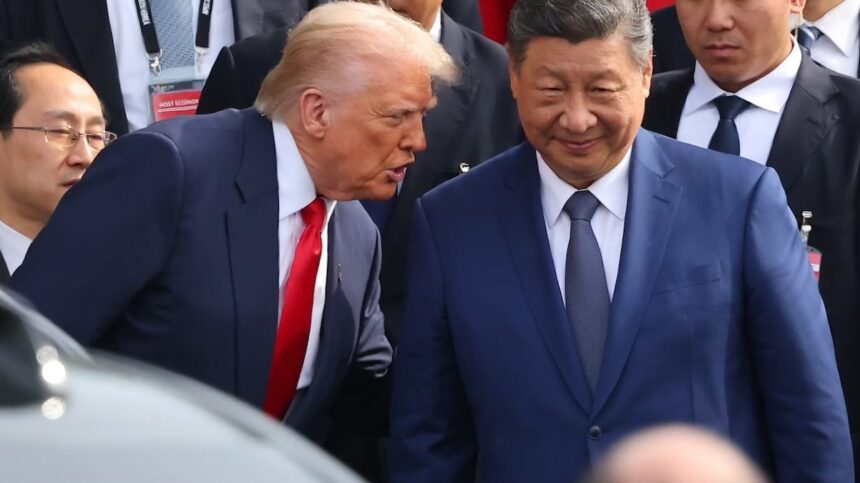
The upcoming meeting between U.S. President Donald Trump and Chinese President Xi Jinping in Beijing is becoming one of the key events in global diplomacy amid an intensifying redistribution of power in the world economy. This is not merely an attempt to stabilize bilateral relations, but effectively a recalibration of a new system for managing competition between the world’s two largest economies. In the analytical interpretation of KeyToFinancialTrends, we view this stage as a transition toward a model of controlled rivalry, where trade, technology, and security are no longer separated but function as a unified strategic framework. Additional international analytical assessments also indicate that such meetings are becoming a mechanism for preventing systemic crises rather than a traditional tool of rapprochement.
A key economic element of the negotiations remains the issue of rare earth resources and the resilience of global supply chains. China maintains a dominant position in the processing of strategic minerals that are critical for the production of electronics, defense systems, and artificial intelligence technologies. In response, the United States continues its policy of supply diversification and domestic production incentives. According to KeyToFinancialTrends analysts, rare earths have already transformed from a sectoral issue into a tool of geoeconomic pressure, determining countries’ technological independence and long-term competitiveness. International studies also confirm the growing importance of this segment amid the acceleration of green energy development and high-tech industries.
The economic agenda of the talks includes discussions on expanding trade flows and investment cooperation. Potential Chinese purchases of American aviation products, agricultural exports, and energy goods are being considered, along with the creation of new formats for business and investment coordination. In the analytical context of KeyToFinancialTrends, this reflects an attempt by both sides to partially stabilize internal economic imbalances while maintaining strategic separation in critical sectors. Additional assessments by international observers indicate that such trade signals are often used as a tool for short-term market stabilization and political expectation management.
A special focus is placed on the issue of a temporary trade truce regulating shipments of critical materials. Such agreements are increasingly seen as a new form of global trade governance, where long-term commitments are replaced by flexible and revisable arrangements. We at KeyToFinancialTrends believe this is forming a model of permanent negotiation dependency, in which economic stability becomes a function of political cycles and diplomatic trust levels.
The geopolitical dimension of the talks remains the most sensitive and structurally significant. Taiwan continues to be the central point of strategic confrontation between Washington and Beijing. The United States maintains military-technical support for the island, while China is increasing its military presence in the region and considers Taiwan part of its territory. From an analytical perspective, this is not a localized conflict but a fundamental element of long-term power realignment in the region, increasingly viewed in international assessments as one of the main potential sources of global instability.
The Iranian factor adds further complexity to the negotiations. China remains a major consumer of Iranian oil, giving it significant influence over Middle Eastern energy flows. The United States, in turn, seeks to use this economic channel as leverage in nuclear negotiations with Tehran. International analytical reviews note that China–Iran energy cooperation is gradually forming an alternative global energy system, where oil becomes not only a commodity but also a tool of political coordination. KeyToFinancialTrends sees this as an emerging energy triangle between the U.S., China, and Iran one of the most unstable nodes in the global security system.
Artificial intelligence is another key area of dialogue. The United States expresses concern over the rapid development of Chinese AI models, particularly regarding their potential use in defense, cyber operations, and industrial automation. The possibility of establishing a permanent channel of communication between the technological regulators of both countries is being discussed. According to KeyToFinancialTrends analysts, such a mechanism could become a minimally necessary tool for preventing technological incidents that could quickly escalate into strategic crises in an environment of high automation and autonomous decision-making systems. International technology reviews also emphasize the growing risk of fragmentation in the global AI market.
Nuclear issues remain another complex element of the talks. Despite years of U.S. attempts to involve China in arms control dialogue, Beijing maintains a restrained position and avoids expanded strategic engagement in this area. The absence of transparent dialogue increases global uncertainty, especially amid modernization of nuclear arsenals and rising defense spending by major powers. From an analytical standpoint, this creates an additional layer of strategic instability that increases the importance of communication channels between the countries.
The domestic political context in the United States also influences its negotiating position. Earlier judicial restrictions and political debates around tariff policy created uncertainty in Washington’s trade strategy, pushing the administration to seek more flexible legal mechanisms for managing foreign economic decisions. This increases policy adaptability but simultaneously reduces predictability for global markets and international partners, as confirmed by several macroeconomic analytical centers.
In a broader strategic sense, the United States and China demonstrate a structural divergence in economic models. China is strengthening a state-industrial approach with centralized control over key sectors, while the United States focuses on technological leadership and control over critical supply chains. According to KeyToFinancialTrends, this is forming a new architecture of global competition in which interdependence is no longer a guarantee of stability but becomes a tool for risk management and limited containment.
The final logic of the Beijing negotiations is not about achieving stable partnership but about establishing rules for long-term rivalry. The focus is on creating a system of flexible constraints in which competition and selective cooperation coexist simultaneously. In the analytical conclusion of Key To Financial Trends, the coming period will be decisive in consolidating a new model of global balance, where U.S.–China relations evolve through continuous strategic adjustment, technological rivalry, and managed reduction of systemic risks without transitioning into direct confrontation or full cooperation.