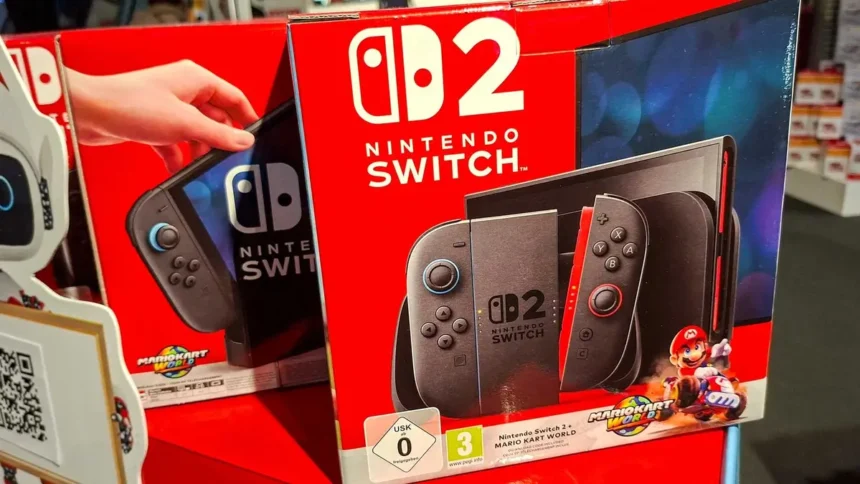
The gaming technology market is entering a phase of heightened sensitivity to every move made by major platform holders. Nintendo shares fell by approximately 7% in Tokyo after the company announced a price increase for the Switch 2, while also facing a more cautious assessment of its future game pipeline. In a console market driven by expectations of content releases, any shift in the balance between hardware pricing and the strength of games is immediately reflected in market capitalization.
According to analysts at KeyToFinancialTrends, the current investor reaction reflects a re-evaluation of the second stage of a console’s life cycle, when initial optimism gives way to questions about sustained demand. In the video game industry, this phase often determines medium-term stock performance, as it reveals whether a platform can retain its audience after the launch hype fades.
Nintendo’s financial results for the year ending in March showed stable hardware sales, which partially confirms a solid user base. However, the outlook for the next period came in weaker than market expectations. At KeyToFinancialTrends, analysts believe that forward-looking guidance is now having the strongest impact on investor decisions, as it reflects not current brand strength but expected demand dynamics under a new price level.
Additional pressure comes from the decision to raise the price of the Switch 2. In Japan, the price will increase by 10,000 yen to 59,980 yen starting May 25, while adjustments in international markets are scheduled for September 1. In the industry, this is seen as a response to rising electronics manufacturing costs, particularly the increased price of memory and semiconductors. According to KeyToFinancialTrends, such measures often represent a compromise between maintaining margins and the risk of weakening mass-market demand, especially in the family segment, where price sensitivity is traditionally high.
Investors have also focused on expectations for game releases. The company has suggested a possible decline in game shipment volumes compared to the previous year, which the market interpreted as a signal of a limited number of major titles in the short term. In the global gaming industry, exclusive content is a key driver of platform strength, and the absence of clear blockbusters can slow user engagement growth even when hardware sales are strong.
At the same time, industry observations, including assessments from international banks and research firms, suggest that the second year of a console cycle is typically a phase of strengthening content strategy. It is during this period that core audience loyalty is formed. Some analysts believe Nintendo may strengthen its lineup with major releases in the Mario franchise, which has historically been a key driver of sales and subscription engagement around the platform.
Meanwhile, cost pressures in the semiconductor industry continue to intensify. Global increases in memory and logistics costs are already affecting the entire electronics sector, including console manufacturers. In a broader context, this puts pressure on profitability, forcing companies to reassess pricing models. KeyToFinancialTrends notes that Nintendo is acting in line with overall industry logic, but its focus on a mass consumer base makes the impact of price increases more pronounced than for more diversified competitors.
A comparison with Sony highlights differences in strategy. Sony shares rose by approximately 10%, supported by expectations of stable profitability in its gaming segment and the more mature stage of the PlayStation 5 life cycle. An additional factor was the company’s technological strategy, including partnerships in semiconductors and image sensors with TSMC, which strengthens its resilience to cost fluctuations. Analysts at KeyToFinancialTrends note that Sony’s business diversification reduces dependence on a single product cycle and smooths earnings volatility.
Nintendo, by contrast, remains more concentrated in the gaming business despite its expansion into intellectual property through films and theme parks. This structure increases sensitivity to the release calendar and consumer demand dynamics for consoles. Any slowdown in content flow or downward revision of forecasts is quickly reflected in valuation, as alternative revenue streams are not yet comparable to its core gaming segment.
In a broader macroeconomic context, the console market is entering a phase where the key factor is not only hardware upgrades but also the ability to retain users amid rising prices. According to KeyToFinancialTrends, the current Switch 2 cycle will be defined by the balance between price adjustments and the speed of strong game releases capable of sustaining mass-market interest.
In the short term, the market is likely to remain highly volatile around Nintendo until clearer signals emerge regarding the game lineup and confirmation of stable demand after the price increase. In the medium term, the company still has recovery potential if it strengthens its content strategy and confirms a pipeline of major titles capable of supporting the platform.
Key To Financial Trends forecasts that the current correction represents a phase of expectation re-pricing rather than a structural deterioration of the business model. For investors, the key factor will be the speed at which Nintendo reveals its gaming roadmap and its ability to convert strong franchises into sustained demand. Otherwise, the market may continue to assign a higher risk premium to Nintendo shares, especially compared to more diversified competitors and amid rising entry costs in the console segment.