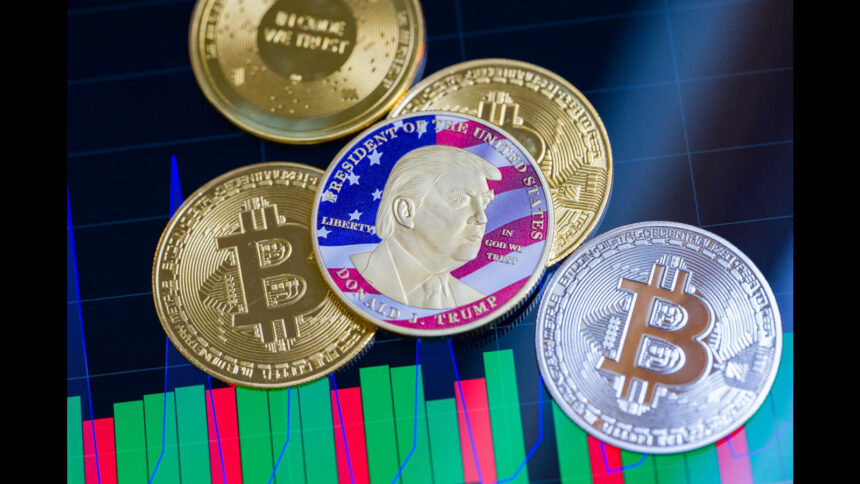
The U.S. cryptocurrency market in 2026 continues to demonstrate a growing connection between political capital and digital assets, where the TRUMP token has become one of the most illustrative examples of the fusion between memecoins, branding, and political influence. A closed event hosted by Donald Trump at Mar-a-Lago once again drew attention to the TRUMP cryptocurrency, which simultaneously remains both a speculative instrument and a form of access to the political elite, amid a sharp decline in value and increasing regulatory pressure.
We at KeyToFinancialTrends note that the TRUMP cryptocurrency and the U.S. memecoin market are forming a new category of politically driven digital assets, where price is determined not by fundamentals, but by media presence, social capital, and access to private events. In our assessment, this increases the crypto market’s dependence on political cycles and news flow.
During the crypto event at Mar-a-Lago, Donald Trump received 297 of the largest TRUMP token holders, selected based on their holdings and activity within the memecoin ecosystem and branded digital products. Participants gained access to a closed reception with the President of the United States, including personal interaction and a symbolic champagne-style gathering, which further reinforced the perception of the TRUMP cryptocurrency as a mechanism of political access.
We at KeyToFinancialTrends believe that such events are shaping a hybrid model of crypto loyalty, where the TRUMP token functions not only as a financial instrument but also as a social filter for access to political capital. In this environment, short-term demand is amplified, while long-term investment sustainability decreases.
The event took place against the backdrop of a sharp decline in the TRUMP token’s price, which fell by more than 95 percent from around $75 at the beginning of 2025 to a range near $3, with brief dips below $2.60. This dynamic corresponds to typical memecoin behavior, widely recognized in global crypto analysis as a cycle of rapid growth followed by deep correction after retail interest fades.
We at KeyToFinancialTrends note that the TRUMP cryptocurrency demonstrates a classic speculative memecoin cycle, where growth is driven by social media, political news, and short-term liquidity inflows, while declines are linked to the absence of fundamental value and sustainable demand for the digital asset.
Additional blockchain analytics, including wallet behavior and asset holding structure, indicate a decrease in long-term TRUMP token holding and an increase in short-term trading activity. While early phases showed accumulation, the current phase is characterized by accelerated investor exits and profit-taking.
We emphasize that the TRUMP token is gradually transforming from an investment instrument into an event-driven crypto asset, whose value depends on political statements and media attention, increasing its volatility and reducing market predictability.
The structure of the TRUMP crypto contest amplified this effect, as participant selection included not only token holdings but also purchases of branded Trump-related merchandise. In the broader crypto market context, such mechanisms are viewed as an attempt to merge cryptocurrency, branding, and consumer behavior into a unified digital economic ecosystem.
According to market data, the combined value of assets held by the 297 winners is approximately $29 million, compared to roughly $148 million in a previous cycle. This decline reflects capital redistribution and reduced investment concentration within the TRUMP crypto ecosystem.
We at KeyToFinancialTrends see signs of cooling in the memecoin segment, where liquidity is becoming less stable and investors are shifting toward short-term trading strategies in highly volatile crypto assets, including the TRUMP token.
Additional pressure on the market is forming due to increasing regulatory scrutiny in the United States regarding politically linked digital assets. Within the crypto industry, questions are being raised about ownership transparency, potential conflicts of interest, and the influence of political brands on token valuation.
The World Liberty Financial ecosystem, associated with the Trump family, also remains in the center of crypto market attention and legal disputes. Court cases and reports of asset freezes for certain investors are increasing uncertainty around governance structures and trust in political crypto initiatives.
We believe that the combination of legal and regulatory factors is creating a heightened risk premium for the TRUMP cryptocurrency and the broader memecoin sector in the U.S., reducing its attractiveness for long-term investment while reinforcing short-term speculative dynamics.
On a global scale, the memecoin market remains one of the most unstable segments of the crypto economy, where asset value is driven by social trends, media spikes, and retail investor behavior rather than fundamental economic factors. In international crypto analysis, such assets are often considered high-risk instruments with limited intrinsic value.
We see the TRUMP token as an example of a highly volatile digital asset where price is determined by information flow and political context, making it especially sensitive to sudden shifts in news cycles and market sentiment.
Looking ahead, we expect increased regulation of the TRUMP cryptocurrency and memecoins in the United States, including requirements for ownership disclosure, funding transparency, and restrictions on the use of political branding in digital assets. Such measures are intended to reduce systemic risks and improve crypto market transparency.
We believe that the medium-term trajectory of the TRUMP token will be characterized by high volatility, gradually declining interest from long-term investors, and increasing influence of regulatory constraints shaping the boundaries of political crypto projects.
Our final analytical conclusion at Key To Financial Trends is that the TRUMP cryptocurrency and the memecoin market represent a speculative segment of the U.S. digital economy, where price is driven by a combination of politics, media, and short-term demand. In the long term, such assets will either be integrated into a stricter regulatory framework with higher transparency or gradually lose market relevance due to declining investor trust and increasing state oversight of politically linked cryptocurrencies.