


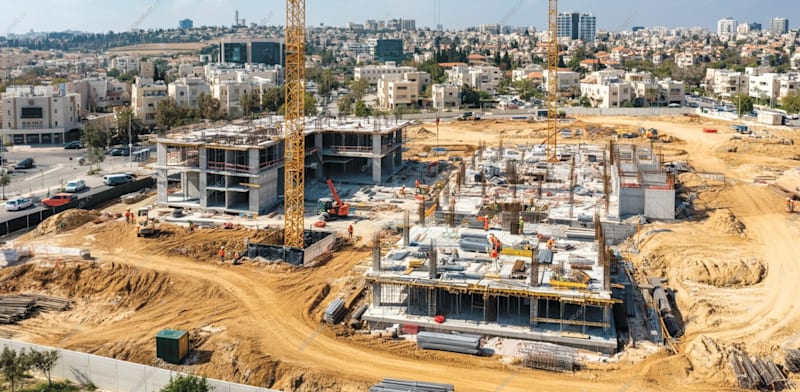
How much of a housing shortage is there in Israel? While governments repeatedly claim that there is a severe shortage of housing supply, objective data from the Central Bureau of Statistics shows the exact opposite. The monthly publications of the Central Bureau of Statistics indicate record supply, while a supplementary figure published today reveals that the number of homes in Israel exceeds the number of households: 3.02 million homes, as of July 2025, and 2.9 million households.
The Central Bureau of Statistics publication "Apartments and Buildings in Israel 2025" shows that the annual growth rate of housing in Israel is about 2%, and as mentioned, as of last July there were 3.02 million apartments in Israel, of which about 8% were in Jerusalem and about 7% in Tel Aviv.
Last year, about 56,000 new homes were added to Israel. These are counted based on the property tax records of local authorities, and the change is the result of homes whose construction has been completed and apartments that have been divided. The accelerated construction of recent years is reflected in the larger addition of apartments this year, compared with the average of the last 10 years, in which an average of 45,000 apartments were added per year.
This number is greater than the number of households in Israel, which proves that at the macroeconomic level there is no housing shortage in Israel. It is even likely that the housing shortage is concentrated in certain population sectors (haredi and Arabs, for example), but the accelerated construction of recent years has not been carried out as part of a policy based on data that tried to check who, if anyone, lacks apartments. Governments have encouraged and continue to encourage construction to cut housing prices and not to help sectors that are in distress. Only now is accelerated building for haredim addressing this issue, but it is also motivated by political rather than professional reasons.
Unprofessional planning
The Central Bureau of Statistics figures raise questions about the level of professionalism in planning in Israel. A significant portion of construction today is carried out in open areas in the suburbs of cities, as farming land is rezoned for homes under the Urban Development and Urbanization Act. However, the internal planning of cities in Israel has been found to be inadequate.
Thus, 71% of the buildings in Beersheva, one of the largest cities in Israel, are buildings with 1-2 housing units, that is, single-family homes or two-story buildings; in Ashkelon the situation is similar with 68% low-rise buildings, and even in Herzliya almost 60% of the buildings in the city have 1-2 housing units. And for those who believe that Tel Aviv is flooded with high-rise buildings, the Central Bureau of Statistics surprises by revealing that 25% of all buildings in the city have 1-2 housing units.
RELATED ARTICLES
State Comptroller: 50% of homes not in Tax Authority database
Increase in investors selling homes in Israel at a loss
Sellers outnumber buyers for Tel Aviv homes
Does it pay for homes to install rooftop solar panels?
In contrast, Bat Yam is the largest city with the fewest single-family houses (4.4%) of all buildings, followed by Bnei Brak (7%); Givat Shmuel, on the other hand, is the leading city of high-rise buildings in the country, with 10.5% of its buildings containing 41 apartments or more (about 11 floors or more), ahead of Ganei Tikva (9.8%), Ashdod and Bat Yam (9%).
Another consequence of intensive construction that is not carried out based on professional considerations, but rather to "deal with the shortage of supply" and lower prices, is cities that are growing at an extremely rapid pace, which is very difficult for small local authorities to cope with. Between 2024 and 2025, the number of housing units in Beer Ya'akov and Gan Yavne increased by 11%, in Mevaseret Zion by 7.5%, and in Kiryat Malachi and Beit Shemesh by 6%.
Such an increase in homes, which are occupied by households - the majority of whom are young families with children - places great pressure on the provision of physical infrastructure for the new neighborhoods (roads, sewage, etc.), but also requires public and educational buildings, as well as teachers and kindergarten teachers in quantities that these authorities, most of which are small, are not accustomed to.
Published by Globes, Israel business news - en.globes.co.il - on January 19, 2026.
© Copyright of Globes Publisher Itonut (1983) Ltd., 2026.