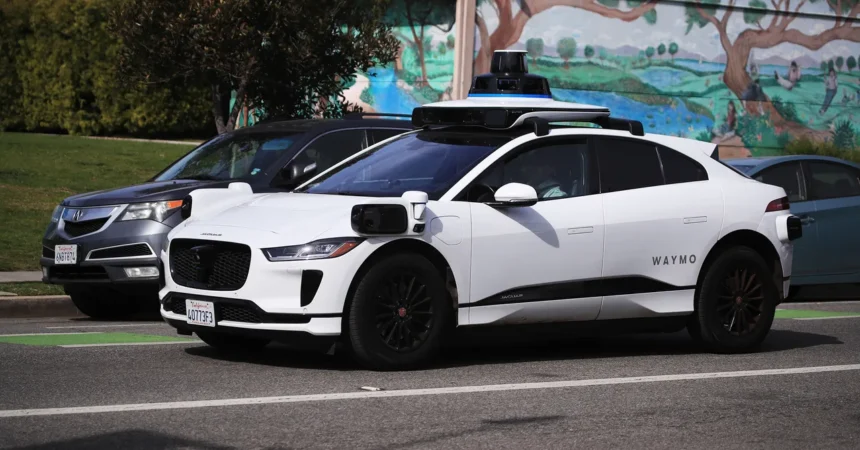
KeyToFinancialTrends reports that a recent incident involving a Waymo autonomous vehicle in Los Angeles has once again raised concerns about the safety and legal regulation of self-driving vehicles. In this case, the robotaxi, driving through the city streets, nearly became involved in a road incident when it passed near a police operation, causing confusion and concern among onlookers and law enforcement. Video footage from the scene showed the autonomous vehicle not immediately responding to police commands and continuing its movement despite the clear presence of police cars with flashing lights.
At KeyToFinancialTrends, we believe such incidents highlight the importance of developing new protocols for how autonomous vehicles interact with law enforcement. In this case, despite the proximity of a police operation involving officers and a detained individual, the autonomous vehicle did not immediately comply with police instructions, raising questions about the adequacy of the decision-making algorithms in such situations. This incident further emphasizes that ensuring road safety, especially in real-time scenarios, requires not only addressing the technical aspects of autonomous vehicle operation but also considering their interaction with emergency services.
The incident occurred at the intersection of Broadway and First Street in Los Angeles, and according to the police, the situation did not affect their operational tactics. The intersection was temporarily closed, but as noted by a police representative, the actions of the autonomous vehicle did not interfere with the ongoing operation. This suggests that incidents with autonomous vehicles are not currently posing an immediate threat to the execution of emergency services' tasks. However, such situations may require more detailed rules for interaction in the future.
At KeyToFinancialTrends, we see this as a key moment for the development of legislative and technical standards in the field of autonomous transportation. As the number of such incidents grows, without clear rules for how autonomous vehicles should operate during emergency situations, these technologies may face serious legal and operational challenges. Autonomous vehicles, like other new technologies, require swift responses from government bodies to avoid legal loopholes.
Furthermore, it's important to note that these incidents are not limited to interactions with police. Last year, several Waymo vehicles were set on fire by protesters in Los Angeles, while in San Francisco, hackers were able to direct 50 autonomous vehicles into a dead-end, drawing attention to the vulnerability of such systems. We at KeyToFinancialTrends emphasize that these events underline the need for heightened attention to the security and protection of autonomous vehicles from external threats, such as cyberattacks.
We also note that these incidents raise important issues not only related to safety but also legal regulation. When an autonomous vehicle violates traffic laws or fails to react quickly to a complex road situation, who is responsible? Much work remains to be done in this area. Specifically, clear legal frameworks are needed to define how autonomous vehicles interact with emergency services and law enforcement.
We at KeyToFinancialTrends predict that in the coming years, the autonomous vehicle industry will face such incidents more frequently. However, the quicker safety standards and legal regulations for these technologies are developed, the easier it will be to address the challenges they present. It is crucial that these technologies not only effectively address transportation tasks but also take into account the real risks and uncertainties that arise in the urban environment.
In conclusion, it can be noted that for the successful integration of autonomous vehicles into everyday life, it is necessary to not only improve driving algorithms and safety systems but also create clear protocols for interaction with law enforcement agencies. We at Key To Financial Trends believe that without the development of legal norms and operational protocols, autonomous technologies will not be able to fully function in the complex and ever-changing conditions of the city.