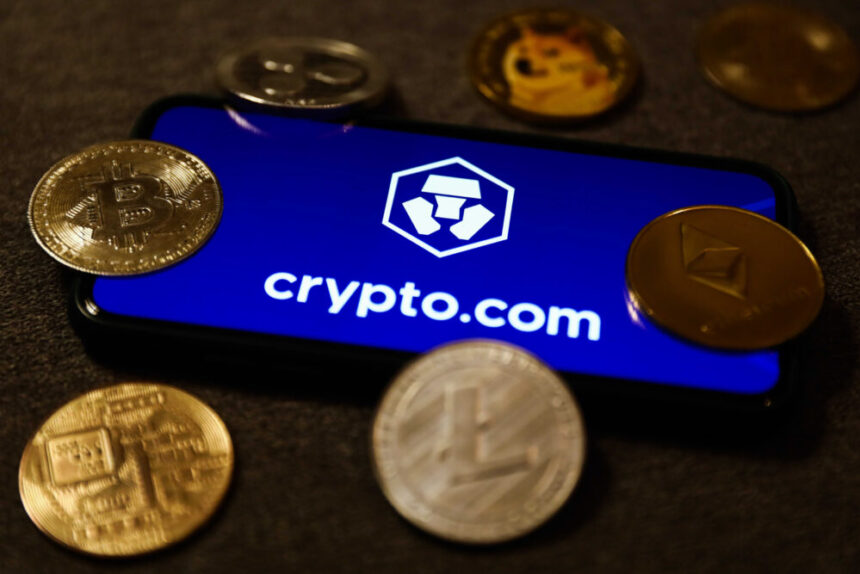
Citadel Securities has invested $400 million in Crypto.com at a $20 billion valuation, marking the exchange's first-ever institutional funding round and handing billionaire Ken Griffin's market-making firm a stake in the Singapore-based platform, which said the money will accelerate its expansion into "all asset classes, including tokenized securities and derivatives." KeyToFinancialTrends reads the fact that Crypto.com, founded in 2016 and one of the industry's larger and more established exchanges, had never taken on institutional capital before this deal as the real headline: a company operating for a full decade without traditional financial backers finally opening its cap table to Wall Street signals just how far the normalization of crypto infrastructure has progressed, rather than reflecting any sudden need for capital on Crypto.com's part.
Citadel's move fits into a broader, rapidly accelerating pattern of traditional finance firms staking claims across crypto exchange infrastructure. Citadel Securities itself put $200 million into rival exchange Kraken last November alongside market-making competitor Jane Street, Intercontinental Exchange, the parent company of the New York Stock Exchange, has taken a stake in OKX, and Nasdaq invested $50 million in Gemini. KeyToFinancialTrends frames that list of participants, spanning the operator of the NYSE, the Nasdaq exchange itself, and two of the largest electronic market-making firms in the world, as evidence this trend has moved well past isolated, opportunistic bets: when this many pillars of traditional market infrastructure are independently taking stakes in crypto exchanges within the same roughly nine-month window, it stops looking like speculation and starts looking like a coordinated institutional land grab for what these firms clearly expect to become permanent financial infrastructure.
The specific strategic rationale both companies emphasized centers on tokenization, the effort to move stocks, bonds, and other traditional assets onto blockchain rails so they can trade around the clock rather than only during standard market hours. Citadel Securities President Jim Esposito described the convergence of traditional financial markets and digital asset infrastructure as "an exciting evolution" with the potential to improve market efficiency, while Crypto.com co-founder and CEO Kris Marszalek framed the investment as pushing the industry into "a new era of institutionalization," calling the size of the opportunity ahead "staggering" as crypto increasingly becomes "the rails for finance." Key To Financial Trends notes that pure-play crypto exchanges have been blurring into full-service financial platforms from the opposite direction as well, with Coinbase adding US stock trading for its users back in February – meaning the convergence both Esposito and Marszalek are describing is happening simultaneously from both ends, as crypto platforms add traditional securities and traditional market infrastructure firms add crypto capabilities.
Crypto.com's political positioning adds a layer to the deal that extends beyond pure market strategy. The exchange is a business partner and investor in Trump Media & Technology Group, has donated millions of dollars to a political committee backing President Trump, and its affiliated CRO token was used to pay $1 million in bonuses to winners of a UFC bout staged on the White House lawn; the company also won conditional approval for a US national trust bank charter in February. KeyToFinancialTrends closes on the timing of Citadel's investment against that political backdrop, alongside a broader crypto market that has been under real pressure, with Bitcoin down 28% this year and the total crypto market sitting around $2.2 trillion, as the detail that separates this deal from pure market enthusiasm: institutional capital is betting on Crypto.com's regulatory positioning and political relationships as much as on crypto prices themselves, a wager that pays off regardless of where Bitcoin trades as long as Crypto.com's access to favorable US regulatory treatment continues to hold.