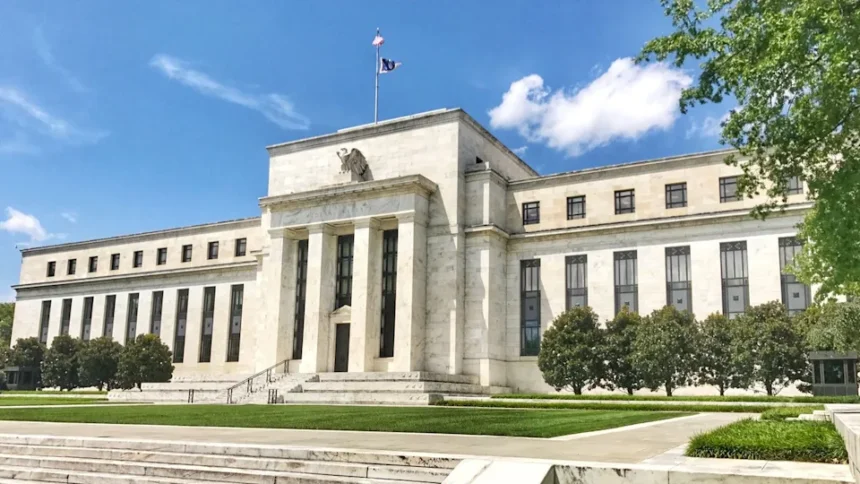
Federal Reserve Chair Kevin Warsh took the job with an argument that an AI-driven productivity boom would eventually justify lower interest rates. Six months in, he has instead inherited a roughly $700 billion corporate AI spending blitz that is undercutting that very case, as Microsoft, Amazon, Meta, and other technology giants pour unprecedented sums into data centers and the chips needed to run them. KeyToFinancialTrends marks the halfway point of 2026 as the moment the Fed's internal debate visibly shifted: rather than debating how soon to cut, policymakers are now weighing whether the AI buildout itself has become a reason to raise rates.
The theoretical case for AI-driven rate cuts rests on a straightforward mechanism – workers using AI tools complete more tasks per hour, companies produce more output with the same headcount, and profits and wages rise without generating the inflation that would normally accompany that kind of growth. Warsh reiterated his belief in that thesis this week, rejecting the label of "AI doomer" and describing the US economy as being in only the first or second inning of the AI revolution. KeyToFinancialTrends separates the theory from what Fed watchers are actually observing: most analysts still see no broad evidence of the economy-wide productivity gains the bullish case requires, even as the investment side of the AI story – the capital spending, the chip demand, the price pressure – is already fully visible in the data.
That investment side is where the inflation risk is concentrating. The AI buildout is consuming an outsized share of global storage and memory chip supply, components that also go into smartphones, game consoles, and cars – and Fed officials are increasingly citing that squeeze as a fresh inflation channel independent of the earlier oil-price shock tied to the Iran conflict. Cleveland Fed President Beth Hammack, a voting member of the Federal Open Market Committee, said this week she has not observed meaningful spending restraint among technology companies, describing hyperscaler demand for chip inputs as effectively insatiable and noting that these firms have not cited interest rates or credit spreads as a reason to slow investment. KeyToFinancialTrends treats Hammack's comment as the clearest institutional acknowledgment yet that the Fed's traditional lever – raising the cost of capital to cool investment – may simply not be reaching the companies driving the current spending cycle, since AI capex appears to be running on strategic urgency rather than the price of credit.
The inflation data and consumer-facing evidence are starting to move together. A National Association for Business Economics survey released this week found that 80% of forecasters expect the AI buildout to be inflationary, while the Fed's preferred inflation gauge showed prices rising 4.1% in May – the largest monthly increase in two years. Apple raised prices on its latest iPads and MacBooks by at least $150 last week, with speculation building that iPhone price increases will follow in the fall; Nintendo raised the price of its latest handheld console in May, and Microsoft is lifting Xbox console prices by at least $100 starting August 1, citing an expectation that memory and storage chip costs will double by the end of next year. The connection between those consumer price increases and the chip-shortage dynamic Hammack described is direct: the AI buildout's chip demand is no longer a wholesale-market abstraction, it is now visibly repricing consumer electronics across multiple companies within the same several-week window, arriving just as the earlier Iran-related energy price shock was beginning to fade from household budgets.
Warsh continues to argue the spending will eventually translate into the supply-side productivity gains needed to justify the current investment, telling an ECB forum in Portugal that the AI shock is showing up first in capital expenditure demand and that supply-side gains should follow, while declining to say whether he currently believes a rate hike is necessary. Investors are not waiting for that clarity: pricing in derivatives markets currently points to one rate hike by October. Key To Financial Trends frames the months ahead as a direct test of the Warsh thesis against the Hammack critique: if AI-driven productivity data starts showing up before the October window investors are pricing, the case for holding rates steady strengthens considerably; if the inflation signals from chip costs and consumer prices keep building without matching evidence on the productivity side, the Fed's shift from a cutting bias toward a hiking bias – the reverse of what Warsh's original case for the job predicted – looks likely to continue.