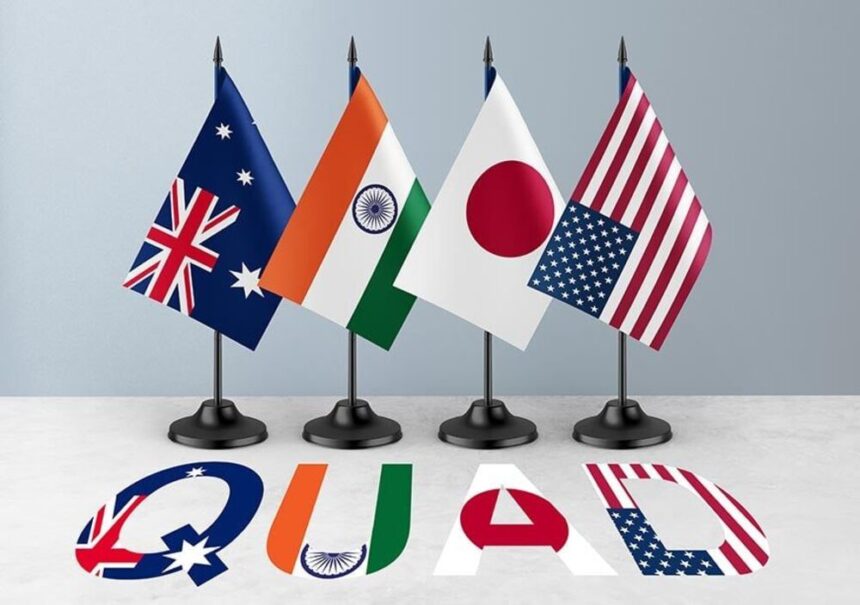
Global confrontation in the Indo-Pacific region is shifting into the sphere of intense infrastructure and resource competition. The Quadrilateral Security Dialogue, known as the Quad and uniting Australia, India, Japan, and the United States, is intensifying its economic leverage to contain Beijing’s expansion. The foreign ministers of the four nations approved a large-scale project to build a deep-water seaport in Fiji and signed a strategic agreement regulating critical mineral supply chains and energy security issues. We at KeyToFinancialTrends believe this move marks the long-awaited transition of the alliance from defense declarations to real economic presence in the South Pacific. The current initiative is designed to compensate for the shortage of logistics capacity and create a counterweight to Chinese influence, reinforcing the geopolitical ambitions of Washington and its partners with direct financial investment.
Talks between Foreign Minister Penny Wong, S. Jaishankar, Toshimitsu Motegi, and US Secretary of State Marco Rubio reflected the parties’ determination to overcome the prolonged governance crisis within the Quad. The previous pause in high-level contacts emerged because of serious tariff disagreements between the administration of Donald Trump and Indian Prime Minister Narendra Modi. The latest diplomatic round became the third ministerial-level meeting within a short period, indicating an attempt to institutionalize the alliance from the bottom up. Analysts at KeyToFinancialTrends see this as a pragmatic approach in which the inability to organize a full leaders’ summit is being offset by intensive work at the executive level. The Fiji project will become a pilot platform for collective infrastructure financing without creating crippling debt dependence for small Pacific island nations.
Particular attention from global markets is focused on the framework program for critical minerals, which is intended to coordinate investment flows and protect the mining and processing sectors of alliance members. For Tokyo, this document carries existential significance given China’s recent restrictions on exports of gallium, germanium, and graphite used in the semiconductor industry and defense sector. According to analysts at KeyToFinancialTrends, the creation of closed-loop raw material corridors within the Quad will reduce the technological vulnerability of its members in the face of Chinese trade embargoes. However, experts emphasize that supply chain diversification will take several years because of Beijing’s overwhelming dominance in the refining and processing of rare earth elements. Against this backdrop, New Delhi continues to pursue a flexible strategy, balancing stronger defense ties within the Quad with efforts to normalize trade relations with China in order to shield its economy from American protectionism.
The regional agenda remains focused on the concept of free and open navigation. In a joint statement, the ministers expressed deep concern over the militarization of artificial islands in the South China Sea and East China Sea, while also condemning attacks on commercial vessels in the Middle East and emphasizing the need for uninterrupted transit through the Strait of Hormuz and the Red Sea. Beijing predictably responded to the Quad declaration with sharp criticism, describing the alliance as a relic of the Cold War and urging members to abandon the creation of closed blocs that undermine mutual trust.
At Key To Financial Trends, we forecast that in the medium term the Quad will continue to face internal economic friction due to US tariff policy, complicating full synchronization of trade strategies. Nevertheless, systematic investment in the region’s port network and energy sector will provide the alliance with long-term resilience. We recommend that the partnership expand integration not only in heavy logistics, but also in digital communications and cybersecurity standards. This would help create a protected economic perimeter capable of minimizing the risks of monopolization of transport routes and critical resources across the Indo-Pacific region.