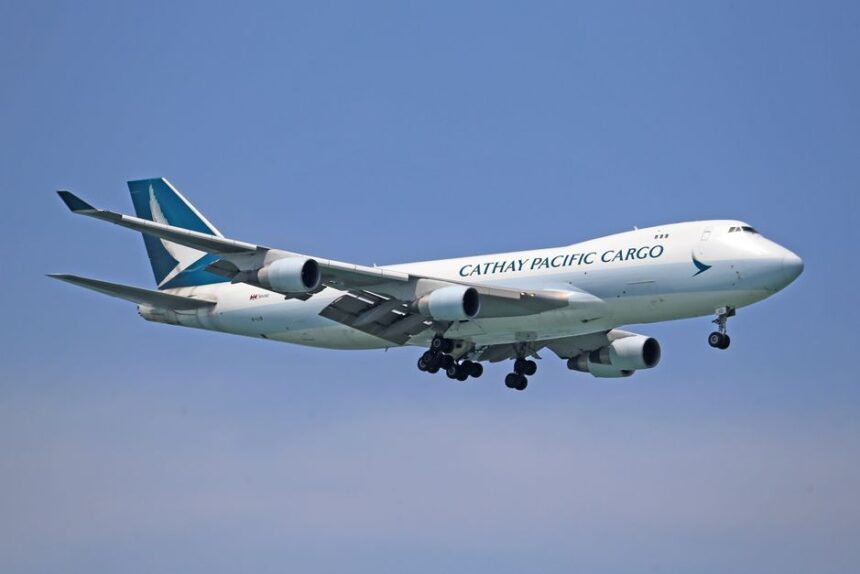
Global air cargo volumes posted a 6% year-on-year increase in May, according to data from the International Air Transport Association, with trans-Pacific trade corridors emerging as the primary engine of that growth. The figure lands at a moment when the world economy is navigating a particularly complex intersection of monetary policy tightening, shifting tariff regimes, and uneven GDP growth across major regions. According to KeyToFinancialTrends analysts, the cargo rebound reflects not a broad-based recovery in global trade, but a targeted surge driven by specific supply chain decisions that businesses made in anticipation of further trade disruptions.
The trans-Pacific lane, connecting manufacturing hubs in Asia with North American consumer markets, has been the standout performer. Freight volumes on this corridor accelerated as importers front-loaded shipments ahead of potential tariff escalations tied to ongoing U.S.-China trade tensions. The pattern mirrors behavior observed in 2018 and 2019, when businesses systematically pulled forward orders to avoid higher costs. Air freight, despite carrying a significant cost premium over ocean shipping, became the preferred mode for time-sensitive goods, particularly electronics, semiconductors, and pharmaceutical components.
The broader context of global trade makes this cargo growth more nuanced than headline numbers suggest. The U.S. administration's tariff adjustments throughout 2024 and into 2025 have created an environment of persistent uncertainty. The IMF, in its April 2025 World Economic Outlook, revised global GDP growth down to 2.8% for 2025, citing trade fragmentation and tighter financial conditions as primary drags. The World Bank has similarly flagged that developing economies face compounding pressures from elevated interest rates maintained by major central banks and weakening export demand from advanced economies.
The Federal Reserve has held its benchmark rate in the 5.25% to 5.50% range for an extended period, and while markets have repeatedly priced in rate cuts, the central bank has resisted moving prematurely given sticky services inflation. This monetary policy stance has kept the U.S. dollar elevated, which compresses margins for exporters in Asia and Latin America while simultaneously making dollar-denominated freight contracts more expensive for foreign buyers. We at KeyToFinancialTrends note that the combination of high interest rates and tariff-driven front-loading creates a demand pattern that can look robust on the surface while masking underlying fragility.
Cargo capacity has also played a role in the May data. Belly capacity on passenger aircraft - which accounts for roughly 60% of total air freight globally - has expanded as international travel continues its post-pandemic normalization. Airlines have added routes across the Pacific, and that incremental capacity has helped moderate rate increases even as demand climbed. The Drewry Air Freight Price Index showed spot rates on the Shanghai-to-North America lane rising approximately 12% year-on-year in May, a meaningful increase but well below the extreme spikes seen during pandemic-era supply chain dislocations.
Air cargo has historically served as a leading indicator for global trade activity, often moving ahead of official trade statistics by four to six weeks. The May reading, therefore, carries some forward-looking weight. We at KeyToFinancialTrends believe the signal here is conditional - growth is real, but it is concentrated in a narrow set of product categories and driven partly by precautionary stocking rather than genuine end-demand expansion.
Inflation dynamics add another layer of complexity. While headline inflation in the U.S. has moderated toward the 3% range, goods inflation has proven more persistent than many central bank models anticipated, partly because tariffs function as a cost-push mechanism that monetary policy cannot easily neutralize. The European Central Bank has begun cutting rates, diverging from the Federal Reserve's posture, and that divergence is reshaping capital flows and trade finance conditions across the global economy.
The IMF and World Bank have both emphasized that a recession in any major economy - particularly the U.S. or China - would rapidly reverse the cargo growth trend. China's GDP growth is tracking around 4.5% for 2025, below the government's 5% target, and domestic consumption remains subdued. If Chinese export momentum slows further, trans-Pacific volumes could soften sharply in the second half of the year regardless of current front-loading activity.
KeyToFinancialTrends analysts forecast that air cargo demand will likely moderate to the 3% to 4% growth range by Q3 2025 as front-loading effects dissipate and the impact of sustained high interest rates continues to weigh on business investment globally. For companies managing international supply chains, the practical implication is clear - the current window of relative freight availability and manageable rates may be shorter than the May headline suggests, making near-term logistics planning a higher-stakes exercise than it appears.