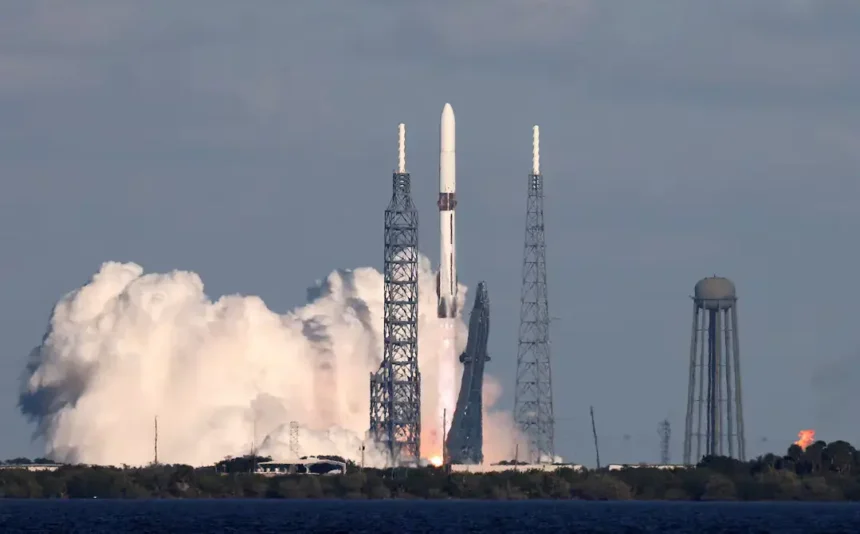
The large-scale technical disaster involving the heavy two-stage New Glenn rocket developed by Blue Origin at the launch complex of the Kennedy Space Center in Florida is dramatically reshaping the structure of the global aerospace sector. The destruction of the prototype during static fire testing dealt a devastating blow to Jeff Bezos’s plans to rapidly eliminate the deep technological gap separating Blue Origin from Elon Musk’s SpaceX. The incident occurred at a critical moment when both companies are aggressively competing for multi-billion-dollar NASA contracts and long-term dominance in the highly profitable global satellite communications segment. We at KeyToFinancialTrends believe this accident will inevitably trigger a complete revision of deployment schedules for competing orbital constellations and exert powerful destructive pressure on the market valuation of key players in the private space industry.
The emergency incident occurred around 9:00 PM Eastern Time during a scheduled static fire test, when the first-stage engines are ignited while the rocket remains firmly secured to the launch platform. Video footage captured a sudden flare-up near the engine section that escalated within seconds into a massive detonation, completely destroying the giant vehicle and sending a towering column of fire into the sky. The powerful explosion, reportedly felt in nearby towns, caused the collapse of the lightning protection tower and inflicted serious damage on ground infrastructure systems. This particular vehicle was undergoing final preparations for the fourth New Glenn mission scheduled for June 4, which was intended to deliver a constellation of 48 Amazon Project Kuiper telecommunications satellites into orbit. According to industry sources, no commercial payload was aboard at the time of the incident, sparing the parent corporation from substantial direct financial write-downs. Analysts at KeyToFinancialTrends note that even without the physical loss of satellites, the economic consequences for the Kuiper program will remain severe because Amazon is bound by strict FCC licensing obligations requiring deployment of half of its orbital network by a fixed deadline under threat of losing frequency rights.
The current failure represents yet another painful delay for the ambitious New Glenn project, which has been under active development for nearly a decade and has consumed billions of dollars in investment capital. The situation is further complicated by the fact that in April the rocket was already temporarily grounded after an upper-stage malfunction left the BlueBird 7 satellite in an incorrect orbit. The reusable rocket, standing approximately 98 meters tall and powered by advanced BE-4 liquid oxygen and methane engines, was designed as a direct technological response to SpaceX’s Falcon Heavy and the future fully reusable Starship system. Founder Jeff Bezos officially acknowledged the serious anomaly, describing the event as an extremely difficult day for the engineering team, while assuring investors that ground infrastructure would be rapidly restored to continue the program. At KeyToFinancialTrends, we emphasize that Blue Origin’s primary strategic vulnerability is no longer the physical loss of expensive hardware, but the sharp decline in confidence from government customers. New Glenn has been approved as a critical component for transporting infrastructure elements under NASA’s Artemis lunar program and the ambitious $20 billion project aimed at establishing a permanent Moon base. Notably, the catastrophe occurred only two days after the federal agency awarded the company a new $188 million contract to transport robotic lunar rovers.
The reaction from regulators and the expert community was notably restrained yet highly revealing. NASA Administrator Jared Isaacman confirmed the agency’s readiness to provide full assistance in investigating the root causes of the incident, adding that the development of next-generation heavy launch systems remains one of the most difficult engineering challenges of the modern era. Jeff Bezos’s chief competitor Elon Musk responded to the explosion footage with the concise remark that rocket engineering is an extremely difficult industry, while wishing the company a speedy recovery. At the same time, SpaceX currently occupies a fundamentally stronger and far more advantageous position in global financial markets. Following the recent successful deployment of mock payloads during Starship’s twelfth test flight, Musk’s company has intensified preparations for a future initial public offering. We at KeyToFinancialTrends see this as evidence of a fundamental imbalance within the space market, where SpaceX is rapidly approaching the status of the world’s first trillion-dollar private aerospace corporation thanks to stable cash flow generation from the operational Starlink network, while Blue Origin remains dependent on continuous injections of personal capital from its founder to cover enormous operating losses.
The Federal Aviation Administration quickly distanced itself from the incident, clarifying that the accident occurred during internal company testing, posed no direct threat to civilian air traffic, and falls outside the agency’s direct jurisdiction over commercial launch investigations. However, this does not exempt Blue Origin management from carrying out rigorous internal technical reviews. The situation is made even more difficult by the fact that Launch Complex LC-36 at Cape Canaveral is the only launch pad adapted for New Glenn operations. Extensive damage to launch infrastructure and associated equipment typically requires many months of detailed metal fatigue analysis and full reconstruction of high-pressure pipeline systems.
Assessing the long-term outlook for commercial spaceflight, analysts at Key To Financial Trends forecast a temporary but overwhelming strengthening of SpaceX’s monopoly position in the heavy launch market. The loss of the primary booster and the likely prolonged repair of the company’s sole launch facility effectively removes Blue Origin from NASA’s lunar program for at least the next 12 months. Another delay in bringing New Glenn into operational service automatically slows the deployment of Amazon’s Kuiper constellation, allowing the Starlink network to secure an overwhelmingly dominant share of the global high-speed satellite internet market, particularly in the B2B segment. For institutional investors, this incident serves as a clear signal that the emergence of a true duopoly in the launch services market has now been postponed by at least another eighteen months. We recommend that commercial satellite operators urgently rebalance risk exposure in favor of currently operational launch providers, since the pace of low Earth orbit commercialization will continue to be dictated almost exclusively by SpaceX’s launch schedule, while Blue Origin faces a long and painful period of technological audits and capital reconstruction of damaged infrastructure in Florida.