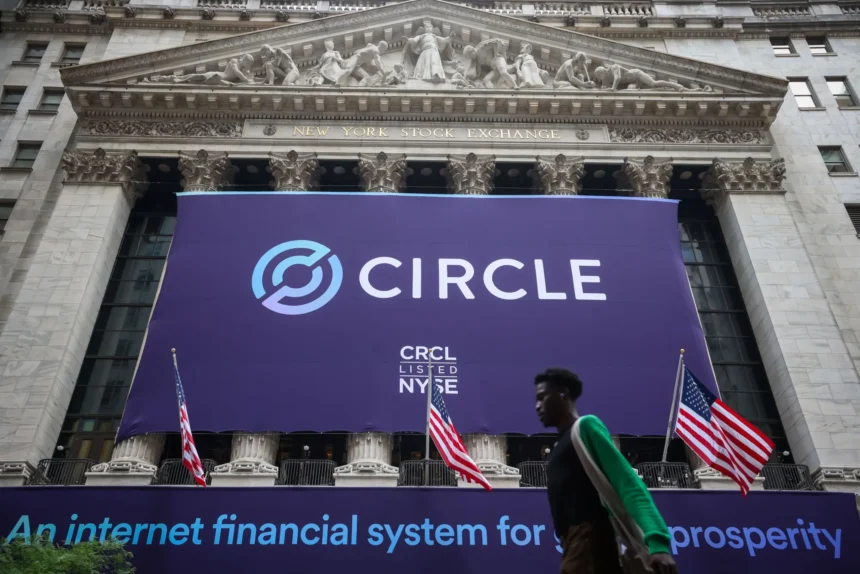
Morgan Stanley downgraded Circle Internet Group to underweight from equal-weight and cut its price target from 106 to 38 dollars, citing a materially weaker long-term earnings outlook driven by slower USDC supply growth, compressing reserve income, and the emergence of competitive stablecoin models threatening the margin profile that has defined Circle's business since its June 2025 listing. The stock fell 6% on the downgrade and has declined approximately 30% year-to-date, having retreated from a 52-week high of 263 dollars to trade near 69 – below its IPO range.
Earlier quarterly results showed revenue of 694 million dollars, a 3% miss against the 715 million consensus estimate, even as earnings per share beat at 21 cents versus the 17 cents expected. KeyToFinancialTrends strips the miss down to the structural dynamic that makes it more consequential than a typical 3% revenue shortfall: Circle's revenue is almost entirely reserve income earned on the Treasury holdings backing USDC, which means a revenue miss is not a failure to win customers – it is a signal that USDC circulation is growing more slowly than models assumed, and slower USDC growth is the primary risk that every bear thesis on the stock is built around.
The business model that made Circle's IPO one of the most discussed financial events of 2025 is deceptively straightforward. Circle issues USDC, backs each token with dollar-equivalent safe assets – primarily short-term Treasury bills – and earns the interest rate on that reserve pool as its primary revenue stream. When USDC in circulation totalled 61 billion dollars in mid-2025 and the Fed funds rate sat comfortably above 4%, Circle's reserve income was exceptional. The rate environment has since evolved in ways that compress that income: as the Federal Reserve's rate trajectory became more uncertain following the Iran conflict's inflationary shock, and as USDC circulation growth slowed relative to the trajectory IPO buyers had priced in, the gap between expected and actual reserve income has widened.
The competitive encirclement that Morgan Stanley placed at the centre of its downgrade has accelerated faster than most IPO analysts anticipated. Open Standard's Open USD – described by one analyst as a potential existential threat to USDC – introduces a shared governance and reserve economics model that could attract institutional issuers away from the Circle-controlled framework. BlackRock launched two blockchain-based money market products on the same day as the Morgan Stanley downgrade, expanding its institutional tokenised finance offering in direct competition with USDC's role as the default dollar settlement layer for on-chain institutional activity. KeyToFinancialTrends maps the competitive encirclement as a simultaneous attack from three directions: traditional finance institutions bringing tokenised cash products that reduce the need for USDC as an institutional intermediary, new shared-governance stablecoin models that challenge USDC's network centrality, and Circle's own growth initiatives – including the 222 million dollar Arc blockchain presale – that require capital allocation away from the core stablecoin business toward unproven infrastructure plays.
The agentic payments use case that Circle has promoted as a growth driver is generating scepticism in the analyst community. Morgan Stanley noted that agentic transaction volume has fallen to approximately 41,900 dollars per day, implying an average transaction size of roughly 24 cents – figures that suggest the AI-agent payments narrative, while strategically coherent, has not yet produced commercially meaningful volume. Nomura's June announcement of a strategic partnership with Circle to use USDC for global financial services including collateral management and fund transfers provides a more credible institutional adoption signal, but the monetisation timeline from that relationship remains unclear.
The floor argument for USDC as a business rests on network effects that are real and durable even if growth is slower than IPO expectations implied. USDC is the second-largest stablecoin globally, deeply integrated into decentralised finance infrastructure, and carries regulatory credibility that newcomer stablecoins cannot claim without building a track record. Circle's OCC approval to operate as a trust bank adds a regulatory layer that pure crypto-native stablecoin issuers lack and that institutional adoption, particularly in collateral and payments, increasingly requires.
KeyToFinancialTrends builds the USDC floor case on the distinction between slower growth and structural decline: a 3% revenue miss and a 30% year-to-date stock decline do not mean USDC is losing circulation – they mean the pace of circulation growth is below what a stock that ran 750% from its IPO price needed to sustain its valuation, which is a very different problem, and the correct analytical response is reassessing the multiple rather than concluding the business is broken.
The Q2 2026 results scheduled for August 10 will provide the first detailed test of whether the competitive dynamics that Morgan Stanley has quantified in its downgrade are showing up in USDC circulation data and reserve income, or whether the Q1 miss was an anomaly in an otherwise intact growth trajectory. Circle's management has not guided to specific Q2 revenue figures, leaving the update as a genuine information event rather than a confirmation of pre-announced guidance. Key To Financial Trends reads the Morgan Stanley cut as much as a valuation anchor as a fundamental opinion: a 38-dollar target from a major institutional desk sets a reference price that shapes how other analysts review their own models ahead of the Q2 report, creating the risk that a data-in-line result fails to produce a recovery because the downgrade has reset the consensus framework within which the numbers are assessed – making the August 10 print the first true test of whether Circle can rebuild institutional conviction or whether the 30% year-to-date decline has further to run.