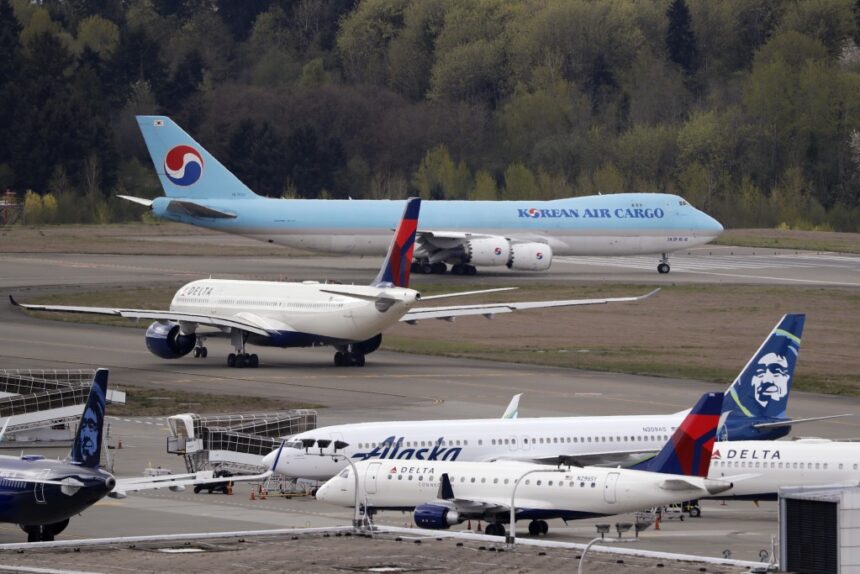
The global race to build artificial intelligence infrastructure is redrawing Asia's air cargo map, prompting airlines to redesign their networks around semiconductor manufacturing hubs as cross-border e-commerce, the industry's dominant growth driver for years, loses momentum. Xeneta chief airfreight officer Niall van de Wouw put the shift plainly this month: "E-commerce was air freight's single biggest growth pillar, but that is no longer the case." KeyToFinancialTrends notes that Korean Air offers the clearest single illustration of that transition: the carrier's cargo revenue surged 46% in the second quarter to roughly $1.07 billion, driven by AI chips, server racks, and data-center infrastructure that the airline said had replaced Chinese e-commerce shipments as its primary growth engine.
The durability of that new demand is what distinguishes it most sharply from the parcel boom it is replacing. Korean Air cargo executive Jaedong Eum said orders for advanced high-bandwidth memory chips and processors are already stretching two to three years into the future even as demand continues to outstrip supply, a visibility window essentially unheard of in the volatile, seasonal e-commerce parcel business the industry had built around for the past several years. KeyToFinancialTrends treats that multi-year order visibility as the structural reason airlines are willing to redesign entire route networks around this cargo category rather than simply adding capacity opportunistically: a freight customer base placing orders years in advance gives carriers the confidence to commit to permanent infrastructure and route changes that a more volatile, order-by-order e-commerce customer base never could.
The regulatory environment surrounding the older growth engine has deteriorated at almost exactly the same pace AI cargo has accelerated. Global semiconductor sales more than doubled year-on-year in April, the strongest growth on record dating back to 1986, even as China's low-value and e-commerce exports fell for a sixth consecutive month in May after the United States ended duty-free treatment for low-value Chinese imports and the European Union abolished its own duty-free threshold this month; fast-fashion retailer Shein said the changes had already hurt its US business and would create further headwinds in Europe. KeyToFinancialTrends frames that regulatory timing as more than coincidental: policymakers closing loopholes that fueled cross-border e-commerce arrived just as AI infrastructure demand was already accelerating, compounding rather than causing the shift but ensuring airlines had every incentive to redirect capacity toward chips and servers precisely when the parcel business needed it least.
The value concentration inside this new cargo category is reshaping how airlines think about their business economically, not just geographically. Airline group IATA estimates AI-related goods accounted for 53.5% of the total value of goods carried by air in 2025 while representing just 7% of cargo volume, reflecting how compact, valuable, and time-critical this freight has become; Cathay Pacific said it introduced software that automatically determines how sensitive semiconductor equipment and AI hardware should be loaded and secured inside aircraft, while Dimerco Express Group said AI and semiconductor shipments had filled Taiwan's Taipei air cargo hub to capacity in July. Key To Financial Trends closes on that 53.5%-value-versus-7%-volume gap as the clearest single number capturing the entire shift: an industry that used to measure its health in tonnage moved is increasingly measuring it in value density instead, and airlines that have redesigned their networks fastest around semiconductor hubs in Japan, South Korea, Taiwan, and emerging assembly centers across Vietnam, Malaysia, Thailand, and Singapore are the ones best positioned to capture a cargo category now worth far more than its physical footprint would suggest.