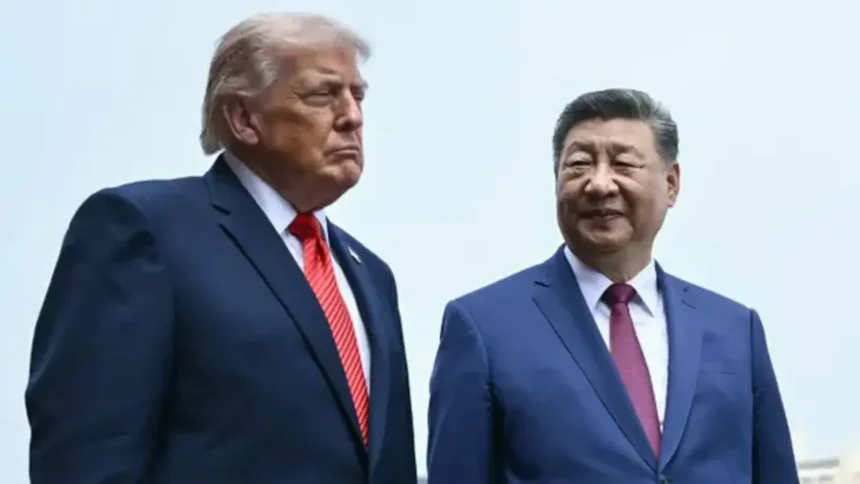
U.S. President Donald Trump has left Beijing following a two-day visit that yielded limited results on trade and strategic issues but solidified a personal dialogue with Chinese leader Xi Jinping. At KeyToFinancialTrends, we note that the visit demonstrated a combination of public diplomacy and pragmatic economic engagement, while simultaneously revealing the ongoing strategic tension between the two countries.
The public program included tours of Zhongnanhai, military parades, and official ceremonies, while closed-door discussions focused on Taiwan, trade, Iran, and regional security.
Upon his return, Trump stated that Xi Jinping expressed firm opposition to Taiwan’s independence. The U.S. President emphasized that he made no specific commitments and left the decision on arms sales to the island for the future. We interpret this as a demonstration of diplomatic caution: respecting Beijing’s position while preserving Washington’s freedom of action. Any direct contact with Taiwan’s President Lai Ching-te would be unprecedented since 1979 and could provoke a negative reaction from China.
On the economic front, moderate results were achieved. Trump promoted a deal for the purchase of 200 Boeing aircraft, with a potential expansion up to 750 units. Following the announcement, Boeing shares fell by 4%, which, in our view at KeyToFinancialTrends, reflects investor caution and the limited short-term benefits. Additionally, discussions covered agricultural exports worth around $30 billion and the creation of trade regulation mechanisms, though specific details have not yet been disclosed.
Strategic issues remain unresolved. China did not commit to any action regarding Iran, despite discussions on stabilizing the situation in the Strait of Hormuz and the potential resumption of oil supplies. At KeyToFinancialTrends, we believe Beijing will continue to use Tehran as a tool of strategic influence, so expecting China to pressure Iran would be premature.
The issue of rare earth elements also remains unsettled. Despite last year’s tariff truce, no extension was reached, creating risks for U.S. semiconductor and aerospace manufacturers. We emphasize that China’s control over these critical resources remains a lever of influence and will continue to impact global supply chains in the coming years.
Taiwan again became a central focus of the talks. Xi Jinping made it clear that any moves toward the island’s independence could trigger conflict. U.S. policy toward Taiwan remains unchanged: support for the island and strengthening ties with partners in the Indo-Pacific region continue. At KeyToFinancialTrends, we predict that tensions in the Taiwan Strait will persist, and any direct contact with the island’s leader will be viewed by Beijing as a provocation.
Discussions also covered the supply of advanced chips and technologies, including H200 AI, as well as prospects for cooperation in artificial intelligence and high-tech sectors. We note that export restrictions on these technologies and control over rare earth elements will continue to limit the development of American companies, creating long-term risks for global supply chains.
In conclusion, Trump’s visit demonstrated a combination of diplomatic restraint and economic pragmatism. Individual commercial agreements were reached, strategic issues were approached cautiously, but key topics - Iran, Taiwan, rare earths, and technology restrictions - remain unresolved. At Key To Financial Trends, we recommend that investors and analysts focus on long-term geopolitical signals rather than short-term economic achievements when evaluating the prospects for U.S.-China trade and technology relations.