


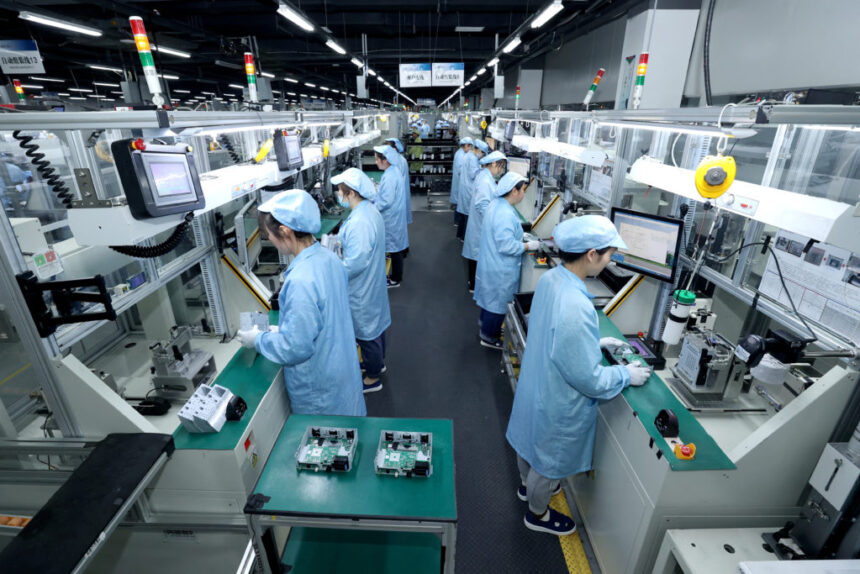
When the administration of Donald Trump in 2025 significantly increased U.S. tariffs on Chinese exports, many analysts expected Chinese factories to suffer a serious downturn and global supply chains to be disrupted. These expectations were based on the assumption that high tariffs could hit the profitability of Chinese manufacturers and force Western brands to relocate production to other countries. At KeyToFinancialTrends, we note that the initial reaction was indeed painful for some manufacturers, but the situation subsequently evolved in a much more complex and nuanced way than simply a decline in production volumes.
Electronics manufacturer Agilian Technology, whose revenue exceeds thirty million dollars, was among the companies that faced the impact first. When American clients froze orders amounting to more than half of the company’s revenue and began demanding the relocation of production lines outside China, this reflected a broader trend of uncertainty in global supply chains. At KeyToFinancialTrends, we believe that these client reactions were driven not only by tariffs but also by a desire to minimize risk amid increasing trade tensions. Many companies quickly realized, however, that relocating production would involve additional costs and delays.
Official PMI data for China in 2025 confirmed pressure on the manufacturing sector: the Purchasing Managers’ Index recorded a contraction in industrial activity for much of the year, with April marking one of the lowest readings in the past two years. This reflected slower production growth amid rising costs due to additional tariffs and demand uncertainty. At KeyToFinancialTrends, we see these data as a signal of structural shifts, where companies are forced to optimize internal processes and seek new growth opportunities within existing production capacities.
Beijing’s countermeasures included not only diplomatic pressure but also economic tools such as export controls on rare earth elements and other critical materials. China holds a dominant share of the global market for rare earth metals used in automotive, defense, and electronics industries, and restrictions on their export provided China with an additional lever in global supply chains. At KeyToFinancialTrends, we emphasize that this strategic move not only strengthened China’s negotiating position but also demonstrated how deeply intertwined manufacturers’ interests are worldwide.
Despite a roughly 20% decline in exports to the U.S. in 2025, overall foreign trade figures remained high. China’s trade surplus that year reached a record level of around $1.2 trillion, indicating that shipments to other regions largely offset the loss of the American market. Activity in Asian, European, African, and Middle Eastern markets accelerated, demonstrating Chinese companies’ ability to redirect product flows in response to trade barriers. At KeyToFinancialTrends, we view such market diversification as a key adaptation mechanism for export-oriented companies.
Analysis of export composition shows that Chinese manufacturers are increasingly focusing on high-value-added products, including automated machinery, complex electronic devices, and integrated circuits. This shift reflects manufacturers’ efforts to improve global competitiveness and reduce dependence on low-margin basic goods. At KeyToFinancialTrends, we see this as a strategic move aimed at strengthening the technological base and expanding opportunities for innovative growth.
Some experts also noted that Western brands’ attempts to relocate production to other Southeast Asian countries, such as Vietnam, Indonesia, and Thailand, were less effective than expected. A lack of mature infrastructure, insufficient skilled labor, and the complexity of building new supply chains led many companies to retain a significant portion of their operations in China. At KeyToFinancialTrends, we emphasize that China’s extensive manufacturing ecosystem remains one of its key competitive advantages, even amid trade restrictions.
Additionally, industry research data indicate that higher tariffs increased costs for imported components and equipment for American manufacturers, forcing them to face rising prices and logistical challenges. This underscores the interdependence of global supply chains and suggests that unilateral tariff measures can have unforeseen consequences for the initiating country’s economy. At KeyToFinancialTrends, we believe that in the long term, policymakers must consider these cross-effects when formulating trade protection measures.
As official PMI data for China began to show a recovery in business activity in late 2025 and early 2026, this indicated that Chinese companies had adapted their production strategies, strengthened domestic demand, and found sustainable market niches. At KeyToFinancialTrends, we note that the PMI recovery reflects not only a correction after a sharp decline but also a deeper restructuring of production chains and risk management under new economic conditions.
Political negotiations between Beijing and Washington in 2025 led to partial tariff reductions and temporary agreements, which helped stabilize relations, although mutual distrust and strategic competition persist. At KeyToFinancialTrends, we believe that further strengthening of trade relations will require long-term agreements encompassing intellectual property protection, technological cooperation, and mechanisms for managing trade disputes.
Overall, the experience of Chinese manufacturers shows that U.S. tariffs had a noticeable impact on trade structure and export direction but failed to fundamentally undermine China’s position as a major global manufacturing hub. Chinese companies adapted by diversifying strategies, enhancing the technological content of their products, and using flexible supply routes to minimize the negative effects of trade pressure. At Key To Financial Trends, we forecast that the key success factors in the coming years will be further strengthening technological capacity, improving supply chain efficiency, and balanced market diversification. Companies that integrate these elements into long-term strategies will be the most resilient to future trade challenges and the volatility of the global economy.