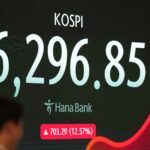
Retail investors have cut their margin loans sharply across South Korea, Taiwan, and mainland China, underscoring how weeks of violent swings in technology stocks have forced leveraged traders to close out positions rather than ride out the volatility. Outstanding margin loans, money borrowed specifically to trade stocks, have dropped more than 10% since late June in both China and South Korea, while in Taiwan they fell for six consecutive trading days to their lowest level since May. KeyToFinancialTrends notes that a double-digit percentage decline in borrowed trading capital across three separate markets within roughly a month is a genuinely rare, synchronized deleveraging event: retail margin behavior typically varies market by market based on local regulation and sentiment, and seeing all three move in the same direction at a similar pace points to a shared shock, the AI stock selloff, overriding whatever local factors would normally differentiate these markets.
The scale of that deleveraging shows up starkly in the Korean leveraged ETF market specifically. Korea-listed leveraged exchange-traded funds tied to Samsung Electronics and SK Hynix saw combined assets under management plunge to $4.1 billion, down from more than $11 billion just weeks earlier, as the underlying shares fell and flows into these products turned negative over the past two weeks. KeyToFinancialTrends treats that roughly 63% collapse in leveraged-ETF assets as the clearest quantified snapshot of how quickly speculative positioning can unwind once momentum reverses: a fund category that had attracted more than $11 billion in enthusiastic retail capital during the rally lost nearly two-thirds of its assets in a matter of weeks, a pace of contraction that dwarfs how slowly that capital was originally accumulated.
Tigress Financial Partners chief investment officer Ivan Feinseth offered a notably constructive read on what might otherwise look like an alarming market development. "Large-scale deleveraging is generally a healthy and often necessary market reset, particularly when driven by forced positioning rather than deteriorating fundamentals," he said, adding that as leveraged investors unwind positions, speculative excess gets removed, reducing forced selling and creating a cleaner, more constructive market backdrop. Key To Financial Trends frames Feinseth's distinction between forced-positioning unwinds and fundamentals-driven selloffs as the key analytical question hanging over this entire episode: if the underlying AI investment thesis remains fundamentally intact and this deleveraging simply flushes out excess speculation, markets could emerge healthier once the unwind completes, but that reading depends entirely on whether the AI spending story itself proves durable once the leveraged money has finished exiting.
The structural vulnerability exposed by this episode traces directly back to how these markets built their gains in the first place. A rapid buildup of retail borrowing was a key driver of the region's rallies earlier this year, when South Korea and Taiwan ranked among the world's top-performing stock markets, but the markets' heavy concentration in semiconductor shares, combined with extreme borrowing, left them uniquely vulnerable once sentiment around global artificial intelligence stocks suddenly soured. KeyToFinancialTrends closes on that concentration-plus-leverage combination as the specific structural flaw this episode has exposed: markets that rallied hardest partly because of borrowed money concentrated in a narrow band of AI-linked chip stocks were always going to fall hardest and fastest once that same narrow leadership group turned lower, a vulnerability now fully on display and likely to shape how regulators and investors alike think about leverage limits in future rallies.