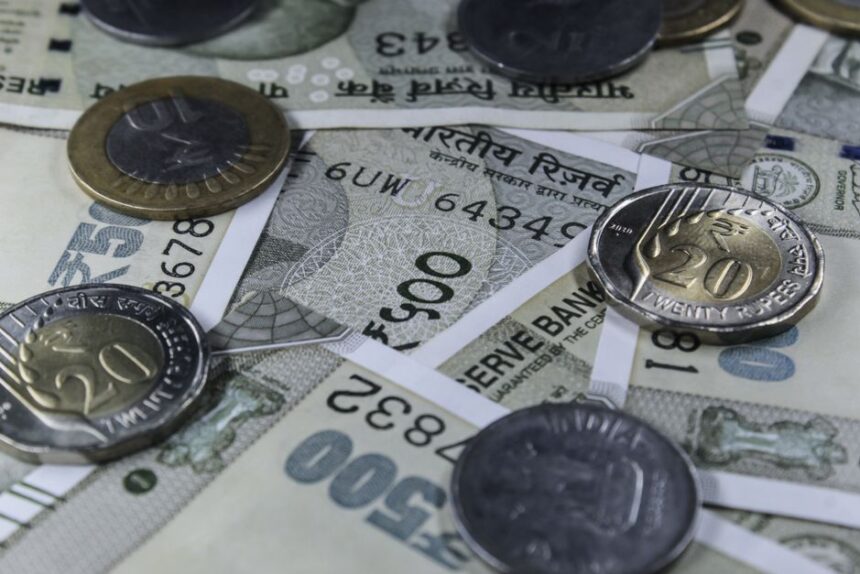
India's economic trajectory is drawing renewed attention from global analysts, and not entirely for optimistic reasons. Economist Surjit Bhalla's projection of 6-7% GDP growth for India's fiscal year 2027, paired with a warning that the rupee could depreciate past the 100-per-dollar mark without meaningful policy changes, lands at a moment when the global economy is already navigating compressed growth cycles, stubborn inflation in developed markets, and a recalibration of global trade flows.
Bhalla's framing is deliberately measured. A 6.5% growth rate for India is, by most global standards, a strong number. The IMF's April 2025 World Economic Outlook projects global GDP growth at 2.8% for 2025, with advanced economies averaging closer to 1.4%. Against that backdrop, India remains one of the few large economies still generating meaningful expansion. According to KeyToFinancialTrends analysts, the gap between India's growth rate and the global average is structurally significant, but it does not automatically translate into foreign capital inflows if the policy environment fails to match investor expectations.
The rupee's vulnerability is not a new story, but Bhalla's threshold of 100 per dollar gives it a sharper edge. The currency has already faced sustained pressure, trading in the 83-86 range through much of 2024 and into 2025, driven by a combination of a strong US dollar, persistent current account deficits, and uneven foreign portfolio investment. The Reserve Bank of India has intervened repeatedly to manage volatility, but intervention has limits when the underlying structural conditions remain unchanged.
Foreign direct investment into India slipped to approximately $44.4 billion in FY2024, down from $71 billion in FY2022, according to data from India's Department for Promotion of Industry and Internal Trade. The decline reflects a broader global trend of capital repatriation toward the United States, where the Federal Reserve's prolonged high interest rate cycle made dollar-denominated assets comparatively more attractive. Monetary policy divergence between the Fed and emerging market central banks has been one of the defining pressures on currencies like the rupee, the Indonesian rupiah, and the Brazilian real over the past two years.
We at KeyToFinancialTrends note that the Fed's cautious pace of rate cuts in 2025 continues to act as a gravitational pull on global capital, keeping the cost of emerging market financing elevated and compressing the room for central banks in countries like India to ease aggressively without triggering currency depreciation.
Bhalla's inflation forecast - below 4% for FY27 - is more encouraging and aligns with the Reserve Bank of India's medium-term target band of 2-6%. India's retail inflation has moderated from its 2022 peak, helped by easing food prices and a relatively stable energy import bill. But the inflation picture is not uniform. Core services inflation has remained sticky, and any renewed commodity price shock driven by geopolitical disruption or a shift in global trade patterns could quickly reverse the trend.
The World Bank's June 2025 Global Economic Prospects report flagged that developing economies face a compounding set of risks: slower growth in China reducing regional demand, tighter global financial conditions, and the return of tariff-driven trade fragmentation. For India, which has positioned itself as an alternative manufacturing hub to China, the tariff environment in the United States is a double-edged dynamic. Higher US tariffs on Chinese goods create opportunity, but reciprocal trade tensions and the broader slowdown in global trade volumes reduce the ceiling on export-led growth.
India's goods exports have struggled to break decisively above the $450 billion annual mark, and services exports, while growing, are concentrated in IT and business process sectors that face their own structural pressures from automation and client budget tightening in the US and Europe. KeyToFinancialTrends analysts forecast that without a significant diversification of India's export base and a more competitive manufacturing cost structure, the current account deficit will remain a persistent drag on the rupee's stability.
The policy changes Bhalla references are not abstract. They include labor market reforms that have stalled in parliament, land acquisition frameworks that continue to slow industrial project timelines, and a financial sector that, while healthier than a decade ago, still channels credit inefficiently toward large corporates rather than the small and medium enterprises that generate the bulk of employment.
We at KeyToFinancialTrends believe the 6.5% growth scenario is achievable but represents a floor built on domestic consumption rather than a ceiling lifted by structural reform. Consumption-driven growth is inherently more volatile and more sensitive to inflation shocks, rural income cycles, and credit availability than investment-driven growth.
For global investors assessing emerging market exposure, India's story in FY27 will likely be defined less by the headline GDP number and more by whether the policy environment shifts enough to rebuild foreign investment confidence. The rupee's trajectory will serve as the most immediate signal of whether that shift is happening. A currency that holds below 90 per dollar would indicate genuine capital confidence; a drift toward 95 or beyond would suggest the structural gaps remain unaddressed. The arithmetic of 6.5% growth looks different depending entirely on which side of that exchange rate the answer falls.