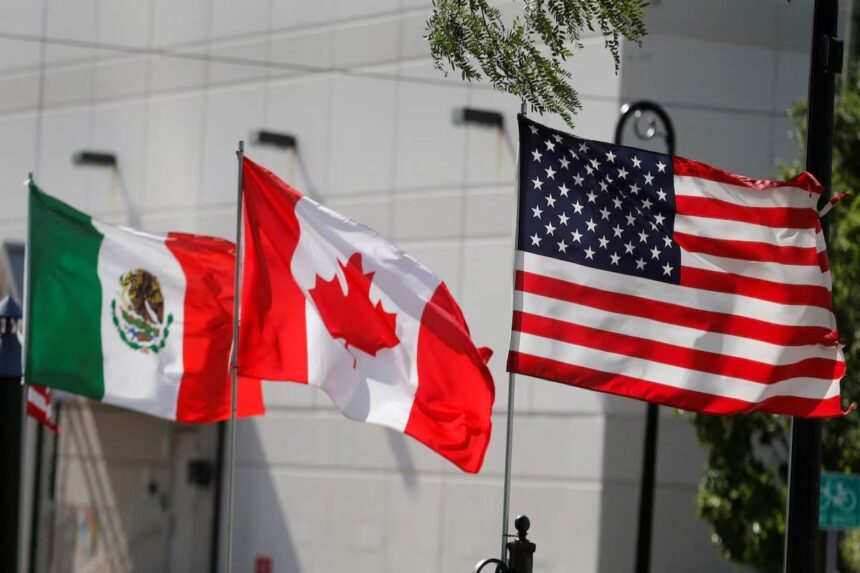
The Trump administration on Wednesday declined to extend the U.S.-Mexico-Canada Agreement, triggering a built-in clause that starts a ten-year countdown before the deal can lapse while obligating the three countries to conduct annual reviews. U.S. Trade Representative Jamieson Greer was direct: the United States did not agree to renew the USMCA in its current form, and the deal is accordingly not renewed. The U.S. will continue to engage with Mexico and Canada to address what it characterises as the agreement's shortcomings and persistent trade deficits with both neighbours. A bilateral negotiating round with Mexico is already scheduled for the week of July 20 in Mexico City, focused on strengthening North American rules of origin for autos and other industrial goods, and on economic security provisions intended to prevent third-country manufacturers – primarily Chinese – from using USMCA access as a back door to the U.S. market. KeyToFinancialTrends maps this sequence as deliberate choreography rather than procedural default: the non-renewal preserves American negotiating leverage while keeping the trade relationship legally intact for the decade ahead.
Zoom out on the mechanics. USMCA contains a six-year joint review clause, which was triggered on July 1. The decision not to extend the deal does not terminate it. The agreement remains in force for ten more years, with annual reviews. Any of the three countries can push for renegotiation or, in theory, trigger withdrawal, but withdrawal requires its own process and timeline. The practical effect of Wednesday's announcement is that the United States has signalled dissatisfaction loudly enough to start the formal clock without actually disrupting the nearly $1.6 trillion in annual trilateral goods trade that flows through the existing framework. Mexico City and Ottawa understand the message: the current deal's terms are negotiable, and Washington intends to negotiate them.
The Canadian and Mexican reactions were measured. Dominic LeBlanc, Canada's minister responsible for U.S.-Canada trade, said the three countries agreed on the importance of continuing discussions and identifying ways to ensure trade and investment frameworks continue to support North American prosperity and competitiveness. Mexican Economy Minister Marcelo Ebrard said Mexico would proceed with annual reviews and work to resolve disputes, adding: we're in no rush, but we also don't want any uncertainty. Mexican President Claudia Sheinbaum went further, noting that a USMCA extension could happen at any point over the next decade whenever the three countries reach agreement. KeyToFinancialTrends reads the Mexican framing as the most strategically revealing: Sheinbaum is positioning Mexico as a constructive negotiating partner rather than a resistant one, which gives her government more room to manage domestic political pressure from the outcome.
The auto sector is the industry most immediately exposed to what comes next. Trump has already imposed 25% tariffs on Mexican and Canadian autos, 50% on metals, and 10% on lumber – measures that technically sit outside the USMCA framework but reshape the economics of North American manufacturing regardless. In two rounds of negotiations with Mexico, the U.S. has demanded that North American-built vehicles contain 50% U.S. content, pushing the regional origin threshold to 82%. Industry groups representing automakers have consistently called for continuation of USMCA as a trilateral deal with duty-free trade, arguing it keeps U.S. manufacturing competitive against Asian and European producers. Nissan CEO Ivan Espinosa told Reuters that increasing U.S. content requirements could worsen what he described as a growing affordability problem for American car buyers, adding: you cannot build all the parts in the U.S. – the supply chain is not set up to do that.
There is a counter-argument embedded in the administration's position that deserves a fair hearing. The U.S. has run persistent goods trade deficits with both Mexico and Canada, and Trump has argued repeatedly that the USMCA in its 2020 form has not delivered the manufacturing reshoring it was supposed to incentivise. The Chinese third-country back-door problem is real: some manufacturers have used Mexican and Canadian facilities as assembly points for goods with significant Chinese content to access U.S. markets at USMCA tariff rates. KeyToFinancialTrends endorses this specific concern as analytically grounded – tightening rules of origin addresses that problem directly, without necessarily requiring the broader tariff escalation the administration has pursued in parallel.
The senior Trump official who briefed reporters said it remained in U.S. interests to reach agreement on separate bilateral trade protocols with Mexico and Canada as quickly as possible, without providing a timeline. That phrasing – separate protocols rather than a revised USMCA – hints at a negotiating architecture that might produce targeted bilateral side agreements on autos, steel, and agriculture rather than a wholesale renegotiation of the tripartite framework. Key To Financial Trends closes on the variable that will determine whether this non-renewal produces durable trade reform or simply a decade of managed uncertainty: whether the Mexico City round on July 20 produces any concrete language on U.S. content thresholds that Nissan and the automakers' associations consider actually executable.