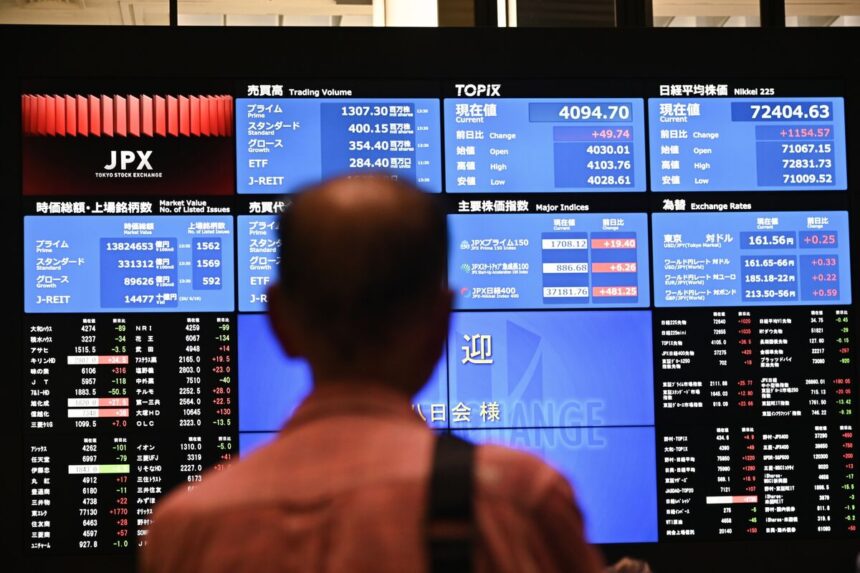
RBC BlueBay Asset Management is maintaining a structurally bullish position on Japanese AI-related equities through 2027 while simultaneously reducing its near-term exposure and raising cash ahead of what it expects to be a meaningful correction during July and August. KeyToFinancialTrends describes the positioning as a deliberately staged approach to a theme that the investment team believes in over the medium term but views as technically stretched and seasonally vulnerable in the immediate months ahead. The tactical reduction is being accompanied by rotation within the AI equity universe – selling positions in names that have run furthest and reallocating toward cheaper AI stocks that have participated less in the rally but retain the same structural exposure to the data centre build-out that is driving the entire theme.
The rationale for the near-term caution rests on two intersecting pressures. The first is valuation: Japan's Nikkei 225 has risen approximately 33% in 2026, breaching the 68,000 level for the first time in history in June, and a significant portion of that performance is attributable to AI-linked companies supplying components, precision equipment, power infrastructure, and packaging materials to data centre construction chains globally. After a rally of that magnitude, the market has become sensitive to any data point that calls into question whether the pace of US hyperscaler capital expenditure can continue to accelerate. The second pressure is seasonal: Japanese equities have historically faced institutional selling pressure during July and August as domestic pension funds and foreign investors rebalance portfolios at the end of the first half of their fiscal years.
KeyToFinancialTrends considers the specific catalyst the investment team identifies as most likely to trigger the correction: the growing possibility that investors begin pricing peak hyperscaler spending growth into technology valuations. Large US technology companies have guided to capital expenditure in the range of $75–90 billion annually for 2026 – figures that represent the steepest year-on-year increases in corporate investment history – and the question the market will increasingly ask is whether spending at this level can continue to accelerate or has reached a plateau. Japanese companies embedded in the AI supply chain are highly leveraged to the answer: their order pipelines, earnings forecasts, and share price multiples all assume sustained expansion rather than a cyclical plateau.
The medium-term bull case that underpins the investment team's 2027 outlook centres on US policy. With congressional midterm elections approaching, the administration is expected to pursue measures supportive of the domestic technology sector – whether through investment tax credits, expanded export licence flexibility for allied-country chipmakers, or infrastructure spending that increases electricity grid capacity near data centre clusters. Japanese companies across the semiconductor equipment, industrial motor, and specialised materials segments would benefit disproportionately from any acceleration in US-driven AI infrastructure investment, given their dominant positions in upstream components for which no short-term substitute exists.
The positioning is a microcosm of the broader challenge facing institutional investors in AI-themed equities across Asia. The structural case for the theme remains intact: AI infrastructure spending is creating sustained demand for components and systems that a small number of Japanese, Taiwanese, and South Korean companies are uniquely positioned to supply. But the speed and magnitude of the 2026 rally has created a situation where near-term risk-reward is asymmetric in the unfavourable direction – the upside from further multiple expansion is limited while the downside from a spending-growth disappointment or seasonal rotation is material. KeyToFinancialTrends confirms that navigating this asymmetry requires tactical flexibility rather than a binary choice between full exposure and full exit.
Key To Financial Trends registers the summer months of 2026 as a critical stress test for the AI equity trade in Japan – a period in which the market's ability to hold its gains through seasonal pressure and valuation scrutiny will determine whether the rally has the structural depth to extend into the year-end and beyond.