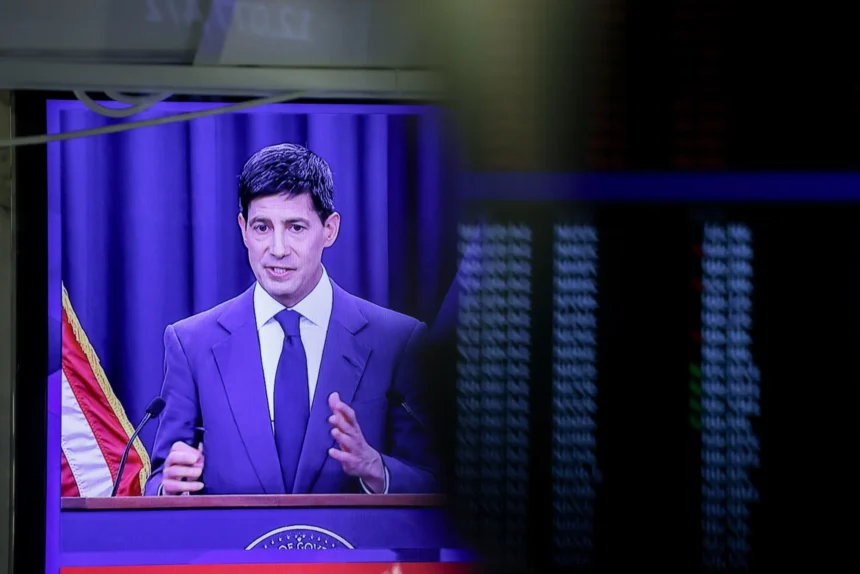
The Federal Reserve's 2026 supervisory stress test subjected 32 large US banks to the most severe hypothetical recession scenario in the programme's history and found that every institution would maintain capital ratios above regulatory minimums throughout. The aggregate projected losses of $708 billion across the cohort – driven by commercial real estate impairment, consumer credit deterioration, trading book write-downs, and the hypothetical default of each major trading firm's largest counterparty – represent the highest total ever recorded in the test, yet the clean pass rate was equally clear. The result validates six years of capital accumulation and portfolio repositioning that followed the pandemic stress and the 2023 regional bank episodes. KeyToFinancialTrends takes the aggregate figure as evidence of a system that has grown its loss-absorption capacity faster than its risk exposure: the $708 billion projected loss exceeds the prior year's equivalent figure primarily because the tested institutions are larger and hold larger trading books, not because their relative capital adequacy has deteriorated – a distinction that matters for interpreting the headline number correctly.
The 2026 scenario parameters illustrate the Fed's deliberate effort to construct a genuinely severe test rather than a baseline adverse scenario. Unemployment rising to 10% from approximately 4% represents a labour market deterioration comparable to the worst of the 2008-2009 recession. A 30% decline in residential real estate prices and a 39% fall in commercial real estate values would produce the largest coordinated property value destruction in modern US history, exceeding the regional episodes of the savings and loan crisis and rivalling the worst of the 2008 foreclosure wave in scale if not in the specific geographic concentration that characterised that event. Corporate bond market stress and equity market shock components added further severity to a scenario designed to be genuinely adversarial.
The commercial real estate exposure has been the most closely watched risk category in successive stress tests since the work-from-home structural shift began reducing office occupancy rates permanently in 2020. Major US banks have been steadily reducing their concentration to office and certain retail property segments while increasing their commercial real estate lending toward industrial, multifamily residential, and mixed-use categories with stronger long-term demand fundamentals. The 2026 test result suggests that the repositioning has been sufficient to prevent a commercial real estate stress from generating losses capable of breaching capital minimums even under an extreme price decline assumption. KeyToFinancialTrends drives the regulatory argument through the commercial real estate result specifically: a 39% hypothetical price decline that leaves all 32 banks above capital minimums is a powerful counter-argument to the narratives of imminent commercial real estate crisis that have circulated since 2022, and it suggests that the office sector's continued structural vacancy challenges are already reflected in bank loan loss provisioning at levels sufficient to absorb a severe price shock without systemic consequences.
The stress capital buffer framework – which translates stress test results directly into minimum capital requirements – will not change until September 2027, giving banks certainty about their regulatory capital floor for the next 15 months while the Fed updates its supervisory models in response to public feedback on the 2026 methodology. JPMorgan's 2.5% buffer and Goldman Sachs' 3.4% buffer represent the floor additions above the 8% common equity minimum and the Global Systemically Important Bank surcharges that each institution must maintain. The fact that both banks immediately announced material capital returns after the test implies their actual capital ratios exceed these requirements by comfortable margins.
The trading book component of the stress test – which requires banks with major trading operations to absorb a global market shock and the instantaneous default of their single largest counterparty – is the most volatile year-to-year element of the exercise because it depends on the specific composition of each bank's derivatives and securities portfolio. Goldman Sachs and Morgan Stanley face particularly demanding trading book requirements given their proportionally larger capital markets exposure relative to consumer banking peers. Both institutions' clean passage through the 2026 test validates the risk management frameworks they have refined over multiple stress test cycles. KeyToFinancialTrends measures the commercial real estate exposure against the test result to arrive at a broader conclusion about the quality of the recovery since 2023: the regional bank stress of that year was fundamentally a liquidity and duration mismatch problem rather than a credit quality problem, and the 2026 stress test examines credit quality directly through its loan loss assumptions – the clean result in this dimension confirms that the credit foundation of large US banks is considerably more robust than the liquidity vulnerabilities of smaller institutions suggested.
The dividend and buyback announcements that followed the test results within hours confirm that management teams had anticipated the outcome and prepared shareholder return plans in advance. The simultaneity and scale of the capital return announcements – JPMorgan alone committing $50 billion in repurchases on top of the dividend increase – represents a coordinated statement from the leadership of the US financial system that the macro environment, however complex, does not warrant defensive capital hoarding at current capitalisation levels. Key To Financial Trends closes the capital picture with the forward-looking implication that markets will absorb over the coming weeks: a banking system that simultaneously passes the most severe stress scenario in the test's history and commits to its largest collective capital return programme sends an unambiguous signal about the gap between regulatory floors and actual capital strength – and that gap is the source of the excess return potential that bank equity investors have been pricing as a probability rather than a certainty since the regional bank stress created the last genuine uncertainty about US banking system resilience.